Apple’s $3 Trillion Counter-Attack: How New Mac Hardware Threatens Nvidia and Microsoft’s Cloud AI Monopoly
CUPERTINO & NEW YORK — In a calculated offensive aimed at the most expensive bottleneck in modern technology, Apple is quietly mounting a high-stakes challenge against Microsoft and Nvidia. Armed with its latest high-end silicon and high-memory Mac hardware, the world’s most valuable consumer tech company is pitching enterprise developers and AI startups on a radical economic proposition: stop paying exorbitant hourly cloud rents to hyperscalers, and bring generative AI workloads back to the local desk.
The strategic pivot comes as tech conglomerates and venture-backed AI firms grapple with staggering compute costs. For the past two years, the generative artificial intelligence boom has been dominated by a singular architecture: Nvidia’s multi-thousand-dollar data-center GPUs hosted inside massive cloud clusters managed by Microsoft Azure, Amazon Web Services (AWS), and Google Cloud. Now, Apple is exploiting the cracks in that capital-intensive model by transforming its premium Mac lineup into cost-deflationary AI inference and fine-tuning engines.
Executive Summary: The Local AI Disruption
- The Strategic Offensive: Apple is directly targeting the enterprise cost crisis driven by cloud-hosted AI, positioning high-end Macs featuring M-series chips as localized alternatives to cloud GPU clusters.
- The Economic Wedge: Running large language models (LLMs) on local devices eliminates recurring API fees, reduces enterprise bandwidth costs, and insulates corporate balance sheets from runaway cloud compute bills.
- The Hardware Advantage: Apple’s unified memory architecture (UMA) allows developers to run 70-billion-parameter open-source models on a single workstation costing under $5,000—a setup that previously required enterprise cloud infrastructure.
- The Incumbent Threat: By enabling on-premise development, Apple directly bypasses Microsoft’s Azure OpenAI ecosystem and chips away at the edge inference market that Nvidia seeks to lock down.
The AI Cloud Tax: Why the Silicon Valley Math Is Breaking
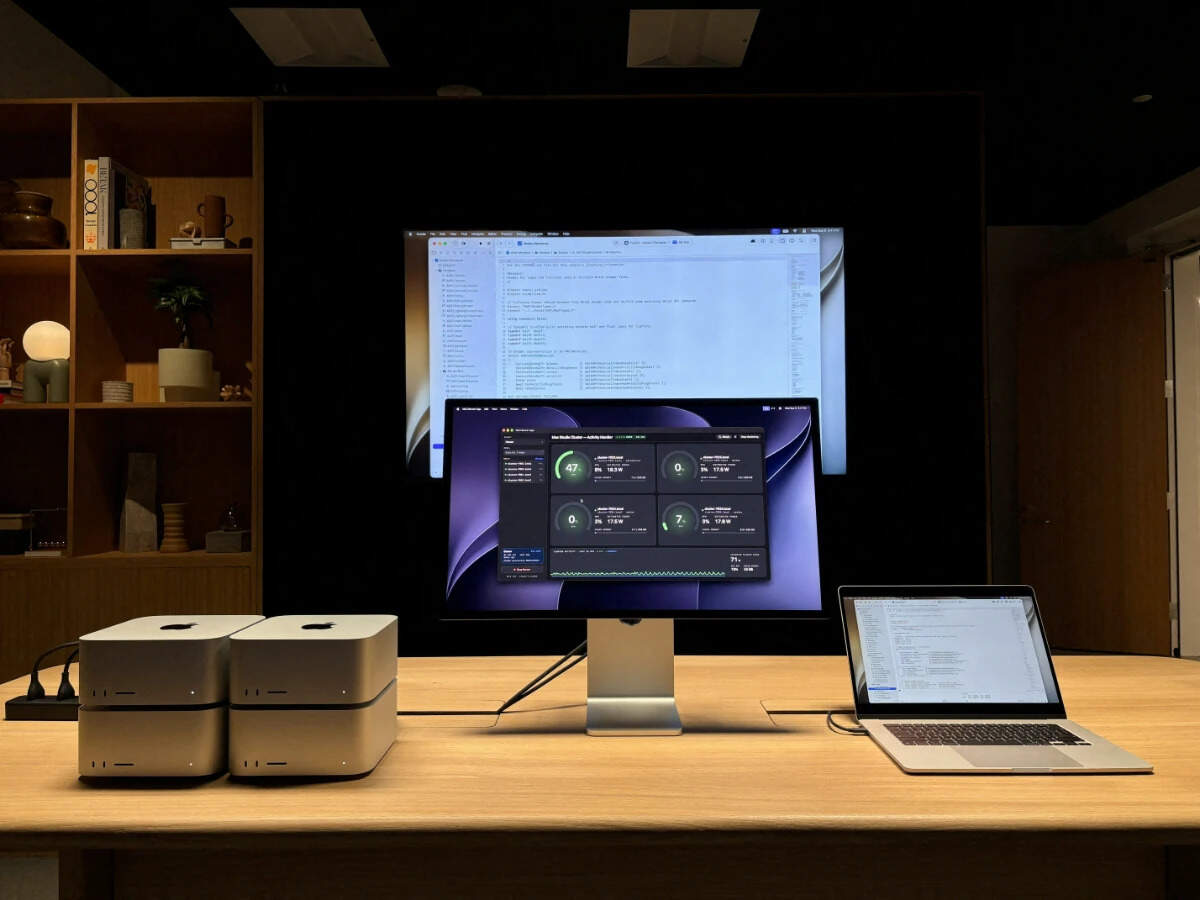
The gold rush toward artificial intelligence has minted historic revenues for Nvidia and cemented Microsoft as the enterprise AI default. However, corporate Chief Information Officers (CIOs) and startup founders are confronting the brutal reality of operational margins. Renting an eight-GPU cluster of Nvidia H100s can cost upwards of $30,000 per month on premier cloud providers. For development, prototyping, and internal deployment, these recurring infrastructure charges have created a punishing "cloud tax."
Apple’s high-end hardware proposition changes the calculus from operational expenditure (OpEx) to a one-time capital investment (CapEx). By equipping professional-grade Macs with massive pools of fast, unified memory—reaching up to 128GB or 192GB—engineers can load and run quantized versions of flagship open-weight models like Meta’s Llama 3 or Mistral directly on their machines without sending a single token over the internet.
“The consensus narrative that enterprise AI must live exclusively in hyperscale data centers is colliding with balance-sheet reality,” noted a senior Silicon Valley venture capitalist specializing in infrastructure. “If an engineer can run inference and local fine-tuning on a $4,000 workstation with zero incremental latency and zero recurring cloud invoices, the unit economics decisively favor local silicon.”
The Technical Moat: Unified Memory vs. PCIe Bottlenecks
Nvidia’s dominance rests on its CUDA software moat and the raw tensor throughput of its data-center accelerators. Yet Apple possesses an architectural advantage that traditional x86 PC vendors and workstation manufacturers have struggled to replicate: Unified Memory Architecture (UMA).
In standard PC and server architectures, the central processor (CPU) and graphics processor (GPU) maintain separate pools of memory, linked across a comparatively narrow PCIe bus. Transferring multi-gigabyte neural network weights between system RAM and video memory creates latency and technical bottlenecks. Apple’s silicon pools its high-bandwidth memory into a single, cohesive architecture. When a Mac equipped with high-tier Apple silicon boots an LLM, the GPU gains instant, zero-copy access to the entire pool of memory.
Enterprise AI Economics: Cloud Infrastructure vs. Local Apple Silicon
| Deployment Metric | Cloud Hyperscalers (Microsoft Azure / Nvidia H100) | Local Edge Hardware (High-End Apple Silicon) |
|---|---|---|
| Cost Structure | Recurring OpEx ($3.00–$5.00+ per GPU hour / API tokens) | Fixed CapEx ($3,999–$6,999 one-time purchase) |
| Data Privacy & Governance | Requires zero-retention contracts and complex cloud compliance | Air-gapped on-device security; zero outbound data transfer |
| Memory Bottlenecks | GPU VRAM limits (80GB per H100); requires multi-node clustering | Up to 128GB–192GB Unified Memory accessible directly by GPU |
| Primary Use Case | Massive frontier pre-training and high-scale public inference | Rapid local prototyping, fine-tuning, and private inference |
Big Tech's Shifting Battleground: Centralized vs. Decentralized Intelligence
This hardware push represents a fundamental divergence in enterprise philosophy between Cupertino and Redmond. Microsoft CEO Satya Nadella has staked his company’s future on massive centralized data centers, funneling tens of billions of dollars into capital expenditures to expand Azure’s cloud footprint. In this model, intelligence is a metered utility piped through corporate networks via subscription APIs.
Apple’s counter-model is radically decentralized. Chief Executive Tim Cook and his hardware engineering leadership have methodically turned client devices into localized inference engines. While Apple cannot match Nvidia in training trillion-parameter frontier foundation models from scratch, training represents only a fraction of the enterprise lifecycle. The vast majority of future enterprise spend will center on inference—the daily, repeated querying of models.
Furthermore, running models on local Apple devices solves the regulatory and legal headaches that plague enterprise AI adoption. In sectors such as financial services, healthcare, and defense, shipping proprietary source code or private patient data to third-party cloud servers presents substantial compliance risks. Local execution eliminates data leakage vectors entirely.
The Wall Street Outlook: Can Apple Carve Out Enterprise Share?
Market observers caution that Apple’s gambit faces entrenched corporate resistance. Microsoft’s deep integration into enterprise IT via Active Directory, Office 365, and Azure creates enormous inertia. Furthermore, Nvidia’s proprietary CUDA software remains the uncontested industry standard for deep learning, although open-source frameworks such as Apple’s MLX and Hugging Face’s optimized runtimes are rapidly closing the developer tooling gap.
Yet as macroeconomic pressure forces technology budgets under stricter CFO scrutiny, the mandate to slash redundant cloud overhead could catalyze a broad migration toward capable edge devices. Apple does not need to displace Nvidia in the cloud data center to win; it only needs to convince the world’s millions of developers and enterprise knowledge workers that the smartest place to run an AI model is the machine sitting directly on their desks.
Frequently Asked Questions
Can high-end Macs completely replace Nvidia cloud clusters for AI?
No. Training multi-billion-parameter foundation models from scratch requires thousands of interconnected data-center GPUs running for months. However, for local model inference, edge deployment, testing, and parameter-efficient fine-tuning (PEFT/LoRA), high-end Macs offer an economically compelling, zero-latency alternative that eliminates monthly cloud bills.
Why does Apple's Unified Memory Architecture matter so much for LLMs?
Generative AI models require massive amounts of memory bandwidth and capacity. In traditional computing setups, GPUs are constrained by dedicated video memory (often capped at 16GB or 24GB on consumer cards). Apple's unified architecture allows the GPU to utilize up to 128GB or 192GB of system RAM seamlessly, enabling complex models to run locally without expensive multi-GPU server rigs.