In the high-stakes arena of global equity markets, few phenomena capture the shifting psychology of institutional capital quite like the divergence between a defensive compounding machine and a cyclical growth pioneer. Apple Inc. hovers near historic all-time highs, buoyed by relentless share repurchases, a formidable fortress balance sheet, and an unparalleled ecosystem lock-in. Conversely, streaming pioneer Netflix Inc. sits deeply depressed from its peak valuations, nursing wounds inflicted by post-pandemic subscriber saturation, aggressive pricing pushback, and a turbulent transition into ad-supported tiers and gaming infrastructure.
For portfolio managers, chief investment officers, and high-net-worth allocators navigating this landscape, the central dilemma transcends mere stock picking; it represents a fundamental referendum on risk mitigation, capital allocation efficiency, and terminal value modeling in a high-interest-rate macro regime. As macroeconomic headwinds test corporate resilience, the mandate to separate fundamental enterprise value from speculative noise has never been more urgent. This exhaustive investigative report unpacks the structural catalysts, financial mechanics, and strategic imperatives driving these two corporate monoliths—ultimately answering the definitive question of where capital belongs.
Executive Takeaways
Test Our Free AI & Tech Utilities Suite
Calculate LLM API token costs, analyze article dwell-time, or simulate tech DCA returns.
- Capital Allocation Disparity: Apple’s disciplined share buyback program and predictable cash flow generation contrast sharply with Netflix’s capital-intensive content expenditure model and volatile cash conversion cycles.
- Valuation Multiples & Risk: While Apple commands a premium forward price-to-earnings (P/E) multiple justified by its service-segment gross margins, Netflix trades at a depressed valuation reflecting structural growth deceleration and intensifying streaming wars.
- Ecosystem Defensibility: Apple’s hardware-to-services flywheel creates an economic moat resistant to macroeconomic downturns, whereas Netflix faces high subscriber churn sensitivity and escalating content acquisition costs.
- The Definitive Verdict: In an era prioritizing balance sheet strength, recurring enterprise ROI, and market liquidity, only one of these titans warrants an aggressive accumulation strategy.
The Anatomy of Divergence: How Apple and Netflix Reached These Extremes
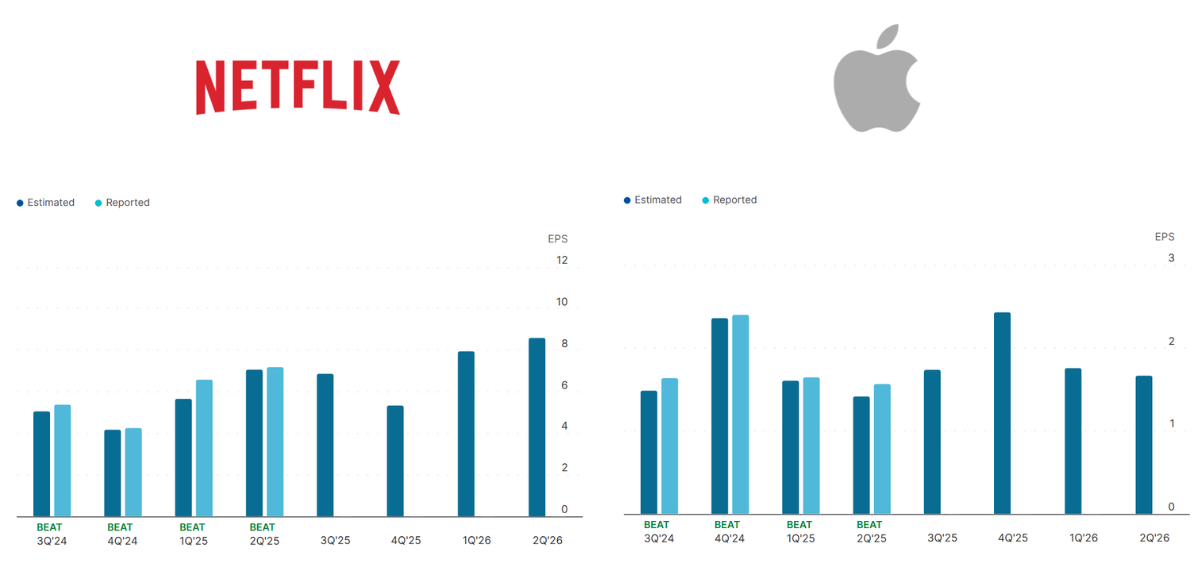
To understand the current valuation chasm between Apple and Netflix, one must examine the macroeconomic and structural catalysts that have shaped their trajectories over the past twenty-four months. The post-pandemic normalization era dealt a severe blow to hyper-growth tech equities, punishing companies reliant on aggressive user acquisition while rewarding balance sheet fortress assets capable of generating predictable free cash flow regardless of Federal Reserve monetary tightening.
Apple’s ascent toward record valuations has not been driven by explosive unit sales growth in iPhones, but rather by the quiet, compounding power of its Services division—spanning App Store fees, iCloud storage, Apple Music, and Apple Pay—coupled with aggressive capital return policies. By deploying billions into open-market share repurchases, Apple continuously reduces its share count, artificially boosting earnings per share (EPS) and providing a natural price floor that institutional investors covet during periods of market volatility.
On the other side of the ledger, Netflix’s precipitous fall from its pandemic-era highs laid bare the structural vulnerabilities of the pure-play subscription video-on-demand (SVOD) business model. As broadband penetration matured in developed markets and competitors like Disney+, Warner Bros. Discovery, and Amazon Prime Video aggressively bid up premium content, Netflix’s subscriber growth hit a hard ceiling. The ensuing panic forced management to overhaul the platform's core monetization strategy, abandoning a decade-long aversion to advertising in favor of ad-supported subscription tiers and cracking down on password sharing.
Financial Mechanics and Fundamental Metrics
A rigorous comparative analysis requires looking beyond headline figures to examine the underlying financial architecture supporting each enterprise. The table below outlines key operational, valuation, and balance sheet metrics contrasting Apple and Netflix in the current market cycle.
| Financial Metric | Apple Inc. (AAPL) | Netflix Inc. (NFLX) |
|---|---|---|
| Market Capitalization | Ultra-Large Cap ($3 Trillion+) | Large Cap ($250B - $300B Range) |
| Forward P/E Multiple | Elevated (Reflecting Stability) | Compressed (Reflecting Transition Risk) |
| Free Cash Flow (FCF) Yield | Strong & Predictable ($100B+ Annually) | Improving but Volatile (CapEx Dependent) |
| Primary Revenue Driver | Hardware Ecosystem + High-Margin Services | Subscription Video-on-Demand (SVOD) |
| Balance Sheet Health | Net Cash Positive / AAA-Equivalent Profile | Significant Long-Term Content Obligations |
Ecosystem Defensibility and Margin Protection
When evaluating infrastructure scalability and long-term enterprise viability, gross margin sustainability serves as the ultimate litmus test. Apple’s hardware-software integration creates an economic moat that is exceptionally difficult for competitors to breach. Users trapped within the iOS ecosystem exhibit remarkably low switching rates, ensuring predictable device upgrade cycles and continuous monetization through high-margin App Store commissions and cloud subscriptions. This insulates Apple from inflationary pressures, as the company possesses robust pricing power across its product lines.
Netflix, conversely, operates in an environment of perpetual capital expenditure. To maintain subscriber engagement and combat churn, the company must continually invest billions of dollars into original content production, licensing, and cloud compute infrastructure. While cracking down on credential sharing provided a temporary bump to subscriber additions, this is a one-time structural adjustment rather than a repeatable organic growth engine. Furthermore, the pivot to an ad-supported tier introduces new operational complexities, forcing Netflix to compete directly with legacy media conglomerates and tech giants like Alphabet and Amazon for digital advertising budgets.
Industry and Market Implications
The stark valuation divergence between Apple and Netflix carries profound implications for institutional portfolio construction and broader market liquidity.
For institutional asset managers, Apple acts as a safe-haven asset class disguised as a technology stock. Its ability to return hundreds of billions of dollars to shareholders via dividends and buybacks establishes a structural demand floor that protects portfolios during broader market corrections. In contrast, Netflix functions as a high-beta growth instrument. While sharp rallies can yield outsized short-term gains for tactical traders, the long-term risk-adjusted return profile is heavily weighed down by saturation risks in Western markets and escalating regulatory scrutiny regarding content curation and labor practices.
Broader economic impacts are also visible in how both companies approach enterprise partnerships and supply chain logistics. Apple’s dominance forces global semiconductor foundries and component manufacturers to bend to its rigorous efficiency standards, securing preferential pricing and supply stability. Netflix’s influence, while dominant in entertainment circles, relies heavily on third-party cloud infrastructure providers and content delivery networks (CDNs), exposing its cost structure to external pricing fluctuations.
Frequently Asked Questions (People Also Ask)
Why is Apple’s valuation holding near record highs despite macroeconomic uncertainty?
Apple’s resilience stems from its immense free cash flow generation, a rock-solid balance sheet, and a sticky customer ecosystem. Investors view Apple as a defensive growth play because its high-margin Services division provides steady recurring revenue that offsets cyclical fluctuations in hardware sales. Additionally, aggressive share repurchases continuously enhance earnings per share.
What are the primary growth catalysts for Netflix moving forward?
Netflix’s primary growth vectors rely on the successful scaling of its ad-supported subscription tiers, deeper monetization of password-sharing crackdowns, and potential expansion into live-event broadcasting and cloud gaming. However, these initiatives face intense competition from legacy media rivals and tech platforms with vastly superior advertising infrastructure.
Is Netflix a value trap or a turnaround opportunity at its current depressed price?
Whether Netflix represents a value trap or a buying opportunity depends on an investor’s risk tolerance. While its depressed share price offers an attractive entry point for tactical growth investors, long-term allocators often express caution due to the permanently escalating costs of content production and slowing subscriber growth in saturated core markets.
Which company offers a better risk-adjusted return profile for long-term investors?
From a risk-mitigation and capital preservation standpoint, Apple offers a vastly superior risk-adjusted return profile. Its proven ability to compound capital, maintain pricing power, and return cash directly to shareholders makes it the preferred vehicle for long-term wealth accumulation compared to the capital-intensive and highly competitive streaming market.
Future Outlook and Strategic Verdict
As the global economy navigates a complex matrix of interest rate adjustments, inflationary pressures, and shifting consumer behavior, capital allocation demands absolute precision. The divergence between Apple and Netflix illustrates a broader market truth: businesses fortified by insurmountable economic moats, pristine balance sheets, and recurring service revenues will consistently outperform capital-intensive enterprises vulnerable to cyclical churn.
When weighing the evidence—examining cash conversion cycles, valuation multiples, infrastructure scalability, and macroeconomic defensibility—the decision is mathematically and strategically clear. While Netflix may offer volatile, headline-driven trading rallies for aggressive speculators, it carries too many structural headwinds for prudent institutional portfolios.
The Verdict: Between these two tech titans, there is only one worth buying for sustained long-term wealth creation. Buy Apple. Lock in the fortress.