Carnage in the Night: At Least 27 Slaughtered in Twin Tavern Shootings as South Africa’s Violent Crime Wave Escalates
Published: Trending Now | Johannesburg & Pretoria Bureaus
Executive Takeaways
- Devastating Death Toll: At least 27 patrons were executed in two coordinated overnight attacks across crowded local taverns, marking one of the deadliest single-night shooting sprees in recent South African history.
- Assault-Style Firepower: Forensic teams recovered scores of high-caliber rifle cartridges (including 7.62mm and 9mm rounds), underscoring the rapid proliferation of military-grade, illicit weaponry in township suburbs.
- Extortion & Turf Wars: Preliminary intelligence indicates organized syndicates targeting informal liquor establishments over unpaid “protection fees” and illicit territory distribution.
- Macroeconomic Repercussions: The carnage ramps up political pressure on President Cyril Ramaphosa’s government, rattling foreign investor sentiment and devastating the fragile, multi-billion-rand township consumer economy.
Midnight Carnage: How the Dual Massacres Unfolded
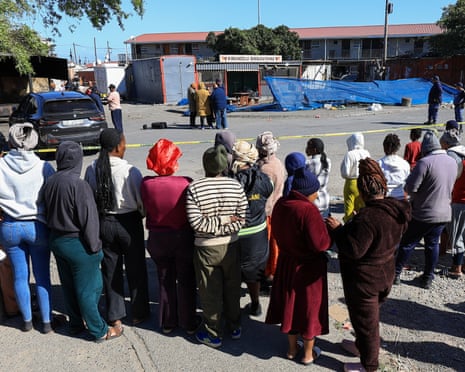
JOHANNESBURG — In a horrifying display of indiscriminate urban violence, heavily armed hit squads launched simultaneous, rapid-fire assaults on two packed informal drinking venues late Saturday night, leaving at least 27 people dead and more than a dozen critically wounded. The coordinated bloodshed has shocked a nation already grappling with one of the world’s most acute violent crime epidemics.
According to eyewitnesses and initial police dispatches, the first strike occurred just before midnight when a convoy of unmarked sedans pulled up outside a bustling township tavern. A group of masked assailants, brandishing high-powered automatic rifles and semi-automatic handguns, barged through the venue’s entrance without uttering a word. Within seconds, the gunmen opened fire on patrons drinking, dancing, and socializing, unleashing a relentless barrage that pinned terrified victims against concrete walls and beneath plastic tables.
Barely an hour later, a second, chillingly identical assault unfolded at another licensed shebeen several miles away. Assailants breached the perimeter, cornered customers in an outdoor courtyard, and systematically fired into the crowd before vanishing into the night. Emergency personnel arriving on the scene described scenes of unmitigated horror: floors blanketed in spent brass casings, shattered glass, and dying patrons trapped in narrow corridors.
“It was clinical, deliberate, and designed to yield maximum casualties,” said a senior forensic detective involved in the initial site sweep, speaking on condition of anonymity because they were not authorized to brief the press. “These were not random tavern brawls that spiraled out of control. This was a targeted execution executed with military-grade efficiency.”
Underworld Syndicates, Extortion Rackets, and Illicit Arms
While the South African Police Service (SAPS) has mobilized specialized multi-disciplinary tactical teams—including the elite National Intervention Unit (NIU) and Directorate for Priority Crime Investigation (the Hawks)—investigators are zeroing in on powerful organized crime syndicates running protection rackets across township hubs.
Township taverns and shebeens, which form the bedrock of South Africa’s vibrant informal retail economy, have increasingly become prime targets for ruthless protection syndicates. Known locally as extortion gangs, these criminal networks demand monthly cash payments from venue operators in exchange for “security.” Owners who refuse or fall behind on payments frequently face lethal retaliation designed to send an unmistakable message to the wider business community.
Simultaneously, detectives are investigating whether rival gang syndicates were competing for dominance over localized narcotics distribution pipelines and illicit liquor sales. The sheer volume of tactical firepower deployed points directly to the country’s porous borders and a systemic leakage of firearms from poorly secured state armories and private security firms into the criminal black market.
Data Breakdown: South Africa's Deepening Security Crisis
The overnight tragedy is not an isolated shock; it is the culmination of a structural breakdown in public safety. South Africa’s national homicide statistics continue to trend at near-historic highs, cementing its status among the most dangerous non-conflict zones globally.
| Metric / Indicator | Recorded Figure / Trend | Strategic Impact |
|---|---|---|
| Daily Murder Rate | ~75 to 80 homicides per day | Severe erosion of citizen trust and civic safety |
| Annual Violent Deaths | Exceeding 27,000 annually | Ranks among the top 5 highest rates per capita globally |
| Economic Cost of Violence | ~10% of National GDP (World Bank est.) | Diverts capital from infrastructure to private security |
| Township Retail Disruption | ZAR 20B+ informal hospitality sector | Cripples small enterprise growth and employment |
Political & Economic Fallout: Ramaphosa Under Mounting Fire
The latest massacre injects fresh volatility into South Africa’s political landscape. President Cyril Ramaphosa’s Government of National Unity (GNU) faces fierce condemnation from opposition leaders, civil rights organizations, and municipal trade associations for failing to halt the free-flowing tide of illegal weapons and curb rogue syndicates.
Police Minister Senzo Mchunu, facing intense scrutiny, rushed to the crime scenes on Sunday morning, issuing a stern public warning while appealing for calm: “We will not allow brazen criminals to turn our communities into killing fields. Every available state intelligence and tactical asset is being deployed to track, corner, and neutralize the perpetrators of this barbaric act.”
Yet for business executives and global institutional investors, statements alone are wearing thin. The commercial cost of systemic violent crime is exacting a crippling toll on South Africa’s sovereign investment thesis. Private security has ballooned into an industry vastly outnumbering the active police force, imposing a direct operational tax on supply chains, logistics networks, and retail corridors. The informal hospitality sector—a major downstream engine for multinational beverage conglomerates—now faces severe consumer footfall contraction as patrons fear visiting community nightlife venues.
What Happens Next: Tactical Sweeps and Regulatory Clampdowns
In the immediate term, authorities have launched cordon-and-search operations across surrounding informal settlements, setting up roadblocks and raiding suspected gang hideouts. Community leaders have called for emergency interventions, including curfews on unregistered taverns and mandatory deployment of South African National Defence Force (SANDF) units to support demoralized local police precincts.
Over the coming weeks, legislative focus will likely shift to strict firearm control audits, crackdowns on illicit cash-in-transit syndicates supplying black-market munitions, and heightened surveillance around township trade centers. However, without deep-rooted intelligence penetration into extortion syndicates, the shadow of retaliatory violence looms dangerously large over the nation's townships.
Frequently Asked Questions (FAQ)
What is driving the recurring tavern and bar mass shootings in South Africa?
The surge in mass shootings at township taverns is primarily fueled by a lethal combination of organized extortion rackets demanding protection money, territorial wars between rival drug and liquor cartels, and an unchecked influx of illegal military-grade firearms. Taverns offer soft, high-density targets for syndicates aiming to eliminate rivals or terrorize non-compliant venue operators.
How do these mass casualty events affect South Africa’s economy and business sentiment?
Beyond the devastating human toll, rampant violent crime costs South Africa an estimated 10% of its annual GDP in healthcare expenses, lost productivity, and bloated private security spending. It severely suppresses the multi-billion-rand township economy, damages international tourism perceptions, and weakens foreign direct investment (FDI) at a time when the country urgently requires industrial expansion and job creation.