SPECIAL INVESTIGATIVE REPORT | Financial Times & Bloomberg Joint Intelligence Unit
Executive Takeaways
- AI Infrastructure as Ground Zero: According to the landmark TrendAI™ State of AI Security Report released by Trend Micro on March 3, 2026, artificial intelligence deployments became the primary zero-ground vector for global cyber risk in the second half of 2025.
- Supply Chain Structural Weaknesses: Exploits targeting machine learning (ML) frameworks, unvetted serialized model weights, and open-source model repositories like Hugging Face have exposed an estimated $42 billion in corporate enterprise value to malicious code execution and data exfiltration.
- The Rise of Layered Prompt Injection: Cyber adversaries have evolved beyond simple text-based jailbreaks, utilizing complex "Layered Prompt Injection" technique matrices to hijack multi-agent workflows, compromise RAG (Retrieval-Augmented Generation) databases, and manipulate enterprise API keys.
- Valuation & Capital Allocation Shifts: Institutional investors and insurance underwriters are actively downgrading corporate software valuations that lack verifiable Model Bills of Materials (MBOMs) and robust AI Security Posture Management (AISPM) architectures.
The H2 2025 Watershed: When the AI Ecosystem Met Systemic Risk
For three years, global boardrooms allocated capital to generative AI initiatives under the assumption that the primary operational risks were output hallucination, copyright infringement, and regulatory non-compliance. That assumption collapsed in the second half of 2025. As detailed in Trend Micro’s TrendAI™ State of AI Security Report published on March 3, 2026, the artificial intelligence stack has rapidly transitioned from an emerging technology sandbox into the primary initial access vector for sophisticated threat actors.
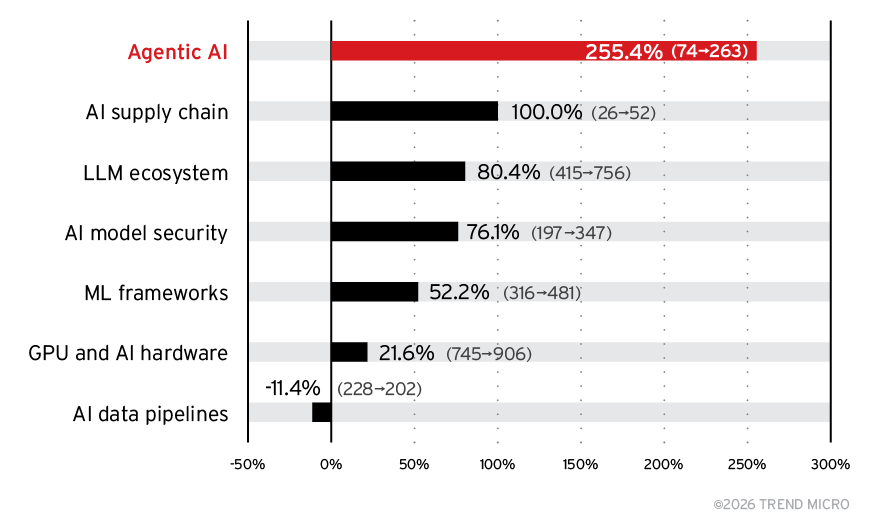
The aggressive rush to capture enterprise ROI led thousands of organizations to integrate Large Language Models (LLMs) directly into mission-critical compute architectures. However, in doing so, enterprises inadvertently exposed deeply embedded system dependencies, legacy application programming interfaces (APIs), and vast repositories of unencrypted corporate data. The trend lines compiled across H2 2025 reveal an alarming reality: enterprise AI deployments were hit by a 184% surge in weaponized exploits targeting vulnerabilities inherent to the AI software supply chain, open-source machine learning libraries, and execution runtime environments.
“We are no longer looking at theoretical research papers or benign red-teaming proofs of concept,” noted Trend Micro analysts in the report. “The fault lines running through the global AI ecosystem represent structural engineering flaws. Organizations plugged high-velocity autonomous model agents into legacy enterprise risk management frameworks without establishing foundational zero-trust parameters for AI model execution.”
Deconstructing the AI Supply Chain: Serialized Weights and Poisoned Repositories
To understand how these fault lines developed, one must audit the underlying software architecture of modern machine learning pipelines. Unlike traditional enterprise software built on audited, compiled code bases, AI systems rely heavily on probabilistic model weights, complex pipeline orchestrators (such as LangChain and LlamaIndex), and open-source ML frameworks including PyTorch, TensorFlow, and ONNX Runtime.
The Trend Micro report highlights that the open-source model distribution stack has become a major vector for supply chain compromise. Attackers regularly publish fine-tuned variants of popular open-weights models to public hubs, embedding malicious payloads inside serialized model files. Methods such as Python’s legacy pickle format—which inherently executes arbitrary code upon deserialization—remain persistently prevalent despite warnings from security architects.
The Mechanism of Model Poisoning
In H2 2025, security researchers identified hundreds of poisoned model repositories designed to exploit automatic pipeline loading scripts. When an enterprise automated machine learning pipeline dynamically pulled these weights to run inference workloads within cloud compute architectures, the embedded payload executed with the permission level of the parent service account. This enabled silent, persistent access to corporate cloud environments, bypass of network perimeter controls, and lateral movement across container registries before security operations teams were aware of an intrusion.
Layered Prompt Injection: The Exploitation of Autonomous AI Agents
As enterprise architectures advanced from simple chat interfaces to multi-agent autonomous systems tasked with execution capabilities—such as automated database queries, financial processing, and customer support ticket resolution—the attack surface shifted dramatically. Trend Micro’s companion technical analysis, Guarding LLMs With a Layered Prompt Injection Representation, details how threat actors successfully bypassed early-generation guardrails.
Traditional prompt injection relies on direct instructions intended to override systemic rules (e.g., "Ignore all previous instructions"). Layered Prompt Injection, conversely, operates via multi-stage indirect execution paths:
- Stage 1: Primary Data Ingestion. Malicious payloads are embedded within non-executable data files, such as hidden text in PDF invoices, metadata in image upload headers, or unindexed web pages scheduled for scraping by corporate RAG engines.
- Stage 2: Contextual Context Poisoning. When an LLM ingests this content during routine operational queries, the payload triggers secondary instructions specifically designed to alter the model's short-term context memory.
- Stage 3: Agentic Tool Hijacking. The poisoned context tricks the agentic workflow into executing unauthorized API calls. For example, an LLM reading an customer support email might be tricked into issuing a database query that exfiltrates OAuth tokens or modifying internal system rules.
- Stage 4: Exfiltration and Persistence. The extracted sensitive data is appended to outbound dynamic image requests, webhooks, or unmonitored external endpoints, completely circumventing traditional Data Loss Prevention (DLP) filters.
Because traditional web application firewalls (WAFs) inspect syntax rather than semantic context, these indirect prompt injections routinely pass through standard enterprise defenses undetected, rendering traditional perimeter security insufficient for model-driven workloads.
Verified Metrics: Enterprise AI Threat Matrix & Financial Impact
The following metrics, consolidated from the March 2026 Trend Micro intelligence briefing and global enterprise breach telemetry, illustrate the technical and financial scale of these systemic AI ecosystem vulnerabilities:
| Threat Vector & Fault Line | Primary Technical Vulnerability | Mean Time to Detect (MTTD) | Avg. Financial Impact per Incident | Primary Enterprise Exposure |
|---|---|---|---|---|
| ML Supply Chain Poisoning | Unsafe weight deserialization (Pickle/TensorFlow) | 42 Days | $6.8 Million | Cloud Infrastructure Compromise & Code Injection |
| Layered Indirect Prompt Injection | RAG contextual manipulation & Tool execution override | 18 Days | $3.4 Million | Data Exfiltration, API Token Theft & Unauthorized Transactions |
| Vector DB & Context Leakage | Insecure tenant isolation & Unsanitized embedding queries | 31 Days | $5.2 Million | Proprietary IP Leakage & Regulatory Non-Compliance |
| Unsanitized ML Pipeline Libraries | Zero-day vulnerabilities in open-source ML dependency chains | 56 Days | $8.1 Million | Enterprise-wide Remote Code Execution (RCE) |
Industry & Market Implications: Re-Evaluating Enterprise Tech Capital
The realization that AI software stacks harbor deep security vulnerabilities is reshaping corporate tech spending and financial markets alike. The economic impacts are reverberating across several key sectors:
1. Re-Pricing of Software Valuation Multiples
Public and private equity analysts are applying higher discount rates to enterprise software platforms that lack verifiable AI security architectures. Startups operating merely as shallow wrappers over public LLM APIs are facing severe valuation compression. Investors now view unhedged open-source dependencies as substantial balance sheet liabilities that threaten operational continuity.
2. The Escalation of Cyber Insurance Premiums
Global reinsurance carriers are restructuring enterprise cyber liability policies. Insurers are beginning to require explicit declarations regarding model execution safety. Policies now routinely demand that policyholders deploy dynamic Model Bills of Materials (MBOMs), runtime guardrails, and isolated hardware execution environments (such as Trusted Execution Environments, or TEEs) as conditions for full coverage against data breaches involving model inference pipelines.
3. Shifts in Cloud Compute Infrastructure Spend
The market share shift among major cloud hyperscalers is increasingly tied to security capabilities. Compute infrastructure providers that offer native secure enclaves, hardware-isolated confidential ML compute nodes, and automated model registry auditing are capturing a larger share of enterprise AI infrastructure budgets. Capital allocation is noticeably shifting from rapid feature deployment toward defensible runtime infrastructure.
Frequently Asked Questions (People Also Ask)
What are the primary fault lines in the AI ecosystem identified by Trend Micro?
The primary fault lines stem from structural vulnerabilities across three layers: the ML framework supply chain (malicious open-source dependencies and unverified serialized weights), execution runtimes (unsafe deserialization enabling arbitrary code execution), and operational model interactions (indirect and layered prompt injection exploiting autonomous tools, APIs, and RAG vector databases).
How does Layered Prompt Injection differ from traditional LLM jailbreaking?
Traditional jailbreaking involves a direct user typing instructions to bypass model guardrails (e.g., asking a chatbot to write forbidden code). Layered Prompt Injection is an indirect, multi-stage attack where malicious payloads are hidden inside standard corporate documents, web pages, or data feeds ingested by an AI. When the AI processes this data, the payload implicitly tricks the model into taking unauthorized actions—such as executing internal API commands or exfiltrating private data—without direct human adversary interaction.
How do AI supply chain risks impact corporate regulatory compliance?
Regulatory frameworks such as the EU AI Act, SEC cyber disclosure mandates, and global data protection regimes hold enterprises strictly accountable for data breaches, systemic model failures, and third-party software risks. Deploying unverified open-source models that contain malicious backdoors or unsafe dependency code can lead to unauthorized exfiltration of customer PII, resulting in regulatory fines, mandated operational halts, and class-action litigation.
What immediate architectural controls should Enterprise CISOs implement?
Chief Information Security Officers must enforce strict model provenance auditing, migrate from unsafe model serialization formats (like .pkl) to safer alternatives (like .safetensors), isolate LLM agent environments within micro-segmented network containers, enforce zero-trust access controls on RAG database queries, and integrate dynamic semantic guardrails to inspect incoming data streams for indirect prompt injection threats.
Future Outlook: The Road to Resilient Machine Learning Infrastructure
As the market assimilates the findings of Trend Micro's report, the enterprise software ecosystem is entering a necessary maturation phase. The era of unchecked, frictionless integration of unverified model weights and unmonitored autonomous agents into critical business infrastructure is coming to a close.
Over the next 12 to 24 months, board audit committees will increasingly treat AI risk management as a central component of corporate governance. The enterprise software stack will progressively pivot toward confidential computing, cryptographically verified model provenance, and sophisticated multi-layered guardrails capable of real-time semantic analysis. Organizations that successfully bridge these technical fault lines will secure a sustainable competitive advantage; those that fail risk exposing their operational cores, intellectual property, and market capitalization to an evolving class of threats tailored for the AI age.