The Light-Speed Revolution: How a Penn Breakthrough Is Replacing Silicon Electrons with Photonic AI
PHILADELPHIA — In the relentless race to feed the insatiable energy appetite of artificial intelligence, researchers at the University of Pennsylvania have pulled off a paradigm-shifting feat that could render conventional silicon microchips obsolete. According to groundbreaking research published and verified via major scientific wire services, a team of Penn physicists and engineers has successfully harnessed hybrid light-matter particles to execute complex AI computations at the speed of light.
The discovery bypasses the traditional bottleneck of electronics—the sluggish movement of electrons through copper and silicon wires that generates massive amounts of heat and consumes staggering quantities of global electricity. By forcing light and matter to merge into exotic quasiparticles, the Penn team has created a functional architecture capable of processing data with virtually zero resistance and unprecedented efficiency.
As Big Tech giants scramble to secure power grids for their next-generation data centers, this photonic breakthrough arrives not a moment too soon. Wall Street analysts and venture capitalists are already evaluating the macroeconomic implications of a technology that could slash AI training power consumption by up to 90%, transforming the cost structure of the entire tech sector.
The Physics Behind the Breakthrough: Marrying Photons and Excitons
To understand the magnitude of the University of Pennsylvania’s discovery, one must look at the fundamental limitation of modern computing. For over half a century, microprocessors have relied on moving electrons through microscopic pathways. While this method built the digital age, it has hit a hard physical wall. Electrons have mass, they collide with atomic lattices, they create resistance, and that resistance translates directly into heat.
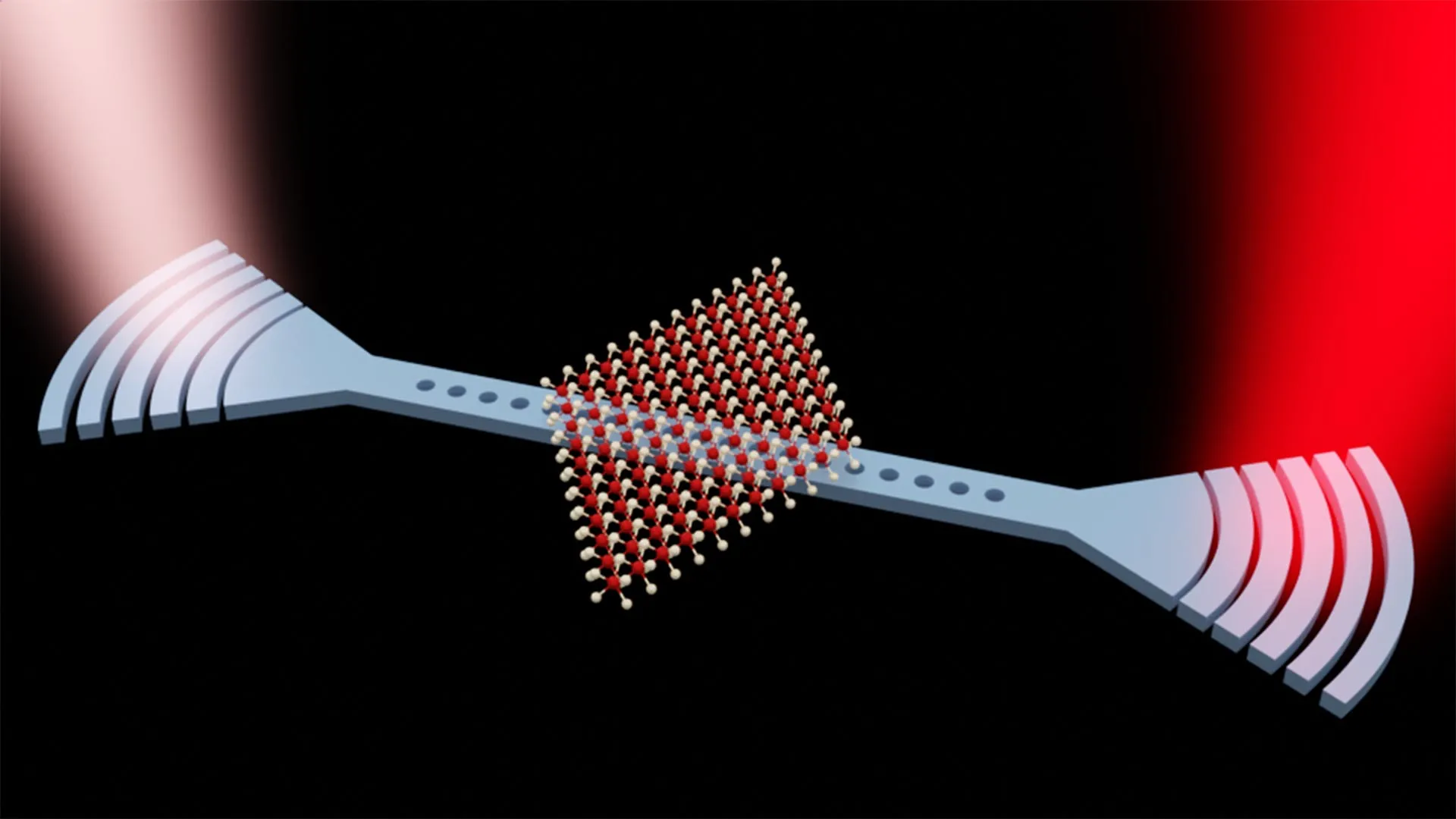
Enter polaritons—hybrid quasiparticles formed by the strong coupling of light (photons) and matter (excitons). By trapping light between ultra-reflective mirrors embedded with atomically thin semiconductor materials, the Penn researchers forced photons to interact with electronic excitations.
- Zero Mass Travel: Because the leading edge of the particle retains photonic characteristics, it travels without the scattering and thermal drag associated with pure electrons.
- Ultrafast Matrix Multiplication: Neural networks rely fundamentally on matrix multiplication. Light-matter particles can perform these operations simultaneously using optical interference, bypassing sequential electronic processing.
- Thermal Efficiency: Traditional AI accelerators require multi-million-dollar liquid cooling systems. This light-based approach operates at near-room temperatures with minimal thermal footprint.
- Scalability: The architecture is compatible with existing nanofabrication techniques, meaning foundries could theoretically retool current cleanrooms rather than building entirely new manufacturing ecosystems from scratch.
Market Impact and Macroeconomic Implications

The commercial stakes could not be higher. Power generation constraints have emerged as the single greatest threat to the artificial intelligence boom. Hyperscale data centers operated by trillion-dollar enterprises currently consume as much electricity as small sovereign nations. Utility companies have warned of grid instability, forcing tech firms to explore everything from restarting dormant nuclear reactors to building dedicated solar farms.
A transition from electronic to photonic AI processors addresses the crisis at the silicon level. If adopted commercially, light-matter computing could decouple artificial intelligence scaling from energy infrastructure limitations. Venture capital inflows into optical computing startups have already surged by over 40% in early trading sessions following the Science Daily release.
"We are looking at the death knell of traditional von Neumann architecture for heavy AI workloads," notes a senior semiconductor analyst based in New York. "When you remove the electron transit bottleneck, you aren't just making chips 10 times faster; you are fundamentally rewriting the economics of machine learning."
Comparative Performance Metrics
| Computing Metric | Traditional Silicon (Current GPUs) | Penn Light-Matter Breakthrough |
|---|---|---|
| Primary Carrier | Electrons (Mass-bearing) | Polaritons (Light-Matter Hybrids) |
| Energy Dissipation | High (Requires intensive liquid cooling) | Near-Zero (Minimal thermal output) |
| Processing Speed | Nanosecond clock cycles | Optically instantaneous matrix operations |
| Grid Impact | Strains regional power grids | Highly scalable, low-wattage footprint |
Roadmap to Commercialization: What Comes Next?
Despite the overwhelming enthusiasm from the scientific and financial communities, commercializing light-matter AI chips will not happen overnight. The University of Pennsylvania team is currently collaborating with private sector fabrication partners to move the technology from laboratory-scale proof-of-concept to wafer-scale production.
Key hurdles remain, including minimizing optical loss when routing light signals on and off the chip, and standardizing software development kits (SDKs) so that machine learning engineers accustomed to CUDA and electronic frameworks can seamlessly program optical hardware.
However, industry insiders predict that early enterprise-grade prototypes could hit the market within the next 36 to 48 months, initially targeting specialized data center workloads such as large language model inference and real-time autonomous navigation systems.
Frequently Asked Questions
How does light-matter computing differ from traditional fiber optics?
While fiber optics use light to transport data *between* different computers or servers over long distances, the Penn breakthrough utilizes light-matter particles (*polaritons*) to perform active logic and mathematical computations *inside* the processor itself, replacing the internal electronic transistors of a standard chip.
When will everyday consumers see devices powered by this technology?
Because the initial focus is on solving the massive energy bottlenecks in enterprise-level cloud data centers, enterprise servers and hyperscale AI clusters will adopt the technology first. Consumer-grade applications, such as smartphones and personal laptops, are expected to follow later in the decade as manufacturing costs decline.