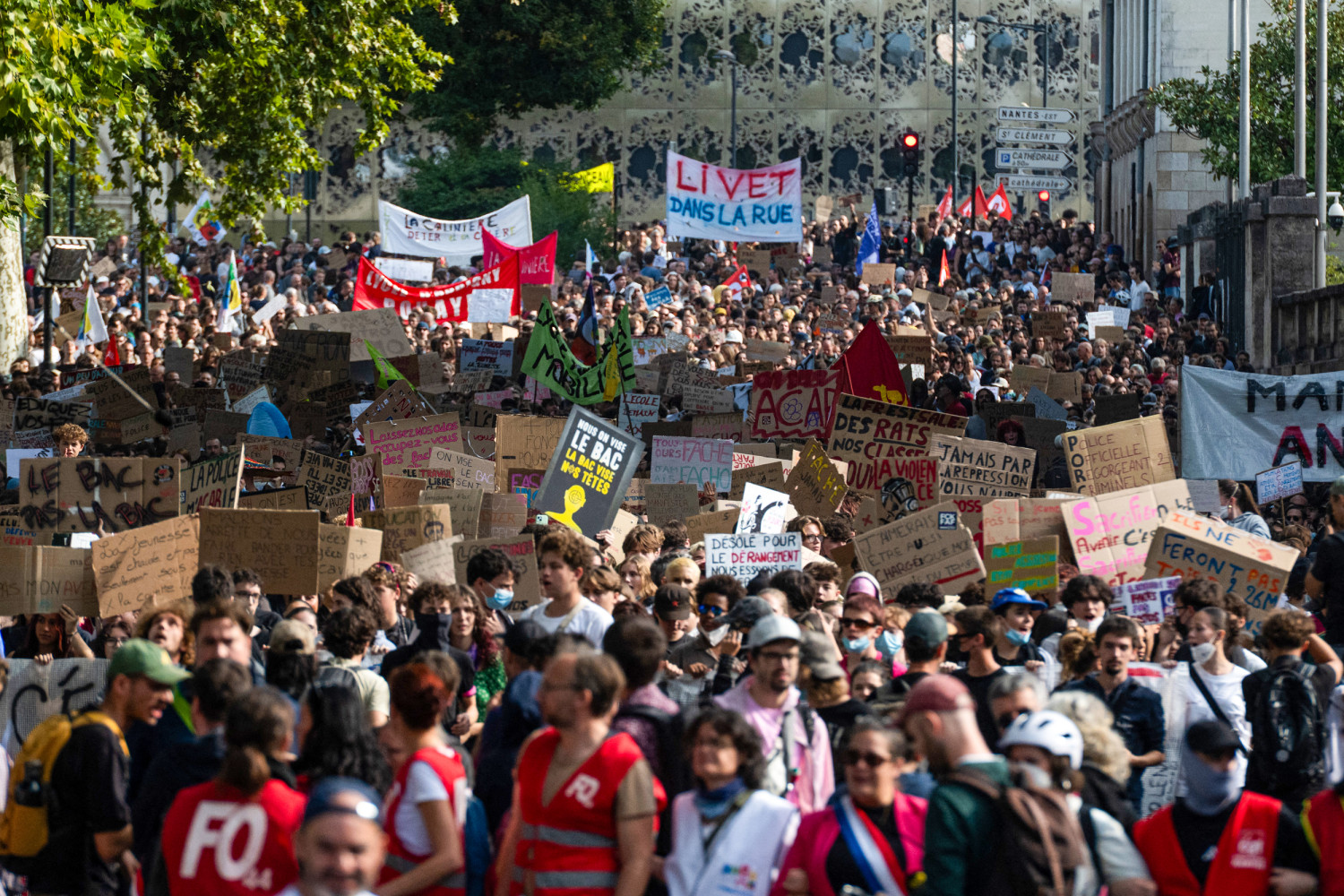
France Paralyzed as Nearly 900 Schools Shutter Amid Escalating Street Clashes and Education Strike Wave
PARIS — The French government faced a widening domestic crisis this week as violent nationwide demonstrations shuttered or severely disrupted nearly 900 schools across the country. What started as an organized walkout by major teachers’ unions over contentious pedagogical reforms and severe austerity measures quickly metastasized into running street clashes between black-clad youth blocs and riot police, leaving President Emmanuel Macron’s administration scrambling to prevent a broader social contagion.
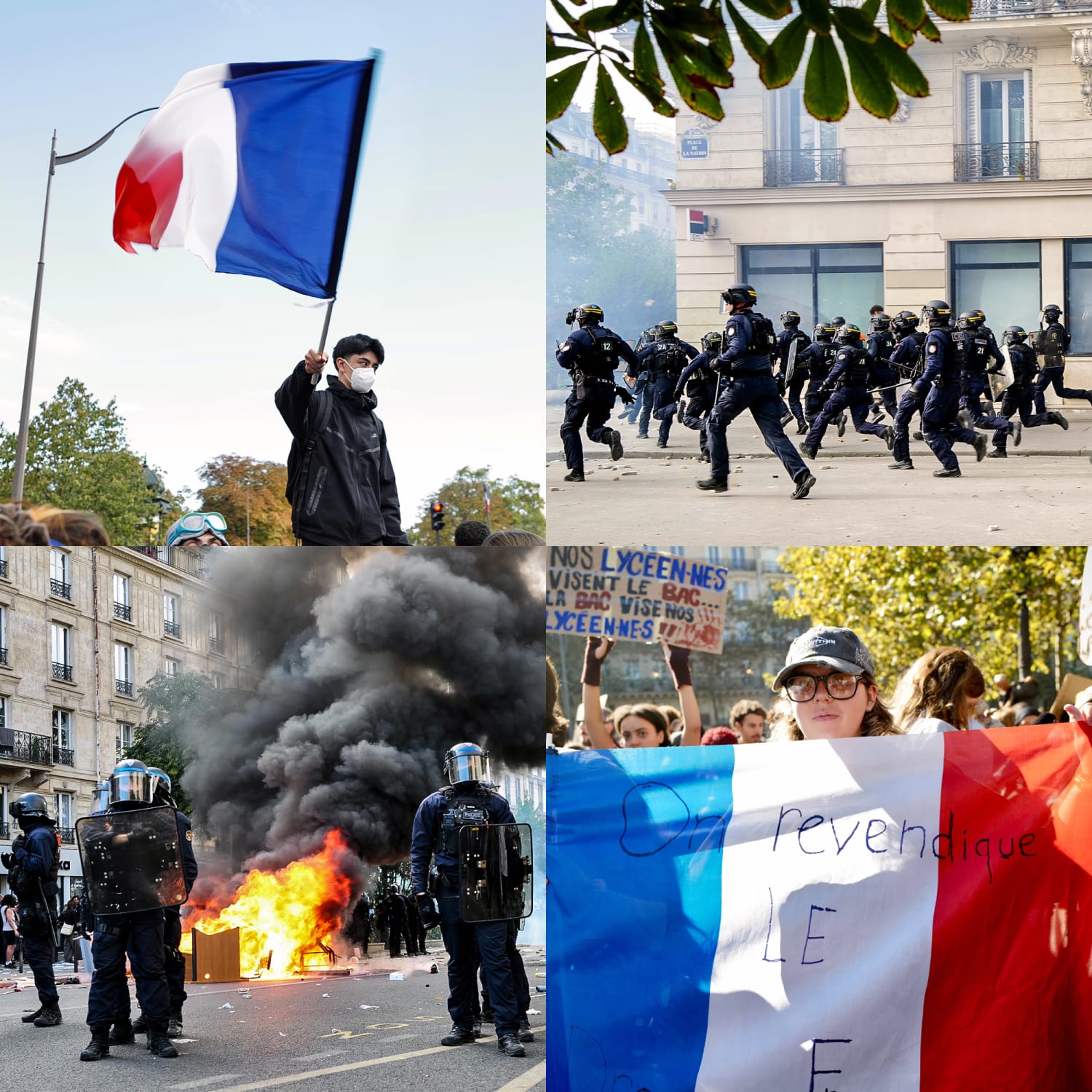
Barricades constructed from dumpsters, construction pallets, and electric scooters were set ablaze in front of high-profile secondary schools from Paris to Marseille, Toulouse, and Lyon. Tear gas filled major boulevards as CRS riot control forces moved in to clear blockades outside dozens of prestigious lycées, leading to scores of arrests and sparking widespread fury among both labor federations and parent associations.
Executive Summary: The Crisis at a Glance
- Unprecedented Scale: Approximately 900 educational establishments—spanning primary schools to secondary lycées—were forced to suspend classes, transition to remote contingency operations, or face total physical blockade.
- Core Grievances: Union coalitions are demanding the immediate withdrawal of contested national curriculum mandates, an end to tiered ability grouping, urgent recruitment drives to stem severe staff shortages, and inflation-indexed wage revisions.
- Escalating Violence: Local prefectures reported targeted property destruction, coordinated attempts to storm administrative regional rectorates, and street confrontations resulting in multiple injuries on both sides.
- Economic Fallout: The sudden closure has sidelined hundreds of thousands of working parents, exacerbating productivity losses across key metropolitan centers and threatening to spill over into cross-sector transport disruptions.
From Classroom Walkout to Urban Battleground
The scale of the disruption caught interior ministry planners flat-footed. While labor organizations, led by the FSU, UNSA Éducation, and CGT Éduc’action, had filed statutory strike notices weeks in advance, the mobilization drew substantial radical youth elements and student collectives who adopted aggressive defensive tactics outside school gates.
In Paris’s 11th and 20th arrondissements, police deployed water cannons and stun grenades to disperse crowds of masked demonstrators after several school entrances were blocked with welded furniture and burning trash. In Lyon, demonstrators surrounded regional ministry headquarters, spraying anti-government slogans and smashing ground-floor display glass before being pushed back by motorized anti-riot units.
“We are witnessing an intolerable degree of radicalization directed at public institutions,” stated France’s Minister of National Education in an emergency national address. “While the right to strike remains constitutionally protected, the deliberate physical sabotage of schools and attacks against law enforcement cross a red line that the Republic will not tolerate.”
Union officials pushed back aggressively, accusing the state of deploying disproportionate paramilitary tactics against underage students and exhausted teaching staff. Union representatives asserted that the closures reflect deep-seated institutional decay rather than isolated agitator activity, warning that the state's uncompromising stance would only accelerate public anger.
Roots of the Crisis: Austerity, Reform, and Structural Decay
At the epicenter of the dispute is the government’s controversial reform package, particularly the mandate known as the “knowledge shock” (choc des savoirs), which introduces mandatory streaming of middle-school pupils into ability-based groupings for core subjects like French and mathematics. Critics argue the initiative fosters social segregation, stigmatizes disadvantaged students, and strips headteachers of operational autonomy.
Beyond curriculum disputes lies a chronic economic dispute. French public-sector educators have seen real wages decline relative to cumulative inflation over the past decade. The profession faces historic recruitment deficits; thousands of teaching posts remain vacant at the start of each academic year, compelling school districts to rely on contractual staff with minimal training.
Simultaneously, the Macron administration’s broader budgetary maneuvers—aimed at curbing France’s sovereign debt deficit to meet European Union fiscal thresholds—have eliminated administrative roles and school health personnel, leaving remaining educators to handle overcrowded classrooms and swelling behavioral challenges.
Disruption Matrix: Geographic and Operational Impact
| Metric / Region | Recorded Level of Disruption | Primary Driver | Operational Status |
|---|---|---|---|
| Paris & Île-de-France | ~310 Schools Disrupted | Physical barricades, street clashes, transit blockades | Partial closures; high police deployment |
| Marseille & PACA | ~220 Schools Disrupted | Inter-union walkouts, spontaneous wildcat sit-ins | Widespread cancellation of primary instruction |
| Lyon & Rhône Valley | ~180 Schools Disrupted | Student mobilizations, rectorate blockades | Remote coursework enacted; exams delayed |
| Rest of France (Toulouse, Nantes, Lille) | ~190 Schools Disrupted | Rolling strikes, logistical coordination strikes | Variable; rolling single-day shutdowns |
Macroeconomic and Political Fallout
For President Macron, the unrest represents another volatile domestic front at an already perilous juncture. With the National Assembly deeply fragmented and the government operating without an absolute majority, social discord carries immediate political risk. Opposition lawmakers on both the left and far right have seized on the protests to portray the government as disconnected from public services and unable to maintain public order.
Economists track severe downstream costs. A nationwide interruption of schooling inevitably ripples through corporate operations. Childcare shortfalls force working parents to take unplanned leave, while disruptions to urban transit corridors exacerbate supply-chain delays. The French corporate confederation warned that a protracted cycle of strikes could trim tenths of a percentage point off quarterly service-sector output if industrial unions join the student action.
Outlook: A Looming War of Attrition
Neither side shows immediate signs of de-escalation. The inter-union collective has scheduled additional general assemblies to debate expanding the walkout into a rolling, open-ended strike. High school student syndicates have called on university campuses to join the mobilization, raising the specter of a broader student movement reminiscent of past French political crises.
Unless the Élysée Palace opens formal negotiations or pauses the contested pedagogical decrees, France appears poised for a prolonged period of civic friction that could test the durability of the current cabinet and disrupt national examinations scheduled for later in the academic cycle.
Frequently Asked Questions
Why did the French government close nearly 900 schools?
The closures resulted from a combination of planned strikes by major educational unions, widespread physical student blockades outside school perimeters, and safety shutdowns ordered by local authorities following violent confrontations with riot police across key metropolitan hubs.
What are the primary demands of the protesters?
Protesters are demanding the repeal of the "choc des savoirs" reforms (specifically tiered ability grouping), an emergency funding package to hire permanent teaching and support staff, competitive salary adjustments to match persistent inflation, and improved safety and resources inside overcrowded public classrooms.