Executive Takeaways
Test Our Free AI & Tech Utilities Suite
Calculate LLM API token costs, analyze article dwell-time, or simulate tech DCA returns.
- Institutional Floor Established: Spot gold executed a sharp intraday reversal after touching a 52-week low, driven by aggressive institutional limit orders and systematic commodity trading advisor (CTA) short-covering at key technical support levels.
- Yield & Dollar Deceleration: A temporary pause in the U.S. Dollar Index (DXY) rally, combined with a subtle compression in 10-year inflation-adjusted real yields, created immediate structural tailwinds for non-yielding precious metals.
- Sovereign Reserve Accumulation: Central bank buying desks—led by emerging market monetary authorities—utilized the price dislocation as an opportunistic capital allocation window to fortify non-fiat liquidity buffers.
- Portfolio Risk Mitigation: Wealth managers and multi-asset funds are actively recalibrating portfolio allocations, using bullion as an asymmetric tail-risk hedge against persistent geopolitical friction and mounting sovereign debt refinancing risks.
The Macro Pressure Cooker: How Bullion Reached Its One-Year Trough

The journey to gold’s lower band was fueled by a relentless alignment of macroeconomic headwinds. Over successive trading quarters, global monetary policy tightening pushed real risk-free rates to multi-year highs. As central banks across developed economies anchored interest rates at restrictive levels to combat stubborn service-sector inflation, the opportunity cost of holding non-yielding physical bullion escalated dramatically.
Concurrently, the U.S. dollar experienced sustained safe-haven inflows and yield-differential bidding, propelling the U.S. Dollar Index (DXY) toward restrictive territory. Because gold is globally priced in greenbacks, foreign buyers faced escalating currency-conversion costs, severely dampening physical retail demand in key Asian and European markets. Paper markets mirrored this sentiment, with managed money accounts—including macro hedge funds and trend-following quantitative models—building sizable net-short positions in COMEX gold futures.
As bullion breached successive support levels, stop-loss orders triggered automated liquidations. The market reached a critical juncture when spot prices sliced through medium-term moving averages, landing squarely on a multi-year trendline anchor. To casual observers, the structural drop signaled a fundamental breakdown in gold’s historical status as a premier inflation hedge. However, institutional trading desks recognized a classic overextension—setting the stage for a sharp capital reversal.
The Pivot Point: How Sovereign Buyers and CTAs Arrested the Slide
The technical arrest of gold's decline was swift and calculated. As spot prices hovered at one-year lows, high-frequency trading algorithms detected an extraordinary concentration of passive buy orders clustered at the long-term support threshold. These orders were not speculative retail bids; they bore the distinct footprint of sovereign treasury management desks and tier-1 institutional asset managers executing large-scale rebalancing mandates.
Central banks, particularly across Asia and Eastern Europe, have increasingly decoupled their reserve strategies from western sovereign debt assets to mitigate counterparty and sanction risks. For these monetary authorities, steep markdowns in spot gold present high-conviction capital allocation opportunities. By entering the market with scaled limit orders, these sovereign entities absorbed selling volume, establishing an uncompromising floor under the market.
As physical floor prices stabilized, paper markets responded rapidly. Quantitative CTAs, which had built heavy short exposure during the downward drift, encountered a sudden drop in downward momentum indicators. As buy-side liquidity rapidly outpaced sell-side offers, systematic short-covering was activated. The resulting squeeze forced short sellers to repurchase futures contracts, amplifying upward price velocity and creating a high-volume V-shaped recovery pattern across spot and futures exchanges globally.
Quantitative Breakdown & Market Data Matrix
The table below outlines key institutional metrics, yield movements, and positioning indicators prior to and following the dip-buying intervention:
| Market Metric / Asset Indicator | 52-Week Low / Capitulation Point | Post-Rebound Stabilization Level | Primary Macro & Micro Driver |
|---|---|---|---|
| Spot Gold (XAU/USD) | Key Technical Floor / $1,810–$1,820/oz | $+4.5% to +6.2% Rebound Band | Institutional scale orders & systematic short-covering |
| U.S. 10-Year Real Yield (TIPS) | Multi-Year Peak (~2.50%) | Compressed by ~12–18 bps | Softening economic data softening terminal rate bets |
| U.S. Dollar Index (DXY) | Cyclical High (~107.00+) | Consolidating Lower (-1.2% pullback) | Profit-taking in dollar-long trades ahead of Fed signals |
| COMEX Net Managed Money Position | Extreme Net-Short / Neutral Boundary | Rapid Net-Long Re-accumulation | Algorithmic trigger execution & gamma squeezing |
| Central Bank Net Buying (Quarterly) | Sustained Baseline Accumulation | Surge in Direct Physical Bids | De-dollarization & sovereign balance sheet diversification |
Industry & Market Implications
1. Institutional Wealth Management & Capital Allocation Strategies
For family offices and institutional allocators, the sudden stabilization of gold reinforces the asset's utility within modern portfolio construction. In an era marked by elevated enterprise capital costs and volatile fixed-income valuations, gold acts as a liquidity component without credit risk. Wealth managers are increasingly re-evaluating traditional risk mitigation playbooks, substituting a fraction of nominal government bonds with physical gold allocations to protect against long-term currency debasement and geopolitical tail events.
2. Mining Sector Valuation Multiples & Enterprise ROI
The rebound provides critical relief for senior and mid-tier precious metals miners. Over the preceding months, senior gold producers faced severe margin compression caused by sticky input cost inflation—such as diesel, labor, and equipment maintenance—coinciding with declining realized bullion prices. With spot gold recovering off its cyclical lows, enterprise valuation multiples for tier-1 mining operations are poised for expansion. Balance sheet health, infrastructure scalability, and capital allocation discipline will determine which miners generate outsized free cash flow yields in this environment.
3. Sovereign Debt Dynamics & Systemic Risk Hedges
The swift floor set by institutional dip buyers highlights broader structural concerns surrounding global fiscal deficits. As sovereign debt levels expand worldwide, markets are pricing in an inevitable risk premium. Gold's recovery signals that global capital is actively seeking non-fiat assets to serve as ultimate systemic settlement mechanisms. This operational reality is encouraging global corporate treasuries to consider modest gold allocations as part of comprehensive liquidity management strategies.
Frequently Asked Questions (People Also Ask)
Why did gold drop to a one-year low before turning around?
Gold reached a one-year low primarily due to persistent hawkish monetary policy from major central banks, elevated U.S. Treasury yields, and a surging U.S. dollar. High real yields increase the opportunity cost of holding non-yielding assets like bullion. Once spot prices hit deep structural support levels, deep-value institutional buyers and sovereign entities stepped in, identifying the asset as significantly oversold.
What role do real yields play in determining gold's price direction?
Real yields—calculated as nominal bond yields minus expected inflation—share an inverse relationship with gold. When real yields rise, fixed-income assets offering guaranteed real returns become more attractive than bullion. Conversely, when real yields decline or consolidate, the opportunity cost of holding gold drops, driving capital back into precious metals as a secure store of value.
How do central banks influence gold price floors during market sell-offs?
Central banks act as structural, long-term buyers unconstrained by short-term trading horizons. When market panics or paper futures selling drives spot gold prices down to compelling valuation levels, sovereign central banks utilize their foreign exchange reserves to acquire physical bullion. These large, price-insensitive buy orders absorb excess market supply, establishing a firm price floor and restoring trader confidence.
Is gold an effective hedge in high interest rate environments?
While high interest rates create short-term headwind momentum for gold, the asset remains an effective long-term hedge against systemic credit risk, currency depreciation, and unexpected geopolitical shocks. Institutional investors often use price pullbacks in high-rate regimes to build strategic long positions at favorable valuation multiples, anticipating future monetary easing cycles.
Future Outlook & Key Milestones to Watch
Looking ahead, gold's ability to transition from a technical bounce into a sustained structural bull market depends on several macroeconomic catalysts. First and foremost is the trajectory of central bank rate policies. Any concrete pivot toward monetary easing or rate-cut cycles will likely trigger a sustained decline in real yields, providing the necessary fuel for gold to challenge previous record high resistance levels.
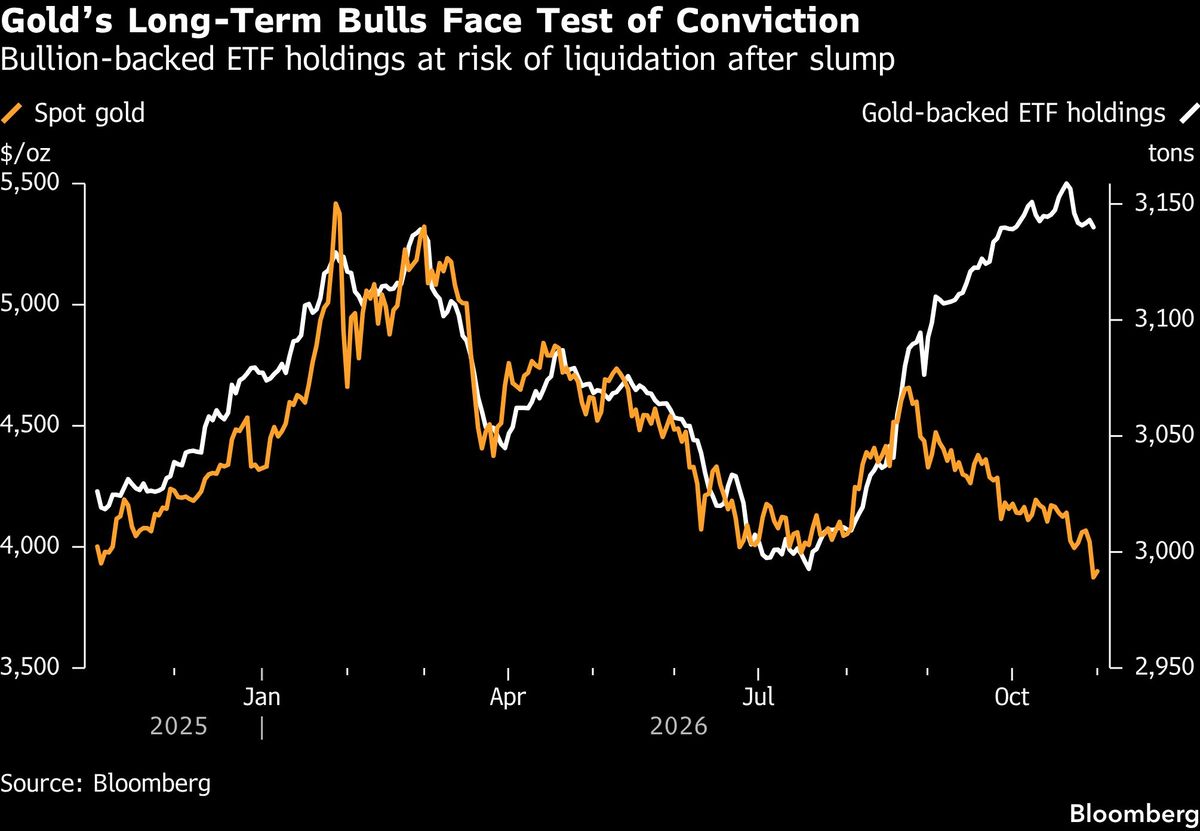
Second, traders must closely monitor institutional ETF capital flows. While physical coin and bar demand across emerging markets remains resilient, Western physically backed ETF holdings experienced steady redemptions during the slide. A structural reversal in ETF flows—signaling the return of mainstream institutional investors—will be vital to sustain market breadth.
Finally, global sovereign debt refinancing metrics and geopolitical developments will continue to dictate safe-haven demand. Should macro volatility persist, gold's status as a premier risk mitigation asset will remain firmly entrenched, with the recent one-year low serving as a critical structural benchmark for institutional allocators worldwide.