
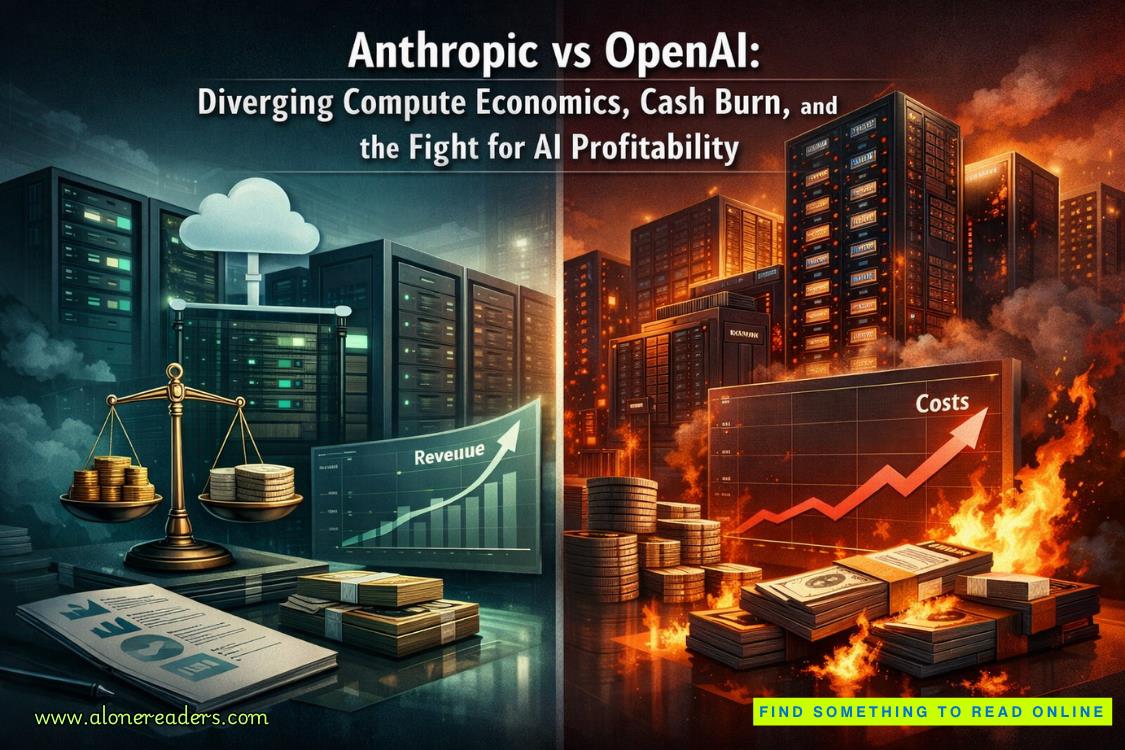
Executive Takeaways
- Capital Intensity vs. Revenue Velocity: Anthropic’s aggressive scaling of its Claude model family continues to test the limits of venture capital, strategic cloud partnerships, and enterprise monetization timelines.
- The Infrastructure Bottleneck: Securing reliable, high-density GPU clusters—predominantly through AWS and Google Cloud infrastructure—imposes steep recurring opex that outpaces traditional SaaS growth models.
- Enterprise ROI Pressures: As enterprise buyers demand proven productivity gains, AI labs face intense margin compression to justify premium API pricing structures.
- Strategic Pivots: The race to profitability requires structural innovations in algorithmic efficiency, custom silicon deployment, and diversified capital allocation.
SAN FRANCISCO & NEW YORK — In the high-stakes arena of generative artificial intelligence, the laws of physics are increasingly dictated by the laws of finance. Behind the polished product releases and safety-first ethos that define Anthropic, the San Francisco-based frontier lab is quietly waging an existential campaign against one of the most stubborn realities in modern technology: the punishing economics of compute.
Interviews with industry insiders, venture capitalists, cloud infrastructure executives, and financial analysts reveal that while Anthropic’s Claude 3.5 series has successfully captured significant enterprise market share from rivals OpenAI and Google DeepMind, the cost of training, fine-tuning, and serving these massive neural networks remains a relentless financial gravitational pull. As the company navigates its next phases of capital formation and infrastructure scalability, the fundamental question facing its executive suite is no longer merely technical—it is strictly economic.
The Catalytic Shift: From Research Lab to Capital-Hungry Enterprise
Test Our Free AI & Tech Utilities Suite
Calculate LLM API token costs, analyze article dwell-time, or simulate tech DCA returns.
Founded in 2021 by former OpenAI researchers including Dario and Daniela Amodei, Anthropic positioned itself as a conscientious counterweight in the generative AI boom, emphasizing "constitutional AI" and rigorous alignment research. However, philosophical distinction does not insulate a company from the brutal mathematics of cloud compute architecture.
Building frontier models requires tens of thousands of specialized accelerator chips—predominantly NVIDIA H100s and newer Blackwell architectures, alongside custom TPUs—operating continuously for months. The capital expenditure (CapEx) required to procure, house, and power these clusters runs into the billions of dollars per generation. To fund this trajectory, Anthropic has executed a series of massive, highly structured fundraising rounds, securing multi-billion-dollar commitments from corporate giants Amazon Web Services (AWS) and Google.
Yet, these strategic alliances come with strings attached. Much of the capital deployed into Anthropic is funneled directly back into AWS and Google Cloud credits, locking the startup into proprietary infrastructure ecosystems. While this symbiotic relationship ensures access to elite hardware, it also creates complex cost-accounting dynamics where top-line valuation expansion is tightly coupled with bottom-line operational expenditure (OpEx).
Decoding the Cost Structure: Training vs. Inference Economics

To understand why compute economics remain Anthropic’s central operational challenge, one must separate the financial dynamics of model training from model inference—the ongoing cost of serving real-time queries to millions of enterprise and retail users.
| Cost Dimension | Primary Driver | Financial Impact | Mitigation Strategy |
|---|---|---|---|
| Model Training | Massive GPU/TPU clusters over 3–6 months | Lump-sum capital outlays exceeding $100M+ per iteration | Algorithmic efficiency, synthetic data, architectural sparsity |
| Inference Serving | Continuous API calls, token generation volume | High recurring OpEx scaling directly with user adoption | Quantization, model distillation, tiered pricing models |
| Infrastructure Lock-in | Cloud provider partnerships (AWS, Google) | Reduced margin flexibility due to hardware pricing terms | Diversifying hardware vendors, exploring custom silicon |
While training costs grab headlines during product launches, inference costs represent the daily burn rate that dictates long-term business viability. Every time an enterprise client deploys Claude to analyze millions of lines of legal code or synthesize complex financial portfolios, immense computational power is consumed. If the cost to generate those tokens outpaces the subscription fee charged to the customer, unit economics turn negative.
For Anthropic, maintaining competitive parity with OpenAI’s GPT-4o and Google’s Gemini requires continuous investment in larger, more capable models. However, scaling model size yields diminishing returns relative to the exponential explosion in compute requirements. This dynamic forces the company to innovate relentlessly on algorithmic efficiency—developing smaller, highly optimized models like Claude 3.5 Haiku that deliver near-frontier performance at a fraction of the inference cost.
Industry & Market Implications: Margin Compression and Enterprise Realities
The struggle with compute economics is not unique to Anthropic; it is the defining structural tension of the generative AI gold rush. However, its ripple effects are reshaping the broader technology ecosystem in profound ways.
1. Enterprise ROI and Pricing Power
Enterprise buyers are transitioning past the experimental pilot phase and demanding rigorous proof of return on investment (ROI). As Chief Information Officers scrutinize software budgets, AI labs face severe pricing pressure. If Anthropic or its competitors attempt to pass rising compute costs onto customers through higher API fees, adoption stalls. Conversely, absorbing those costs squeezes gross margins, delaying the path to sustainable profitability.
2. The Hardware Supply Chain Bottleneck
Anthropic’s financial health is inextricably tied to the semiconductor supply chain. Any disruption in advanced lithography, packaging, or foundry allocation directly impacts the timeline and cost of training future frontier models. This reality explains why leading AI labs are aggressively exploring custom silicon partnerships to reduce their reliance on off-the-shelf accelerators.
3. Market Liquidation and Consolidation Risk
As capital markets become more selective amid fluctuating interest rates and macroeconomic uncertainty, the valuation multiples of AI startups face downward pressure. Only well-capitalized players backed by cloud hyper-scalers—such as Anthropic’s alliance with Amazon—possess the balance sheet strength to absorb multi-year operating losses in pursuit of eventual market dominance.
Frequently Asked Questions (People Also Ask)
Why are compute costs so high for frontier AI companies like Anthropic?
Training and operating frontier large language models requires massive parallel processing units (GPUs/TPUs) operating continuously for months. The combination of hardware procurement, specialized data center power requirements, and high-bandwidth networking creates extraordinary capital and operational expenditures.
How does Anthropic fund its massive compute requirements?
Anthropic relies heavily on strategic venture capital financing and massive corporate partnerships, most notably multi-billion-dollar investments and cloud infrastructure agreements with Amazon Web Services (AWS) and Google Cloud.
What is the difference between training and inference economics in AI?
Training economics refer to the one-time, highly capital-intensive cost of building a foundational model from scratch using raw data. Inference economics refer to the ongoing, recurring operational cost of serving user requests and generating real-time model outputs at scale.
How is Anthropic working to improve its profit margins?
Anthropic is focusing on algorithmic efficiency, developing smaller, highly optimized models (such as the Haiku tier) that reduce inference costs, and structuring enterprise contracts with predictable, high-value recurring revenue streams.
Future Outlook: Milestones to Watch in the Compute Battle
As the generative AI market matures, the coming 12 to 18 months will serve as a crucial crucible for Anthropic and its peers. Key leading indicators and milestones to monitor include:
- Efficiency Breakthroughs: Evidence that algorithmic advancements—such as mixture-of-experts (MoE) architectures, model quantization, and advanced distillation—are successfully decoupling performance gains from linear compute growth.
- Enterprise Monetization Metrics: Conversion rates of pilot enterprise contracts into long-term, high-value commitments that comfortably cover underlying inference costs.
- Infrastructure Diversification: The extent to which Anthropic diversifies its hardware dependency beyond standard NVIDIA architectures by integrating custom silicon solutions from cloud partners.
- Regulatory and Compliance Headwinds: Emerging legislative frameworks regarding data acquisition, copyright, and computational safety guardrails that could impact training overhead and operational compliance costs.
Ultimately, Anthropic’s long-term market position will not be determined solely by the sophistication of its constitutional AI frameworks or the benchmark scores of its Claude models. Success will belong to the organization that masters the delicate equilibrium between relentless technological innovation and sustainable financial architecture—proving that frontier intelligence can finally balance its ledger.




