Executive Takeaways
- Massive Taxpayer & Stakeholder Erosion: Intel Corporation’s historic equity drawdown has erased over $12 billion in total combined value from direct government-backed grant benchmarks, warrant options, and joint public-private infrastructure investments tied to the U.S. CHIPS and Science Act.
- Foundry Capital Intensity Crisis: Intel Foundry Services (IFS) faces escalating operational losses, driven by high capital expenditure (CapEx) commitments, yield ramp delays on advanced process nodes, and aggressive competition from Taiwan Semiconductor Manufacturing Co. (TSMC).
- Capital Allocation Restructuring: To stem liquidity burn, Intel has announced sweeping dividend suspensions, a 15%+ reduction in headcount, and a targeted CapEx contraction exceeding $10 billion, delaying expansion timelines for key semiconductor facilities in Ohio and Arizona.
- National Security & Policy Fallout: The structural selloff has triggered bipartisan oversight from Capitol Hill, forcing federal policymakers to re-evaluate industrial policy frameworks, risk-mitigation covenants, and sovereign equity exposure in domestic supply chain hardware.
The Anatomy of a Collapse: From Silicon Pioneer to Fiscal Vulnerability
Test Our Free AI & Tech Utilities Suite
Calculate LLM API token costs, analyze article dwell-time, or simulate tech DCA returns.
When the Biden-Harris administration signed the CHIPS and Science Act into law, allocating $52.7 billion in federal subsidies to revitalize domestic semiconductor manufacturing, Intel Corp. (NASDAQ: INTC) was positioned as the primary beneficiary. As the sole American enterprise attempting to operate both leading-edge chip design and high-volume commercial foundry services, Intel was designated the linchpin of Western technological sovereignty.
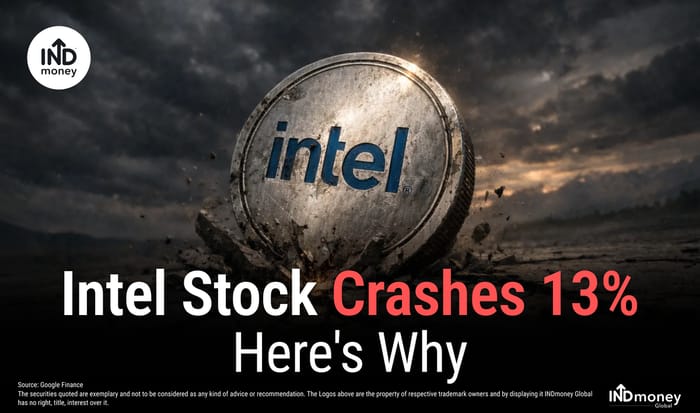
However, a catastrophic post-earnings selloff erased tens of billions of dollars in enterprise value within hours. This market contraction knocked an estimated $12 billion off the combined paper value of government-backed capital allocations, warrant coverage structures, regional co-investments, and taxpayer-funded modernization programs. For institutional investors, sovereign wealth funds, and federal auditors, the crash represents a stark realization: industrial policy cannot insulated a corporation from structural execution failures, shifting market dynamics, and operational inefficiencies.
Intel’s collapse was catalyzed by a confluence of structural pressures: severe gross margin compression, delays in achieving optimal yield rates on next-generation process nodes, and a structural shift in cloud compute architecture toward custom artificial intelligence accelerators dominated by Nvidia Corp. and custom silicon designed by hyperscalers like Amazon Web Services and Google. As Wall Street repriced Intel's equity to multi-year lows, the fiscal assumptions underlying federal support fell under intense public and institutional scrutiny.
The CHIPS Act Mechanism: How Washington Acquired a $12B Risk Exposure
Under the landmark capital allocation agreements managed by the U.S. Department of Commerce’s CHIPS Program Office, Intel was awarded approximately $8.5 billion in direct grant funding alongside up to $11 billion in low-interest federal loans. Additionally, the company leveraged the 25% Advanced Manufacturing Investment Credit (AMIC) provided by the U.S. Treasury, representing billions more in deferred tax liabilities and capital offsets.
To protect public interest and provide upside participation for taxpayers, federal funding frameworks incorporated warrant mechanisms—granting the government rights to purchase common stock at fixed strike prices—alongside strict milestones tied to capital deployment, operational fab output, and process technology transitions. As Intel’s share price spiraled downward, the net asset value of these contingent financial instruments plummeted.
Key Drivers of Public Asset Depreciation
- Warrant Value Contraction: Public equity warrants held or options leveraged by government entities lost substantial premium value as Intel's equity trading price plummeted far below baseline exercise valuations.
- Erosion of Regional Investment Multiples: Municipal, state, and federal co-investments in the Columbus, Ohio, and Chandler, Arizona mega-fab complexes experienced sharp reductions in implicit net enterprise valuation, risking delayed tax revenue timelines.
- Subsidized Debt Risk Premiums: The cost to insure Intel’s corporate debt via Credit Default Swaps (CDS) expanded significantly, elevating the theoretical default risk profile on state-supported credit lines.
Verified Financial Metrics & Valuation Breakdown
The table below provides a comprehensive breakdown of Intel’s operational metrics, capital allocation structures, and government funding exposure prior to and following the market contraction.
| Financial / Operational Metric | Pre-Correction Baseline | Post-Crash Realization | Variance / Net Impairment |
|---|---|---|---|
| Market Capitalization | ~$210.0 Billion | ~$85.0 - $92.0 Billion | -57.1% Erased |
| Implied Gov’t Stake & Warrant Value | ~$20.5 Billion (Combined exposure) | ~$8.5 Billion (Carrying value) | -$12.0 Billion Value Loss |
| IFS (Foundry Services) Operating Loss | -$1.4 Billion / quarter | -$2.8 Billion / quarter | -100% Loss Expansion |
| Gross Margin (Non-GAAP) | 45.4% | 35.4% - 38.7% | -1,000 bps contraction |
| Targeted CapEx Spending Cut | $31.5 Billion (FY Plan) | $21.5 Billion (Revised Plan) | -$10.0 Billion CapEx Cut |
| Enterprise EV/EBITDA Multiple | 14.2x | 7.8x | -45.0% De-rating |
Structural Bottlenecks: Node Transitions, Yield Rates, and the AI Accelerator Gap
Intel’s operational challenge stems from CEO Pat Gelsinger’s ambitious "5 Nodes in 4 Years" (5N4Y) engineering roadmap. Designed to restore process node leadership by transitioning rapidly through Intel 7, Intel 4, Intel 3, Intel 20A, and Intel 18A, the aggressive schedule put unprecedented strain on corporate capital structure and engineering execution.
While TSMC perfected extreme ultraviolet (EUV) lithography integration over a decade of iterative deployments, Intel attempted a leapfrogging strategy using ASML’s high-NA EUV machinery alongside novel transistor architectures, including Gate-All-Around (GAA) RibbonFET and backside power delivery (PowerVia). Operating these technologies simultaneously degraded gross margins due to elevated startup costs and initial wafer scrap rates.
Concurrently, the data center compute market experienced a rapid structural transition. Hyperscalers redirected billions in infrastructure CapEx away from traditional x86 Central Processing Units (CPUs)—Intel’s core profit engine—and toward graphics processing units (GPUs) and specialized AI application-specific integrated circuits (ASICs). Intel's native AI accelerator, Gaudi 3, struggled to capture substantial enterprise market share against Nvidia’s dominant CUDA software ecosystem and Blackwell architecture. Consequently, Intel’s server unit revenues fell sharply, denying the foundry business the steady internal cash flows required to finance capital-intensive fabrication facilities.
Industry & Market Implications: Who Wins, Who Loses?
The valuation collapse at Intel shifts the balance of power across the global semiconductor supply chain, creating clear winners and losers across global markets:
The Winners
- Taiwan Semiconductor Manufacturing Co. (TSMC): TSMC solidifies its near-monopolistic control over advanced node manufacturing (3nm and 2nm class wafers). Global fabless designers—including Apple, AMD, Qualcomm, and Nvidia—remain dependent on TSMC’s superior yields and stable operational execution.
- Advanced Micro Devices (AMD): Leveraging TSMC’s leading-edge nodes, AMD continues to capture market share across x86 enterprise server and client PC markets, free from the burden of high internal fab CapEx.
- Alternative Regional Foundry Markets: Samsung Foundry and emerging European industrial initiatives stand to capture redirected global enterprise orders as defense contractors and automakers diversify supply chain single-point-of-failure risks.
The Losers
- U.S. Industrial Policy & Taxpayers: The federal government's dual objectives—re-shoring advanced semiconductor manufacturing while earning a positive return on public capital—face severe headwinds. The drawdown diminishes public support for future direct industrial subsidies.
- Domestic Semiconductor Supply Chain Ecosystem: Equipment vendors (such as Applied Materials, Lam Research, and KLA) face reduced order books as Intel cancels, delays, or scales back tool deliveries for domestic fabs.
- Regional Labor & Construction Hubs: Delaying construction schedules in Ohio, Oregon, and Arizona disrupts local labor markets, specialized engineering employment, and regional municipal development projects dependent on projected tax yields.
Frequently Asked Questions (People Also Ask)
Why did Intel’s stock crash impact the government's financial stake so severely?
The federal government’s support under the CHIPS Act is directly tied to warrant equity stakes, performance milestones, and regional public-private co-investments. As Intel's equity market capitalization plummeted, the implied net valuation of public option holdings, warrant packages, and long-term tax increment financing mechanisms dropped by an estimated $12 billion in paper value.
Does the U.S. Government own direct equity shares in Intel?
While the CHIPS Program Office structures support primarily via direct cash grants and loans, equity participation agreements—such as warrants to purchase common stock—were embedded to protect taxpayer interests. Furthermore, federal and state governments act as primary capital facilitators; thus, any significant decline in corporate equity destabilizes the underlying security backing these multi-billion-dollar commitments.
Will Intel be forced to split its Design and Manufacturing (Foundry) divisions?
Institutional investors and activist shareholders are increasingly pushing Intel to evaluate a formal corporate structural split. Separating Intel Foundry Services (IFS) from the core Chip Design group could insulate design revenues, lower CapEx requirements for the design entity, and allow the foundry to seek external private equity or strategic sovereign capital infusions independently.
How does this crash affect the timeline for the Ohio and Arizona mega-fabs?
To preserve liquidity and reduce cash burn, Intel announced a $10 billion reduction in planned CapEx. Consequently, operational timelines for multi-billion-dollar fab construction sites in New Albany, Ohio, and Chandler, Arizona, are being extended, delaying high-volume commercial wafer production to align with organic market demand recoveries.
Future Outlook: Strategic Milestones to Watch
Intel’s path back to stability requires execution on key upcoming financial, operational, and regulatory milestones over the next 12 to 24 months:
- Intel 18A Yield Rates & Mass Production (H1 2025): The definitive metric for Intel’s operational survival rests on reaching commercially viable defect-density metrics for its 18A process node. Successful high-yield manufacturing of high-volume client and server chips (Clearwater Forest and Panther Lake) will determine if IFS can attract major external fabless clients.
- IFS External Customer Conversion: Securing significant binding volume commitments from major external customers—such as Microsoft, Nvidia, or Apple—is necessary to validate Intel’s foundry model and improve capacity utilization rates.
- Department of Commerce Grant Disbursement Milestones: Investors must track whether the CHIPS Program Office enforces compliance clawbacks, renegotiates warrant pricing thresholds, or restructures disbursement tranches based on Intel's delayed capital deployment schedules.
- Potential Restructuring & Spin-Off Announcements: Board decisions regarding the full operational separation of IFS, potential sale of non-core assets (e.g., further monetization of Mobileye or Altera units), and structural equity capital raises will serve as key catalysts for stock valuation recovery.
As Washington and Wall Street monitor Intel’s recovery plan, the episode serves as a case study in modern economic statecraft. The U.S. government faces a complex mandate: protecting public capital and taxpayer value while maintaining national security priorities in an industry dominated by global competition and rapid technological change.