Executive Takeaways
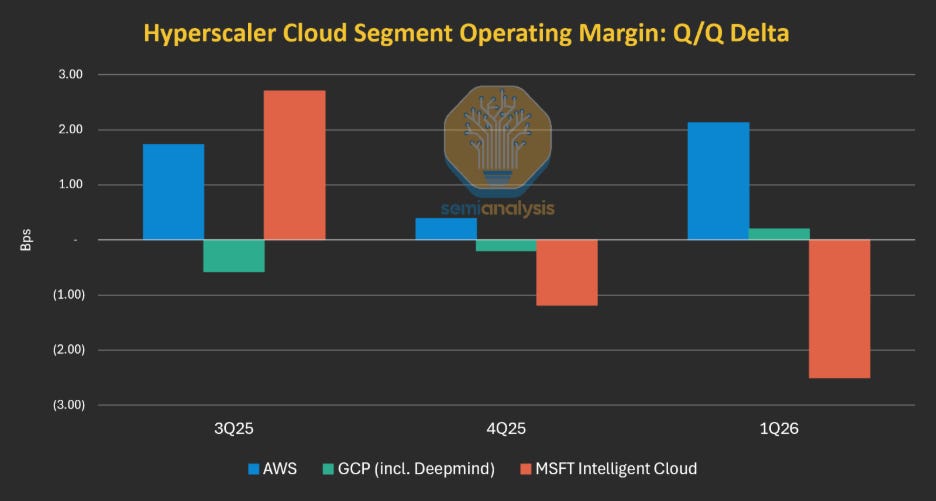
- Structural Margin Expansion: Proprietary data from SemiAnalysis’s newly released Tokenomics 2.0 model reveals that Amazon Web Services (AWS) is capturing outsized operating leverage by pairing strategic investments in Anthropic with the rapid scaling of its managed AI hub, Amazon Bedrock.
- The Bedrock Multiplexer Advantage: Unlike monolithic infrastructure plays reliant on raw GPU leasing, AWS has engineered a high-margin software and inference orchestration layer that drives down compute overhead while maximizing monetization per token.
- Peer Divergence: While Microsoft Azure and Google Cloud Platform (GCP) grapple with the heavy amortization schedules of proprietary silicon and intensive capital expenditure, AWS’s symbiotic commercial terms with Anthropic have created a widening efficiency gap across hyperscale peers.
- Enterprise ROI Acceleration: Fortune 500 adoption patterns show that corporate clients are prioritizing secure, multi-model flexibility inside Bedrock, translating to stickier cloud spend and superior long-term customer lifetime value (LTV) for Amazon.
For the better part of three years, Wall Street’s consensus narrative surrounding the generative artificial intelligence boom has centered on a zero-sum race for capital expenditure. Hyperscale cloud providers have poured tens of billions of dollars into advanced NVIDIA H100 and B200 clusters, proprietary custom ASICs, and sprawling data center real estate, often at the expense of near-term operating margins. However, a landmark forensic financial analysis released via SemiAnalysis’s Tokenomics 2.0 framework shatters this monolithic view, laying bare a nuanced reality: Amazon Web Services (AWS) has unlocked a structural margin flywheel that leaves its primary competitors struggling to catch up.
At the center of this financial transformation is a potent combination: the multi-billion-dollar strategic partnership with frontier AI developer Anthropic, and the architectural scaling of Amazon Bedrock. Far from being a simple reseller relationship, the structural alignment between AWS and Anthropic has engineered a unique economic model. By coupling premier access to Claude foundation models with AWS’s proprietary silicon infrastructure and managed orchestration layers, Amazon has solved the holy grail of enterprise AI—achieving high-velocity top-line growth while simultaneously expanding operating margins.
The Architecture of the Trade: Decoding Tokenomics 2.0
Test Our Free AI & Tech Utilities Suite
Calculate LLM API token costs, analyze article dwell-time, or simulate tech DCA returns.
To understand why AWS is widening its margin advantage over Microsoft Azure and Google Cloud Platform, one must look deep beneath the hypervisor layer into the economics of token generation and inference serving. Historically, cloud providers viewed AI workloads as low-margin, compute-heavy necessities designed merely to anchor core IaaS (Infrastructure-as-a-Service) contracts. However, the introduction of managed orchestration services fundamentally alters this dynamic.
According to the Tokenomics 2.0 model, the core profit engine for AWS relies on three interdependent pillars:
- Inference Optimization and Hardware Heterogeneity: AWS has aggressively integrated its custom Trainium and Inferentia chips alongside traditional GPU fleets. This hardware diversity dramatically reduces the cost-per-token for high-volume enterprise deployments.
- The Bedrock Mix Effect: Amazon Bedrock acts as a high-margin software layer. Rather than forcing clients into a single foundational model, Bedrock allows enterprises to dynamically route queries across Anthropic’s Claude models, Meta’s Llama, and Amazon’s own Titan architectures. This flexibility commands premium platform pricing while insulating AWS from the risk of single-model obsolescence.
- Strategic Deal Structuring: The specific financial and cloud-credit terms negotiated under the Anthropic partnership ensure that AWS captures substantial economic value as downstream API calls and enterprise deployments scale globally.
Market analysts examining capital allocation strategies note that this commercial structure effectively hedges Amazon’s downside while maximizing upside exposure to enterprise generative AI adoption. When an enterprise client builds a mission-critical application on Claude via Bedrock, the marginal cost of compute drops relative to the billed token rate, yielding an exceptionally attractive business model for AWS.
Comparative Metrics: How AWS Outpaces the Hyperscale Field
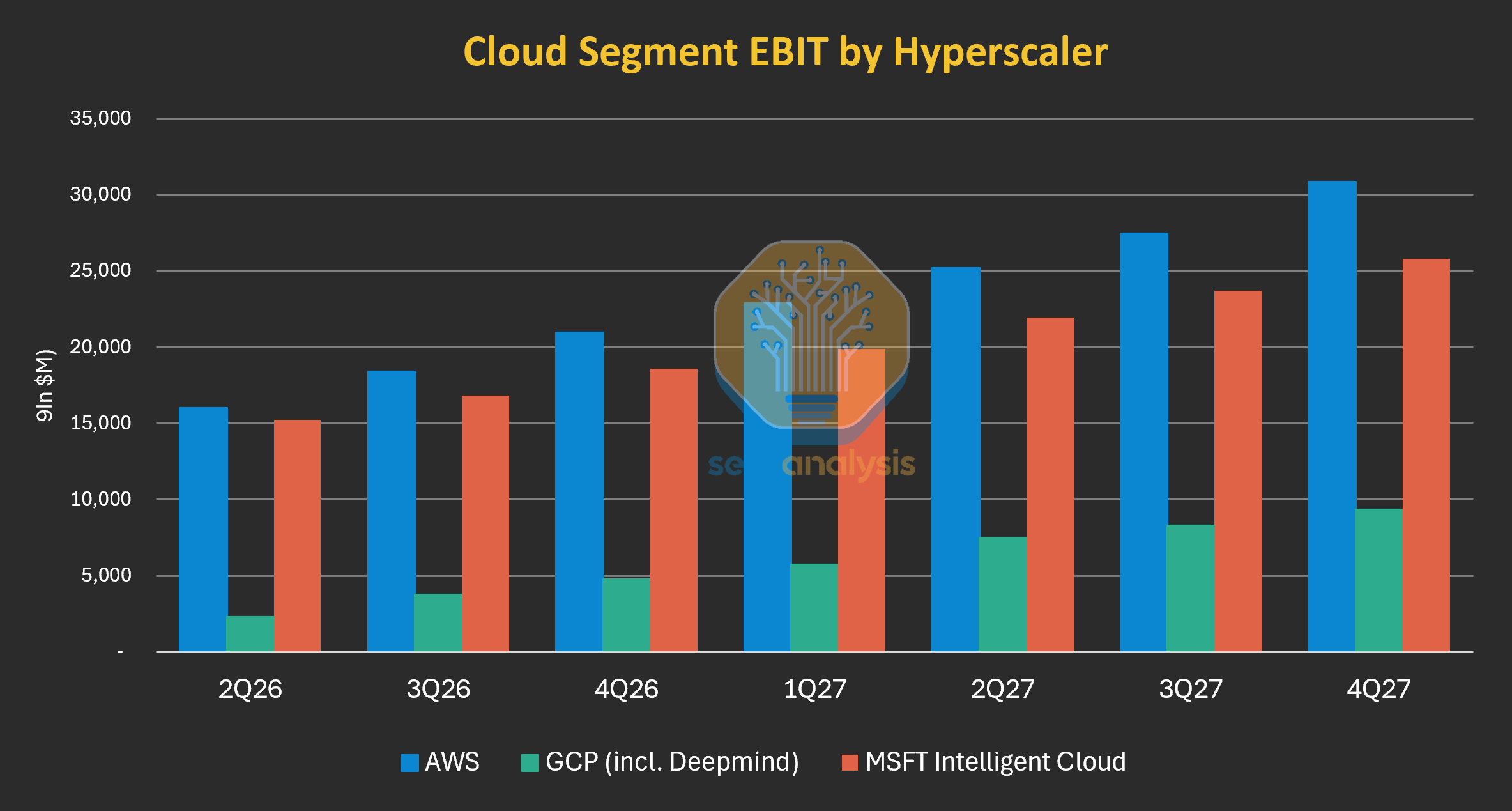
The divergence in operating efficiency between AWS and its peers is starkly illustrated when evaluating infrastructure utilization, average selling prices (ASPs) per token, and capital expenditure (CapEx) payback periods. While Google leverages its deep integration with Gemini and Microsoft anchors its strategy to OpenAI, both competitors face distinct margin headwinds that Amazon has successfully mitigated.
| Hyperscale Provider | Primary AI Model Alignment | Orchestration Layer | Estimated Margin Impact | CapEx Amortization Headwind |
|---|---|---|---|---|
| AWS | Anthropic (Claude) + Multi-Model | Amazon Bedrock | Expanding / Accretive | Low (Balanced via Custom Silicon) |
| Microsoft Azure | OpenAI (GPT Series) | Azure OpenAI Service | Neutral / Dilutive (High API Pass-Through) | High (Heavy Reliance on OpenAI Revenue Share) |
| Google Cloud (GCP) | Google Gemini (Proprietary) | Vertex AI | Stabilizing but CapEx-Heavy | Very High (Massive Internal TPU/GPU Buildout) |
As detailed in the breakdown above, Microsoft’s deep financial entanglements with OpenAI involve complex revenue-sharing agreements and substantial API pass-through costs that can compress gross margins on high-volume enterprise contracts. Conversely, Amazon’s equity stake and commercial agreements with Anthropic allow AWS to capture direct cloud consumption revenue while benefiting from Anthropic's rapid algorithmic breakthroughs without bearing the entirety of foundational model R&D overhead directly on its balance sheet.
Industry Implications: Enterprise ROI and Market Liquidity
The broader economic ramifications of AWS’s margin expansion extend far beyond quarterly earnings reports. For enterprise chief information officers (CIOs), the maturity of Amazon Bedrock provides crucial risk mitigation. Regulatory compliance, data residency, and enterprise-grade security are paramount when deploying customer-facing AI agents. Bedrock’s integration of Claude enables regulated sectors—such as financial services, healthcare, and defense—to deploy frontier intelligence within secure Virtual Private Clouds (VPCs) without exposing proprietary training data.
This enterprise trust translates directly into market liquidity and superior customer lifetime value. Corporate buyers are increasingly standardizing their cloud compute architecture around platforms that offer model optionality. By avoiding vendor lock-in to a single proprietary model while simultaneously offering the market-leading capabilities of Claude, AWS has established a gravitational pull for enterprise IT budgets.
Furthermore, this dynamic shifts valuation multiples across the cloud computing sector. Wall Street equity research analysts are beginning to re-rate AWS not merely as a commoditized infrastructure utility, but as a high-margin software and intelligence platform. The ability to scale AI revenue streams without sacrificing operating margin profile addresses the single greatest investor anxiety of the 2024–2026 tech cycle.
Frequently Asked Questions (People Also Ask)
1. How does the Anthropic deal specifically drive higher margins for AWS?
The partnership combines Amazon's massive infrastructure scale with Anthropic's market-leading Claude models. Through structured commercial agreements and preferred cloud provider status, AWS secures foundational model access that attracts high-volume enterprise customers to Amazon Bedrock. This drives massive core IaaS and managed service consumption while avoiding the full internal R&D costs of building a frontier model from scratch.
2. What makes Amazon Bedrock different from competing cloud AI hubs like Azure OpenAI Service?
Unlike Azure OpenAI Service, which is fundamentally tethered to OpenAI's ecosystem, Amazon Bedrock is architected as a multi-model multiplexer. Enterprises can seamlessly switch between Anthropic Claude, Meta Llama, Cohere, Mistral, and Amazon Titan within the same unified API framework. This flexibility reduces enterprise migration friction and allows AWS to optimize compute routing across heterogeneous hardware, protecting its gross margins.
3. Why are cloud competitors lagging behind AWS in generative AI operating margins?
Competitors like Microsoft and Google face heavier margin compression due to complex revenue-sharing obligations with exclusive model partners and massive capital expenditure amortization schedules for proprietary silicon and data centers. AWS has effectively balanced its hardware mix using custom Trainium and Inferentia chips while leveraging a diverse model ecosystem that maximizes monetization per token.
4. What does SemiAnalysis’s Tokenomics 2.0 model reveal about future cloud profitability?
Tokenomics 2.0 demonstrates that as inference efficiency improves and enterprise token volumes scale exponentially, platforms with optimized orchestration layers (such as Bedrock) will achieve significant operating leverage. The model proves that AI workloads are transitioning from margin-dilutive capital drains to highly accretive revenue drivers for disciplined cloud providers.
Future Outlook: Milestones to Watch
As the cloud computing sector navigates the remainder of 2026 and looks toward the horizon, several critical milestones will determine whether AWS can sustain its margin dominance:
- Custom Silicon Adoption Rates: The speed at which AWS scales its second- and third-generation Trainium accelerators for Anthropic model training and fine-tuning will directly dictate infrastructure cost reductions.
- Enterprise Agentic Workloads: Transitioning from simple chat-based LLM queries to complex, multi-step autonomous AI agents will dramatically increase token consumption per enterprise user, testing the scalability of the Bedrock orchestration engine.
- Regulatory Scrutiny and Antitrust Dynamics: Global antitrust regulators continue to monitor Big Tech investments in artificial intelligence startups. Any shifts in the formal governance or structural ties between Amazon and Anthropic will be closely parsed by financial markets.
Ultimately, the findings illuminated by advanced economic models like Tokenomics 2.0 signal a maturation point in the AI infrastructure cycle. The era of unchecked, indiscriminate spending is giving way to an era of disciplined execution and operational leverage. For AWS, the strategic synchronization of Anthropic’s model innovation with Amazon Bedrock’s distribution power has created an economic moat that will be exceedingly difficult for lagging peers to bridge.