

Executive Takeaways
Test Our Free AI & Tech Utilities Suite
Calculate LLM API token costs, analyze article dwell-time, or simulate tech DCA returns.
- Cross-Partisan Local Electoral Shifts: Recent election cycles—dubbed the "Blue Tsunami" in municipal and state races—revealed an unexpected unifying voter sentiment: bipartisan rejection of hyperscale data center zoning, municipal tax abatements, and unconstrained utility load growth.
- Capital Allocation Friction: Hyperscalers (Amazon Web Services, Microsoft, Alphabet, and Meta) face growing friction in turning their $200+ billion annual aggregate AI capital expenditure (CapEx) into operational megawatt capacity due to local land-use moratoriums and NIMBY opposition.
- Utility Grid & PPA Repricing: Commercial power purchase agreements (PPAs) and retail electricity rates are escalating as local communities resist absorbing the infrastructure grid upgrade costs required to support 500+ megawatt compute campuses.
- Valuation Risks for Infrastructure REITs: Pure-play data center Real Estate Investment Trusts (REITs) and power utility providers face heightened regulatory compliance costs, delayed commercial operation dates (CODs), and potential asset devaluations in primary markets like Northern Virginia, Georgia, and Arizona.
The Grassroots Revolt Threatening Big Tech’s AI Ambitions
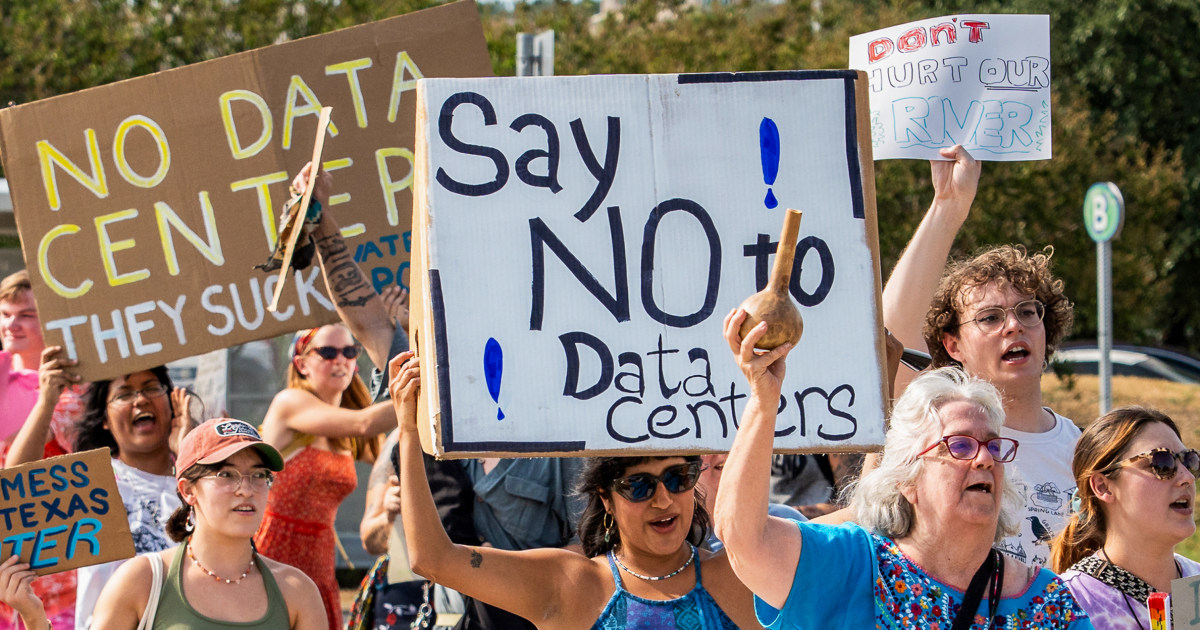
For more than a decade, municipal economic development boards viewed hyperscale data centers as the ultimate civic windfall. Cities and counties routinely offered sweeping property tax exemptions, expedited site-plan approvals, and discounted utility access to attract Fortune 50 cloud operators. The proposition appeared simple: transform low-density agricultural or industrial land into high-value rate bases that yielded property tax revenue without burdening local school districts or municipal service infrastructure.
That consensus has fractured. In recent state and municipal elections across the United States—ranging from suburban districts in Northern Virginia to rural townships in Georgia, Ohio, and Arizona—a grassroots political realignment took center stage. Voters from across the political spectrum turned out in record numbers to penalize incumbents who greenlit massive server farms. The clear takeaway from what analysts are calling the municipal "Blue Tsunami" is that local communities are increasingly resisting the expansion of data centers in their backyards.
The pushback stems from a convergence of quality-of-life and economic concerns: soaring residential electricity bills driven by regional transmission upgrades, municipal water table depletion linked to liquid cooling systems, continuous low-frequency acoustic pollution, and the suburban encroachment of massive industrial complexes. As artificial intelligence models scale exponentially, requiring clusters that consume anywhere from 300 megawatts to over a gigawatt of continuous power, the physical footprint of computing has clashed directly with local voters.
From Silent Industrial Parks to Front-Line Political Battlegrounds
The rapid escalation of this grassroots opposition caught both corporate site selectors and political strategists off guard. Historically, data centers operated quietly on the periphery of real estate markets. However, the modern generative AI gold rush transformed these low-profile structures into sprawling, energy-intensive industrial campuses requiring specialized substations, massive backup diesel generator fleets, and high-voltage transmission corridors.
In Northern Virginia's Loudoun and Prince William counties—the undisputed capital of global internet traffic—local municipal races turned into referendums on land-use rights and environmental governance. Candidates running on explicit platforms of data center moratoriums, enhanced buffer-zone mandates, and strict acoustic thresholds defeated long-standing municipal leaders who had embraced hyperscaler development. Similar dynamics played out in Georgia's Newton and Douglas counties, as well as rural jurisdictions outside Columbus, Ohio, and Phoenix, Arizona.
This political shift comes at a delicate moment for executive leadership teams across Big Tech. Enterprise ROI on artificial intelligence investments depends on deploying compute clusters rapidly to capture market share in generative models, enterprise cloud services, and autonomous systems. When local zoning boards delay site approvals or issue moratoriums, the resulting gridlock strains capital allocation efficiency and increases execution risk for publicly traded cloud providers.
Grid Capacity Constraints and the Reapportionment of Energy Costs
At the center of voter frustration is the economic strain placed on regional energy grids. Hyperscale data centers require unyielding baseline power operating at near 100% capacity factors. To accommodate this unprecedented load growth, regional transmission organizations (RTOs) such as PJM Interconnection and MISO have been forced to fast-track billions of dollars in grid infrastructure upgrades.
Under traditional utility rate structures, the capital expenditures required for broad grid expansion are often amortized across the entire ratepayer base. As a result, residential consumers and small commercial businesses saw their monthly electricity costs rise significantly to subsidize the infrastructure needed for multi-megawatt tech campuses. Voters identified this dynamic as a net transfer of economic value from local taxpayers to mega-cap technology corporations.
Furthermore, concerns over water resource management have drawn significant public scrutiny. In arid and drought-prone regions such as the American Southwest, public outcry over the millions of gallons of potable water consumed daily by evaporative cooling towers has led to regulatory impasses. Even as operators transition toward closed-loop cooling and air-chilled architectures, public skepticism remains high, creating persistent political friction during site plan approvals.
Comparative Market Analysis: Regulatory & Sentiment Shifts
The table below outlines key metrics across major U.S. data center markets, illustrating the correlation between hyperscale density, voter sentiment, and operational headwinds.
| Primary Metro Market | Active & Pipeline Capacity (GW) | Avg. Residential Tariff Surge (3-Yr % Delta) | Zoning Rejection & Moratorium Index | Primary Voter Concern | Hyperscaler CapEx Risk Level |
|---|---|---|---|---|---|
| Northern Virginia (PJM) | 3.4 GW | +24.2% | High | Grid Overload, Historical Preservation, Noise | Critical |
| Atlanta Metro, GA (Southern Co.) | 1.8 GW | +18.7% | Moderate-High | Water Consumption, Tax Abatement Equity | Elevated |
| Columbus Metro, OH (AEP) | 1.2 GW | +15.3% | Moderate | Suburban Sprawl, Agricultural Land Loss | Moderate |
| Phoenix / Chandler, AZ (APS/SRP) | 2.1 GW | +21.5% | High | Water Security, Extreme Heat Grid Strain | High |
| Dallas-Fort Worth, TX (ERCOT) | 1.6 GW | +19.1% | Moderate | Grid Reliability, Backup Generator Emissions | Moderate |
Industry & Market Implications: Re-Evaluating Valuations and Expansion Strategies
The political backlash against data centers is reshaping corporate strategy across several major business sectors:
1. Data Center REITs and Infrastructure Developers
Publicly traded Real Estate Investment Trusts (REITs) specializing in data center assets face operational delays. As municipal approval timelines extend from 6–12 months to 24–36 months, the cost of holding undeveloped land increases. Valuation multiples for speculative greenfield developments are adjusting downward to reflect heightened entitlement risks, forcing developers to seek alternative site selection frameworks.
2. The Pivot to Behind-the-Meter (BTM) and Nuclear Solutions
To bypass municipal opposition and local utility grid congestion, hyperscalers are altering their infrastructure architecture. Tech companies are increasingly pursuing "behind-the-meter" (BTM) co-location strategies directly adjacent to existing nuclear power plants, natural gas generation sites, or dedicated small modular reactor (SMR) facilities. By building dedicated power systems independent of the public distribution grid, operators can reduce their impact on local utility rates and bypass traditional municipal pushback.
3. Escalating Regulatory Compliance and ESG Reporting
State legislatures are stepping in to codify voter demands. Proposed legislation across multiple states aims to eliminate property tax exemptions for facilities that fail to meet strict water conservation metrics, noise abatement standards, and clean energy procurement goals. Additionally, corporate Scope 2 and Scope 3 carbon reporting standards are forcing companies to account for the indirect environmental impact of backup diesel generators and power draw, adding layer of compliance costs.
Frequently Asked Questions (People Also Ask)
Why are local voters opposing data centers despite the municipal tax benefits?
While data centers generate local property tax revenue, voters increasingly argue that the trade-offs outweigh the economic gains. Key drivers of opposition include rising residential electricity bills from grid upgrades, environmental concerns over water usage, continuous acoustic noise from cooling equipment, loss of green space, and minimal long-term local job creation once construction concludes.
How does community opposition impact Big Tech’s AI capital investments?
Local opposition creates site approval delays, regulatory litigation, and supply chain bottlenecks, extending the Commercial Operation Date (COD) for critical computing clusters. These delays introduce execution risk for hyperscalers, slowing down the deployment of next-generation large language models and impacting projected returns on enterprise cloud investments.
What strategies are data center operators using to navigate local pushback?
Operators are adjusting their deployment strategies by moving away from populated suburban hubs toward brownfield industrial sites, rural locations with excess power capacity, and locations with direct energy sources. They are also investing in dry-cooling systems, advanced noise containment walls, and customized community benefit agreements (CBAs) that guarantee local infrastructure funding.
Can federal regulatory intervention override local zoning decisions for data centers?
In the United States, primary land-use and zoning decisions remain under the jurisdiction of local municipal governments and county boards. While federal agencies like FERC regulate interstate high-voltage electricity transmission, they do not hold authority to mandate local municipal zoning approvals for private industrial or enterprise computing developments.
Future Outlook: The New Frontier of Distributed and Strategic Compute Architecture
The political realities highlighted by recent election results signal a turning point for the hyperscale data center industry. The era of unchecked land acquisition and rapid municipal tax concessions has largely come to a close. Over the next decade, the industry will likely undergo a structural transformation in how compute infrastructure is deployed, capitalized, and managed politically.
Site selection strategies will increasingly prioritize community engagement, grid-independent energy procurement, and brownfield re-development over prime suburban real estate acquisitions. Companies that proactively integrate community benefit agreements, fund municipal infrastructure improvements, and adopt advanced cooling architectures will be better positioned to navigate local regulatory processes.
Ultimately, the challenge facing Big Tech is no longer just securing capital or silicon; it is managing the physical footprint of computing within local communities. Operators that balance rapid infrastructure deployment with local economic and environmental priorities will be best equipped to sustain their long-term growth trajectories.




