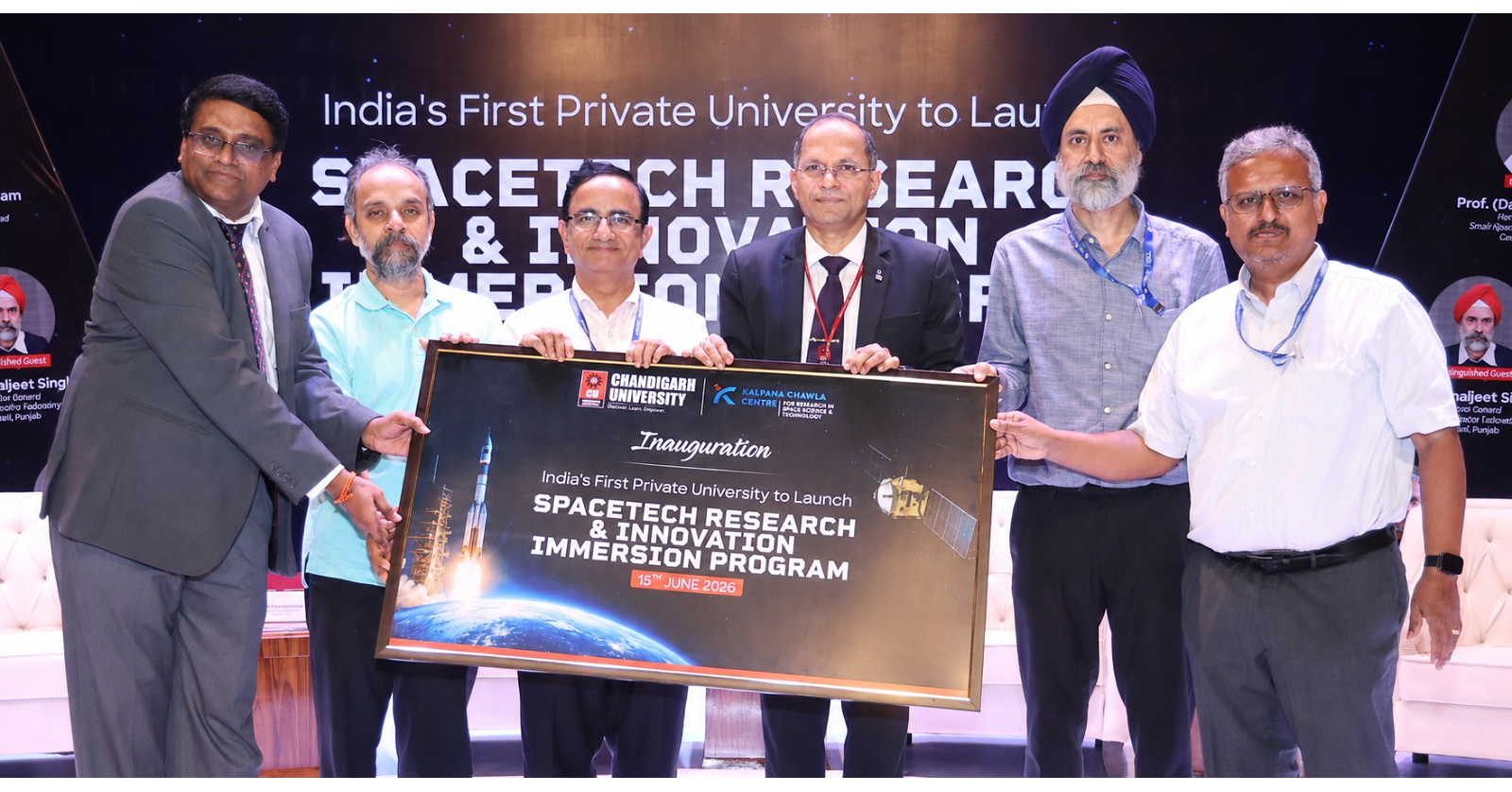
ISRO and Chandigarh University Unleash 2026 Space Tech Program to Build India’s Next Orbital Workforce
CHANDIGARH — In a landmark strategic convergence of academic rigor and deep-space ambition, top scientists and researchers from the Indian Space Research Organisation (ISRO) and the Indian Institute of Space Science and Technology (IIST) have officially launched the Space Technology & Research Program 2026 at Chandigarh University (CU). This high-stakes initiative aims to bridge India’s widening aerospace talent gap, providing the next generation of engineers with direct, hands-on access to mission-critical training, advanced propulsion research, and satellite payload design.
Announced on June 15, 2026, the program marks a pivotal milestone in India's commercial and exploratory space roadmap. As ISRO continues to break global records with low-cost lunar missions, upcoming crewed Gaganyaan flights, and a rapidly expanding commercial space economy, the demand for specialized aerospace engineering talent has skyrocketed. The partnership with Chandigarh University positions the institution as a premier pipeline for future space scientists, offering students unprecedented exposure to actual mission workflows.
Inside the 2026 CU Space Program: Training Ground for Orbital Pioneers
The newly unveiled Space Technology & Research Program 2026 is not merely an academic elective; it is an immersive incubator designed to simulate real-world aerospace development environments. Under the direct mentorship of visiting ISRO and IIST scientists, enrolled students will work on state-of-the-art challenges spanning satellite telemetry, navigation systems, materials science for extreme thermal environments, and autonomous robotics for planetary exploration.
Industry analysts note that this collaboration arrives at a critical juncture. With India opening its doors wider to private sector participation through IN-SPACe, the nation's space ecosystem requires a workforce fluent in both theoretical astrophysics and pragmatic engineering execution. The curriculum at Chandigarh University has been specifically restructured to align with these national imperatives, ensuring that graduates hit the ground running in both public sector research labs and venture-backed private space startups.
Core Pillars of the ISRO-CU Partnership
- Direct Mentorship: Direct access to senior ISRO and IIST engineers who serve as guest faculty, project advisors, and research evaluators.
- Advanced R&D Labs: Dedicated facilities on campus equipped with specialized testing apparatus for avionics, signal processing, and structural stress analysis.
- Live Project Collaboration: Opportunities for top-performing students to contribute to sub-components destined for upcoming scientific payloads and atmospheric research rockets.
- Industry-Academia Synergy: Direct pipelines into India's booming private aerospace sector, bridging the gap between classroom theory and commercial deployment.
Strategic Implications for India’s Aerospace Economy
The timing of the 2026 program underscores India's aggressive push toward technological self-reliance. Over the past decade, ISRO has transitioned from a domestic science agency to a globally competitive launch provider, capturing international payloads and executing complex interplanetary maneuvers on remarkably lean budgets. However, scaling this momentum requires a massive influx of specialized engineering talent.
By embedding ISRO’s operational expertise directly into a major university ecosystem, the program democratizes access to elite aerospace training. Historically, such specialized knowledge was siloed within government-exclusive institutions. By extending this framework to Chandigarh University, ISRO is casting a wider net, scouting raw engineering talent from across the country's northern corridor and channeling it directly into the national space pipeline.
Quick Facts: The 2026 Space Technology & Research Initiative
| Parameter | Details |
|---|---|
| Initiative Launch Date | June 15, 2026 |
| Core Collaborators | ISRO, IIST, and Chandigarh University (CU) |
| Primary Objective | Advanced training, satellite tech R&D, and aerospace workforce development |
| Target Audience | Engineering and science students specializing in aerospace, electronics, and mechanical fields |
| Expected Impact | Creation of a robust talent pipeline for India's public space agency and private commercial sector |
Looking Ahead: The Future of India’s Space Classroom
As the first cohort of the Space Technology & Research Program 2026 begins its rigorous training regimen, university officials and ISRO delegates are already eyeing future expansions. Plans are underway to scale the collaborative research framework, introducing joint hackathons, satellite design challenges, and fellowship grants for doctoral candidates focusing on deep-space communication and reusable launch vehicle dynamics.
For students at Chandigarh University, the program represents a rare, once-in-a-generation gateway to the stars. As India cements its status as an undisputed space superpower, the lecture halls of CU are rapidly transforming into the launching pads of tomorrow.
Frequently Asked Questions
What is the main objective of the ISRO Space Technology & Research Program 2026 at Chandigarh University?
The program is designed to provide students with specialized training, hands-on research opportunities, and direct mentorship from ISRO and IIST scientists. Its goal is to bridge the aerospace talent gap and prepare students for careers in India's expanding public and private space sectors.
Who is eligible to participate in the CU Space Program?
The initiative primarily targets engineering and science students at Chandigarh University, particularly those enrolled in aerospace, mechanical, electronics, and computer science disciplines who meet specific academic merit criteria set by the institution and visiting mentors.