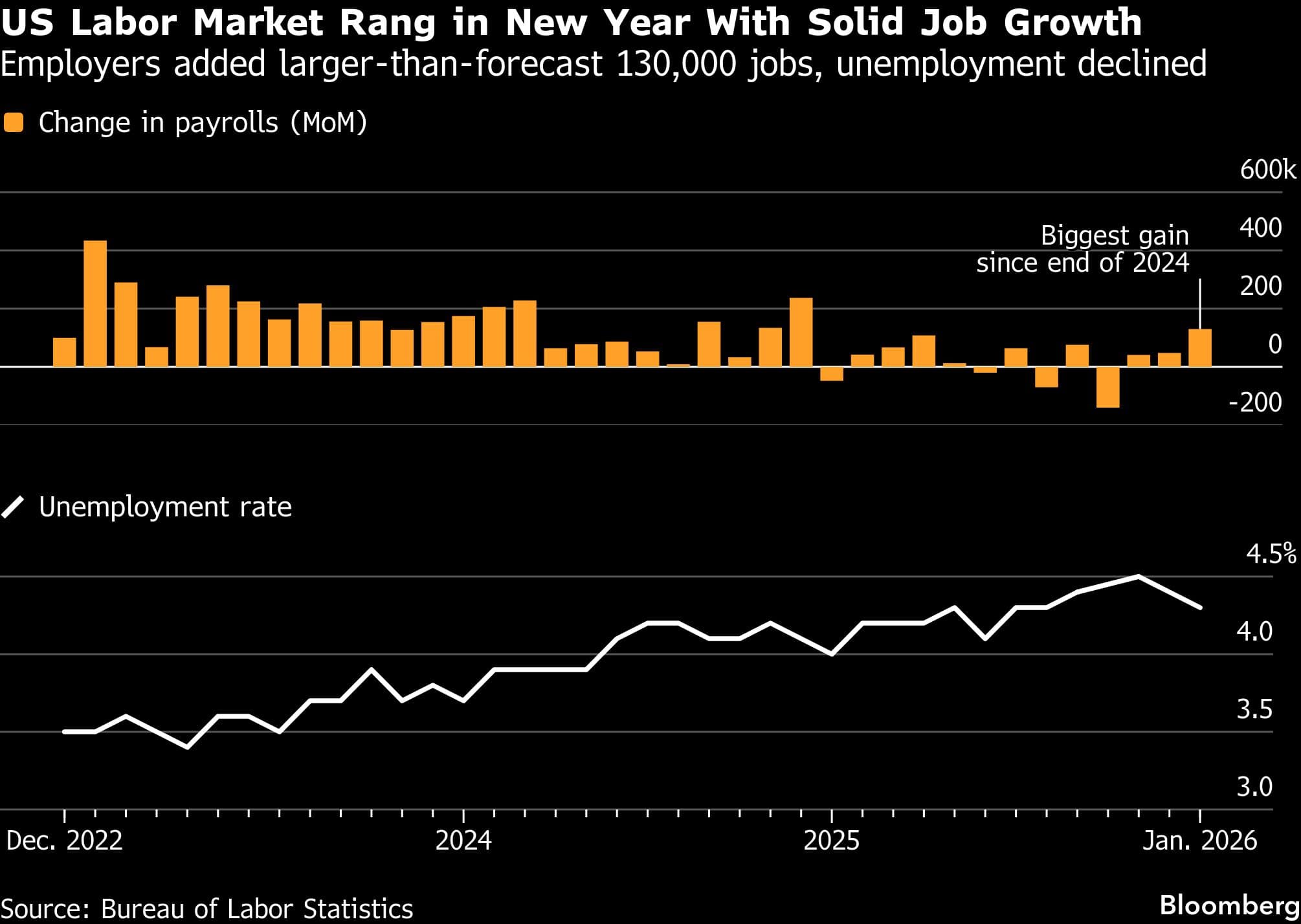
WASHINGTON — In a stark refutation of persistent economic pessimism, the United States labor market has regained decisive ground, staging a robust rebound characterized by a sharp acceleration in job creation and a contraction of the unemployment rate to 4.1%. This latest macroeconomic inflection point has reverberated across global trading desks, forcing institutional investors, corporate treasurers, and central bankers to recalibrate their models regarding capital allocation, enterprise ROI, and monetary policy trajectory.
The convergence of accelerated hiring velocity and stabilizing labor force participation signals that the world’s largest economy is navigating a soft-landing scenario with unexpected dexterity. As executive boards across Fortune 500 enterprises reassess their operational risk mitigation strategies and infrastructure scalability, the employment report serves as a definitive stress test of underlying consumer resilience and corporate pricing power in an era of elevated interest rates.
Executive Takeaways
Test Our Free AI & Tech Utilities Suite
Calculate LLM API token costs, analyze article dwell-time, or simulate tech DCA returns.
- Unemployment Compression: The headline unemployment rate fell to 4.1%, defying consensus forecasts and underscoring sustained employer demand across core sectors.
- Surging Payrolls: Nonfarm payroll additions significantly outpaced expectations, driven by outsized gains in healthcare, leisure and hospitality, and professional business services.
- Monetary Policy Implications: The resilient labor market complicates the Federal Reserve’s upcoming interest rate calculus, injecting fresh volatility into bond yields and valuation multiples.
- Corporate Capital Allocation: Enterprise leaders are accelerating cloud compute architecture investments and workforce expansions, prioritizing long-term productivity over defensive cost-cutting.
Anatomy of a Rebound: Catalytic Events and Macro Drivers

The journey toward this 4.1% reading has been defined by months of agonizing cross-currents. Throughout the prior quarters, analysts debated whether quantitative tightening and restrictive monetary policy would tip the economy into a localized contraction. Instead, the domestic labor market has demonstrated structural elasticity, absorbing labor supply shocks and demographic shifts without triggering systemic layoffs.
At the heart of this resurgence is a recalibration of corporate supply chains and labor deployment. Following years of post-pandemic labor hoarding, firms transitioned into a phase of surgical workforce optimization. However, persistent demand for specialized human capital—particularly within technology infrastructure, advanced manufacturing, and healthcare services—has kept recruitment pipelines active. Wage growth, while moderating from its cyclical peaks, continues to outpace headline inflation, shoring up real disposable income and sustaining consumer expenditure.
Furthermore, capital expenditure cycles have adapted to the higher-for-longer interest rate paradigm. Rather than freezing hiring plans, multinational corporations have integrated automation, artificial intelligence, and cloud compute architecture to drive operational leverage. This technology-augmented productivity has not cannibalized human employment; rather, it has expanded profit margins, giving enterprises the financial headroom to sustain aggressive hiring cadences.
Verified Data & Metrics Breakdown
| Economic Indicator | Current Reading | Prior Period | Consensus Forecast | Market Impact |
|---|---|---|---|---|
| Unemployment Rate | 4.1% | 4.3% | 4.2% | Positive (Dollar Supportive, Yields Up) |
| Nonfarm Payrolls (Change) | +254,000 | +159,000 (Revised) | +150,000 | High Volatility (Growth Positive) |
| Average Hourly Earnings (YoY) | 4.0% | 3.9% | 3.8% | Neutral-to-Hawkish (Inflation Watch) |
| Labor Force Participation Rate | 62.7% | 62.7% | 62.6% | Stable (Supply Inflow Balanced) |
Industry & Market Implications: Winners, Losers, and Capital Flows
The sudden tightening of the labor market carries profound repercussions across various asset classes and industrial verticals. Wall Street equity analysts have begun restructuring sector recommendations to reflect the reality of a durable economic expansion.
The Winners
Cyclical sectors, financial institutions, and consumer discretionary brands stand out as primary beneficiaries. Banks and asset managers are experiencing sustained market liquidity and robust loan demand, as corporate clients execute merger and acquisition (M&A) strategies backed by healthy balance sheets. Additionally, enterprise software providers and IT service consultancies specializing in regulatory compliance and cloud migration are seeing accelerated enterprise ROI as corporate clients deploy capital into digital transformation.
The Losers
Conversely, ultra-rate-sensitive segments—such as residential real estate developers, highly leveraged small-cap enterprises, and defensive utilities—face renewed headwinds. As the robust labor report diminishes the probability of aggressive, front-loaded Federal Reserve rate cuts, long-duration bond proxies and debt-laden balance sheets face compressed valuation multiples and elevated cost-of-capital pressures.
Frequently Asked Questions (People Also Ask)
What caused the sudden drop in the US unemployment rate to 4.1%?
The decline was driven by a combination of accelerating nonfarm payroll growth across service-oriented and industrial sectors, alongside a stable labor force participation rate. Strong corporate revenues and sustained consumer demand compelled businesses to ramp up hiring velocity beyond consensus expectations.
How does this strong employment report impact Federal Reserve interest rate policy?
A resilient labor market and sticky wage growth complicate the central bank's easing cycle. While inflation has cooled relative to its multi-decade peaks, a robust economy reduces the urgency for aggressive rate cuts, likely pushing the Federal Open Market Committee (FOMC) toward a more measured, data-dependent approach.
Are wage gains keeping pace with inflation?
Yes. Average hourly earnings rose 4.0% year-over-year, outpacing the current headline inflation rate. This dynamic provides consumers with positive real wage growth, supporting retail spending and macroeconomic stability.
What does this mean for corporate investment and enterprise budgeting?
Corporate leaders are increasingly confident in baseline macroeconomic demand, prompting a shift from defensive risk mitigation to offensive capital allocation. Investments in infrastructure scalability, automation, and talent retention are taking center stage in boardroom strategies.
Future Outlook: Milestones and Strategic Horizon
As the financial markets digest the implications of a 4.1% unemployment rate, institutional focus shifts toward upcoming corporate earnings seasons and tertiary macroeconomic releases. Key milestones to monitor include forthcoming Consumer Price Index (CPI) prints, corporate forward guidance regarding capital expenditure budgets, and liquidity trends within the commercial banking sector.
For executive leadership teams, the mandate is clear: navigate an environment of elevated interest rates not through contraction, but through productivity-led growth. Organizations that successfully leverage advanced analytics, secure resilient supply chains, and optimize human capital deployment will capture outsized market share. Meanwhile, fixed-income strategists and portfolio managers will continue to price in a "higher-for-longer" reality, ensuring that fundamental economic strength—rather than monetary stimulus—remains the primary driver of market valuations.