

Executive Takeaways
- Fiscal Gridlock as a Market Stabilizer: Divided government following the midterms historically restricts aggressive fiscal expansion, capping sovereign debt velocity while preserving valuation multiples across defensive sectors.
- Regulatory Volatility & Capital Allocation: Shifts in congressional committee oversight directly threaten enterprise ROI in energy, financial technology, and healthcare, forcing institutional portfolios into rigorous risk mitigation postures.
- Debt Ceiling and Liquidity Shocks: Impending statutory debt limit showdowns elevate short-term Treasury yield volatility, directly impacting corporate borrowing costs and broader market liquidity.
- Unprecedented search volumes and algorithmic trading shifts indicate heightened institutional anxiety over fiscal policy execution and infrastructure scalability funding.
As the political pendulum swings toward the midterm elections, institutional investors, sovereign wealth managers, and corporate treasurers are confronting a volatile intersection of legislative uncertainty and macroeconomic fragility. For Wall Street and the City of London alike, the upcoming electoral cycle is not merely a contest for congressional seats; it is a referendum on capital allocation, regulatory compliance, and the trajectory of the United States national debt. With trillions of dollars in asset valuations tethered to fiscal policy, corporate tax rates, and federal spending bills, the market implications of a shifting legislative majority extend far beyond short-term ticker tape fluctuations.
In this comprehensive investigative report, we analyze the historical correlations between midterm outcomes and equity performance, decode the mechanics of impending debt ceiling brinkmanship, and evaluate how institutional portfolios are executing risk mitigation strategies to insulate against regulatory shocks.
The Legislative Matrix: Gridlock Versus Fiscal Expansion
Test Our Free AI & Tech Utilities Suite
Calculate LLM API token costs, analyze article dwell-time, or simulate tech DCA returns.
For decades, Wall Street consensus has favored political gridlock. When control of Washington is divided between an executive branch eager to spend and a legislative branch capable of blocking sweeping tax hikes or unconstrained entitlement expansion, equity markets have historically found a reliable anchor. However, the contemporary macroeconomic landscape—marked by stubbornly sticky inflation, high interest rate regimes, and an escalating sovereign debt burden—complicates this traditional playbook.
A shift in congressional power away from the incumbent party typically halts major fiscal initiatives, effectively freezing federal spending growth. While this dynamic limits infrastructure scalability and targeted industrial subsidies that benefit specific technology and manufacturing verticals, it serves as a crucial check on runaway deficit spending. Chief investment officers across major tier-1 asset management firms are currently stress-testing portfolios for two primary scenarios:
- The Divided Government Scenario: Characterized by legislative paralysis, an inability to pass transformative tax reform, and a reliance on continuing resolutions to fund the federal government. This outcome generally preserves existing valuation multiples for large-cap equities while capping upside potential in cyclical sectors.
- The Unified Sweep Scenario: A less probable but high-impact outcome where one party secures the White House and both chambers of Congress. This scenario unlocks aggressive fiscal maneuvering, instantly altering enterprise ROI calculations through sweeping corporate tax adjustments or targeted regulatory crackdowns.
As corporate earnings face margin compression from elevated input costs and labor market normalization, the capacity of Congress to pass supportive legislation or enact punitive measures remains the single largest exogenous variable for equity risk premiums.
Sovereign Debt Velocity and Treasury Market Liquidity
Beneath the surface of equity market volatility lies a more structural anxiety: the trajectory of United States sovereign debt and its direct transmission mechanism into global capital markets. Federal borrowing requirements have scaled dramatically, fueled by past stimulus programs, defense commitments, and rising entitlement obligations. The midterm elections arrive at a critical juncture when statutory debt limits will once again require congressional action.
History demonstrates that using the debt ceiling as political leverage introduces acute friction into short-term money markets. Even when default is ultimately averted through eleventh-hour compromises, the threat of technical default drives up credit default swap (CDS) spreads on U.S. sovereign debt and distorts pricing in the short-term Treasury bill market. Institutional liquidity managers report that portfolio risk mitigation protocols must now account for artificial liquidity pinches weeks ahead of legislative deadlines.
Furthermore, persistent deficits complicate the Federal Reserve's monetary policy transmission. If the legislative branch fails to impose structural spending reforms, the sheer volume of Treasury issuance required to finance the deficit risks crowding out private sector borrowing. This dynamic exerts upward pressure on long-term yields, directly challenging asset valuation models that rely on historical risk-free rate assumptions.
| Legislative Outcome | Primary Market Impact | Debt Ceiling Risk Profile | Key Sector Implications |
|---|---|---|---|
| Divided Congress (Gridlock) | Stable valuation multiples; reduced fiscal stimulus | High potential for brinkmanship and short-term volatility | Defensive sectors outperform; tech faces less regulatory pressure |
| Unified Majority (Party A) | Targeted sector booms; potential tax code restructuring | Moderate risk; party discipline usually ensures passage | Energy, defense, and infrastructure see heavy capital inflows |
| Unified Majority (Party B) | Margin compression via corporate tax hikes and compliance costs | Moderate to high risk tied to spending negotiations | Green tech and healthcare benefit; traditional energy faces headwinds |
Sector-Specific Vulnerabilities: Winners, Losers, and Regulatory Compliance
As committees change hands following the midterms, subpoena power, investigative priorities, and legislative markup schedules undergo radical transformations. Institutional equity research desks are actively re-weighting sectors based on anticipated regulatory shifts:
Energy and Infrastructure
Traditional oil and gas operators view divided government as a shield against aggressive environmental taxation and federal leasing bans. Conversely, renewable energy developers and electric vehicle supply chain participants rely heavily on federal tax credits codified in previous legislative packages. A congressional majority shift could stall funding disbursements or alter regulatory compliance standards for cloud compute architecture and green data center power consumption, impacting long-term enterprise ROI for utility-scale energy projects.
Financial Services and Fintech
Banking institutions and digital asset platforms monitor committee leadership appointments with intense scrutiny. Regulatory compliance burdens under progressive oversight have driven up operational expenditures across tier-1 and tier-2 banks. A conservative swing in congressional oversight committees typically signals a loosening of regulatory enforcement, potentially unlocking M&A activity and reducing capital reserve penalties, thereby boosting bank valuations.
Healthcare and Pharmaceuticals
Drug pricing negotiations and federal healthcare subsidies remain prime battlegrounds. Legislative shifts dictate whether pharmaceutical balance sheets face pricing caps or expanded market access. Institutional asset allocators frequently rotate out of biotech and pharmaceutical equities during periods of heightened legislative uncertainty.
Frequently Asked Questions (People Also Ask)
How do midterm elections historically impact stock market returns?
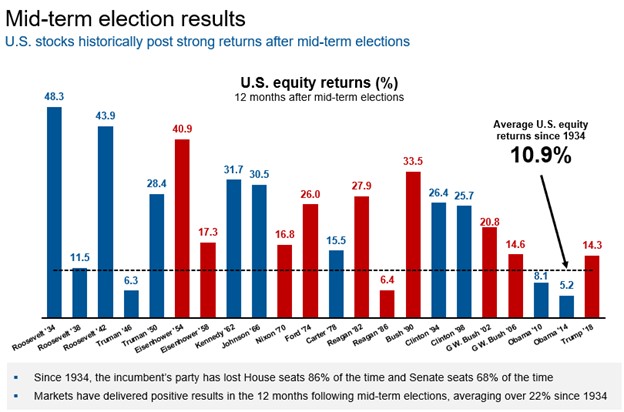
Historically, the U.S. stock market experiences heightened volatility leading up to midterm elections due to policy uncertainty. However, once the election concludes, markets have demonstrated a reliable tendency to rally sharply over the subsequent 12 months, regardless of which party wins control of Congress. This post-election relief rally is largely driven by the removal of political ambiguity and the historical tendency toward legislative gridlock.
What is the direct link between the debt ceiling and market liquidity?
When the U.S. approaches its statutory debt limit, the Treasury Department employs extraordinary measures, often drawing down its account at the Federal Reserve (the Treasury General Account or TGA). This temporary drawdown injects liquidity into the financial system. Once the debt ceiling is raised, the Treasury rebuilds its balance by issuing massive quantities of new debt, which aggressively drains liquidity from private financial markets and can cause short-term spikes in repo rates and Treasury yields.
Why do institutional investors prefer a divided government?
Institutional investors favor divided government because it acts as a structural restraint against radical fiscal expansion, sudden corporate tax code overhauls, and disruptive regulatory mandates. Gridlock provides corporate management teams with a predictable legislative environment, facilitating more accurate long-term capital allocation and enterprise valuation modeling.
How should portfolio managers adjust asset allocation ahead of midterm shifts?
Sophisticated portfolio managers implement multi-layered risk mitigation strategies, including increasing allocations to high-quality short-duration fixed income, rotating into defensive sectors with stable cash flows, and hedging against regulatory risk in heavily scrutinized industries such as technology, energy, and healthcare.
Future Outlook and Strategic Milestones
As the election cycle accelerates, market participants must look past political rhetoric and focus on measurable structural milestones. The primary indicators to monitor over the next two quarters include congressional budget committee markups, Treasury quarterly refunding announcements, and Federal Reserve balance sheet normalization velocity. Enterprise leaders and institutional investors who successfully navigate this transition will be those who decouple short-term noise from structural fiscal realities.
Ultimately, while the midterm elections will introduce acute pockets of volatility across equity and debt markets, the underlying resilience of global capital structures remains tied to corporate earnings power, technological innovation, and disciplined capital allocation. Wall Street will continue to price risk dynamically, rewarding entities that maintain operational agility in the face of shifting political tides.


