Executive Takeaways
- 80% Operational Cost Reduction: Nvidia has deployed proprietary software optimizations across its TensorRT-LLM and Megatron-LM libraries, slashing the operational cost of serving DeepSeek V4 on Blackwell GPUs fivefold.
- Software as the Ultimate Moat: This milestone shifts the competitive frontier from raw silicon manufacturing to software-hardware co-design, solidifying Nvidia’s market-dominant position against merchant silicon and in-house hyperscaler ASICs.
- Disruption of Proprietary SaaS Models: By lowering the cost of hosting frontier-grade open-weights models to historic lows, the financial feasibility of self-hosting escalates, directly threatening the high-margin subscription models of closed-source AI vendors.
- Capital Allocation Optimization: Hyperscalers and venture-backed enterprises can now dramatically improve their infrastructure scalability and enterprise ROI, resetting valuation multiples for AI-native platforms.
The Catalytic Event: Software Rewrites the Marginal Cost of Inference
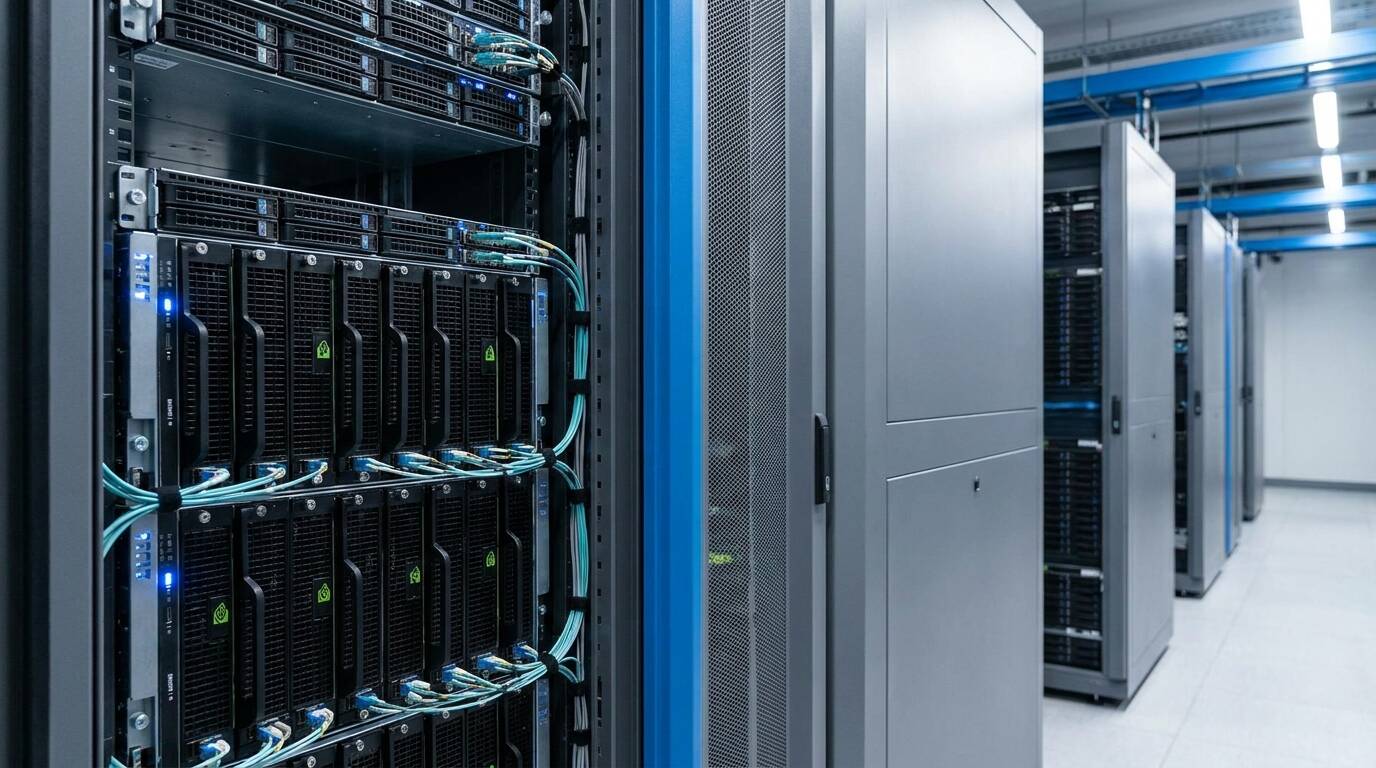
On July 1, 2026, Nvidia quietly redrew the battle lines of the global artificial intelligence arms race. In a technical release detailing system-level performance gains on its flagship Blackwell architecture (GB200/B200), the silicon giant announced that targeted software optimization pipelines had reduced the token-serving cost of DeepSeek V4 by a factor of five. This development comes at a critical juncture for global financial markets, where institutional investors have increasingly demanded proof of enterprise ROI following multi-billion-dollar capital expenditure programs across global datacenters.
DeepSeek V4—the latest iteration of the highly disruptive Chinese open-weights model family—has gained rapid traction among enterprises looking to bypass the expensive API structures of proprietary closed-source developers. However, running an ultra-large-scale Mixture-of-Experts (MoE) model has historically posed severe operational challenges, primarily due to the massive communication overhead required when routing tokens across distributed GPU clusters. By optimizing memory-bandwidth bottlenecks and compute utilization via software, Nvidia has effectively executed a massive supply-side shock to the marginal cost of intelligence.
This breakthrough is not the result of physical hardware upgrades, but rather the culmination of advanced compiler techniques, specialized quantization math, and highly orchestrated networking topologies. The market implications are profound: high-performance AI execution is transitioning from an exotic, capital-constrained luxury to a highly optimized, high-volume commodity.
Anatomy of the Breakthrough: How the Software Stack Cut Costs
To understand the fivefold cost reduction, one must dissect the intersection of DeepSeek V4’s algorithmic architecture and Nvidia's Blackwell software-hardware integration. DeepSeek V4 relies heavily on a sparse Mixture-of-Experts (MoE) architecture coupled with Multi-head Latent Attention (MLA). While MoE dramatically reduces the active parameter count per token—making computation theoretically cheaper—it introduces massive communication overhead as tokens are continually routed to specialized "experts" hosted on different physical GPUs.
Nvidia’s software breakthrough addresses this bottleneck through three distinct architectural pillars:
1. Native FP4 Quantization and the Blackwell Transformer Engine
The primary driver of memory compression and throughput acceleration is the deployment of native 4-bit floating-point (FP4) quantization pipelines. Leveraging the second-generation Transformer Engine built into Blackwell GPUs, Nvidia’s software dynamically scales precision. This allows the model’s weights and key-value (KV) caches to run at ultra-low precision without sacrificing model perplexity or reasoning accuracy. By shifting from FP8 to FP4, the model's memory footprint is halved, allowing larger batch sizes to fit within the ultra-fast High Bandwidth Memory (HBM3e) of a single Blackwell platform, reducing the physical node footprint required for deployment.
2. NVLink-Optimized Custom All-to-All Kernels
Under standard open-source execution engines, MoE expert routing triggers severe network congestion across GPUs. Nvidia’s updated software suite introduces proprietary CUDA kernels designed specifically for Blackwell’s NVLink Switch physical architecture, which delivers 1.8 TB/s of bidirectional bandwidth per GPU. The new software dynamically coalesces token routing requests, executing "All-to-All" communication primitives directly on the NVLink network processor. This virtually eliminates the idle GPU cycles previously spent waiting for inter-GPU data transfers to complete.
3. Intraday Dynamic Batching and Optimized KV Cache Management
By integrating advanced PageAttention algorithms directly into TensorRT-LLM, Nvidia has minimized memory fragmentation within the activation cache. Combined with real-time dynamic batching—which groups user requests of varying lengths on the fly—the system achieves exceptionally high Model Flops Utilization (MFU). The results are clear: hardware is kept running at peak thermodynamic and computational limits, squeezing more tokens out of every watt of electricity consumed.
Industry & Market Implications: Rebalancing the AI Value Chain
The business model of artificial intelligence is transitioning rapidly from speculative research to hard industrial economics. This 5x efficiency leap destabilizes several assumptions currently priced into technology equities and venture capital valuations.
The SaaS Margin Miracle vs. The Proprietary API Trap
For enterprise software-as-a-service (SaaS) companies, the massive reduction in the cost of open-weights models like DeepSeek V4 transforms unit economics. Previously, integrating LLM features meant paying hefty, recurring API fees to closed-source providers, severely compressing gross margins. By migrating workloads to self-hosted DeepSeek V4 models deployed on optimized Blackwell cloud compute architecture, enterprises can expand gross margins from the mid-50% range back to the historical software gold standard of 80%+. Consequently, companies that rely solely on wrapping third-party APIs face structural margin collapse unless they pivot their core infrastructure strategies.
Strategic Imperatives for Hyperscalers
For hyperscalers (Amazon Web Services, Microsoft Azure, Google Cloud Platform, and Meta), this software optimization acts as a powerful lever for capital allocation. Historically, there has been widespread concern that the capital expenditures poured into building hyper-scale datacenters would result in underutilized, low-yield assets. By multiplying the output capacity of existing Blackwell contracts fivefold via software updates, cloud providers can fulfill exponentially higher customer demand without immediately requiring capital-intensive physical expansions. This provides a crucial risk mitigation window, allowing hyperscalers to manage cash flows and secure energy resources without halting their infrastructure scaling plans.
Nvidia’s Fortified Software Moat
Many Wall Street analysts have argued that custom application-specific integrated circuits (ASICs) developed by cloud providers would eventually erode Nvidia’s near-monopoly. However, this development illustrates why raw silicon is only half the battle. Because Nvidia controls the entire CUDA ecosystem and can engineer deep, algorithmic-level compiler optimizations specifically for its proprietary architectures, it can deliver massive performance upgrades overnight via software downloads. ASICs, which often lack mature compiler ecosystems, struggle to keep pace with these rapid optimization cycles, keeping buyers locked into Nvidia's hardware-software ecosystem.
People Also Ask (FAQ)
How does Nvidia's software update achieve a 5x cost reduction for DeepSeek V4?
The fivefold cost reduction is achieved by combining FP4 quantization with the Blackwell Transformer Engine, which dramatically reduces the model’s memory footprint, allowing for larger batch sizes. Additionally, the update integrates custom "All-to-All" communication kernels that run directly on Blackwell’s 1.8 TB/s NVLink switch architecture. This significantly reduces the network latency and idle GPU time typically associated with sparse Mixture-of-Experts (MoE) models like DeepSeek V4.
What are the implications of this breakthrough for enterprise AI capital allocation and ROI?
By reducing token costs by 80%, the payback period for capital investments in Blackwell hardware drops from an estimated 14 months to just over 4 months. Enterprises and hyperscalers can scale their AI workloads and serve five times more traffic on the same physical infrastructure. This dramatically improves enterprise ROI, preserves liquidity, and reduces the risk of over-building physical datacenters before consumer demand fully matures.
How does this optimization affect the competitive dynamics between open-weights and closed-source models?
This breakthrough makes running high-performance, open-weights models like DeepSeek V4 drastically cheaper than paying for premium proprietary APIs. Organizations looking to maintain data sovereignty and lower operational costs now have a financially superior alternative to closed models. This pressure will likely force proprietary model developers to aggressively slash their prices, accelerating a price-to-zero race for standard cognitive compute tokens.
Is this 5x cost reduction applicable to older GPU architectures like Hopper (H100/H200)?
While some of the compiler and KV cache optimizations will provide minor performance benefits on Hopper GPUs, the full 5x cost reduction is highly dependent on hardware-specific features of the Blackwell architecture. These include native FP4 hardware execution units and the massive bandwidth of the second-generation NVLink Switch, which are not present in older architectures.
Future Outlook: The Industrialization of AI Inference
As we look toward the latter half of 2026 and the transition to Nvidia's next-generation "Rubin" architecture, the focus of the AI market will increasingly target systemic, operational efficiency. The low-hanging fruit of raw model parameter scaling is giving way to a disciplined era of hardware-software co-design. Software optimizations like those applied to DeepSeek V4 demonstrate that the future of AI profitability lies in computational efficiency, advanced quantization standards, and sophisticated compiler routing.
For executive decision-makers, the mandate is clear: capital allocation strategies must prioritize flexible, software-configurable compute environments over static hardware footprints. Organizations that can rapidly integrate these software breakthroughs will achieve unmatched operational leverage, driving superior market liquidity and valuation multiples. Meanwhile, those slow to adapt risk being crushed by the deflationary forces of optimized, open-source cognitive compute.
![The $79 Sovereign Chasm: Inside Canada’s Enterprise AI Seat Gap and the Battle Between Cohere, OpenAI, and Gemini [2026]](https://tech-insider.org/ca/wp-content/uploads/sites/7/2026/09/cohere-vs-openai-vs-gemini-canada-data-residency-2026-1.webp)