In a decisive victory for orbital asset management and deep-space commercialization, spacewalking astronauts have successfully installed and deployed the sixth and final International Space Station Roll-Out Solar Array (iROSA). The multi-year infrastructure overhaul boosts the station’s baseline power capacity by over 30%, securing operational viability through 2030 and laying the structural foundation for private commercial LEO destinations.
Executive Takeaways
Test Our Free AI & Tech Utilities Suite
Calculate LLM API token costs, analyze article dwell-time, or simulate tech DCA returns.
- Complete Grid Modernization: The successful deployment of the final iROSA unit concludes a multi-year, six-array installation strategy, increasing total ISS generation capacity from ~160 kilowatts to more than 215 kilowatts.
- Lifecycle Extension & Risk Mitigation: The upgrade counters two decades of natural solar cell degradation, preventing brownout constraints on critical microgravity payloads and life-support operations.
- Commercial Gateway Enabler: Additional wattage directly supports incoming private modules, notably Axiom Space’s commercial segment, transforming the station from a purely government laboratory into an economically viable commercial hub.
- Supply Chain & Capital Market Impacts: High-margin contracts awarded to prime contractor Boeing and sub-tier manufacturer Redwire Space (NYSE: RDW) validate the commercial viability of flexible roll-out structures in defense and satellite infrastructure.
The Orbital Infrastructure Bottleneck: Degraded Power and Expanding Payloads
For more than two decades, the International Space Station (ISS) relied on eight legacy rigid-panel solar wings deployed between 2000 and 2009. Designed with a 15-year operational lifespan, these original arrays suffered predictable structural and efficiency decay due to continuous exposure to atomic oxygen, micrometeoroid impacts, and extreme thermal cycling across 16 daily sun-to-shadow orbital transitions.
By 2020, total available power had degraded from a peak of nearly 250 kilowatts down to approximately 160 kilowatts. Concurrently, power demand from international research partners, commercial research facilities, and advanced life-support loops reached an all-time high. NASA and its international partners faced a compounding operational bottleneck: high-density payloads, high-throughput cloud compute nodes, and complex material synthesis experiments were competing for limited energy budgets.
To resolve this power crunch without undertaking the prohibitive cost and mass requirements of replacing the massive legacy arrays, NASA engineered a retrofitting solution. The agency contracted Boeing as prime system integrator, which partnered with Redwire Space to build compact, flexible roll-out arrays. Mounted directly in front of six legacy arrays, the new iROSA panels operate synergistically, utilizing existing rotary joints and power conversion units while allowing a portion of light to reach the functioning legacy cells behind them.
Execution in the Vacuum: Mechanics of the Final iROSA Installation
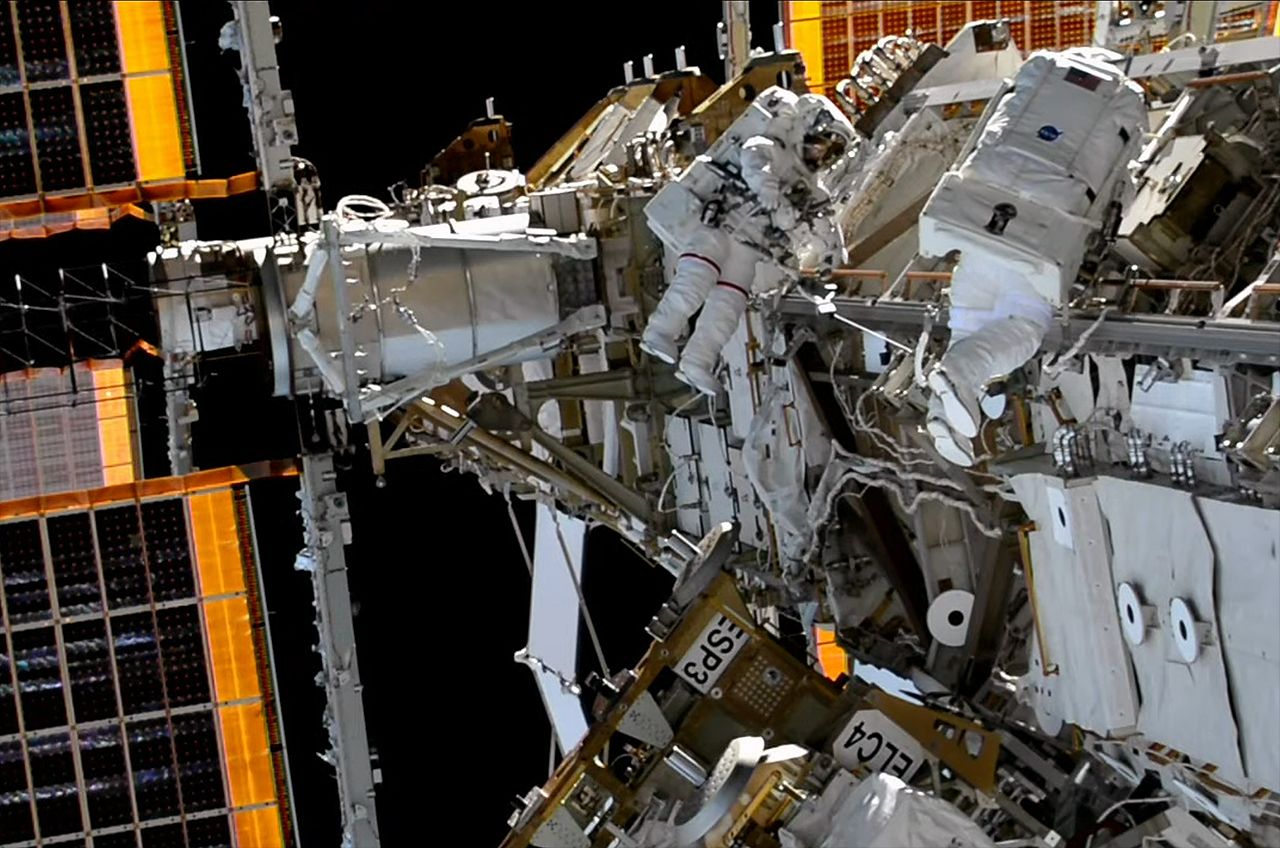
The execution of the final Extravehicular Activity (EVA) represented the culmination of years of orbital assembly planning. Working over seven hours in the vacuum of space, the spacewalking crew maneuvered the 750-pound rolled assembly out of the station’s truss segment using the Canadarm2 robotic arm.
The physical installation required surgical precision. Astronauts anchored the mounting bracket to the station’s 1B power channel structural truss, completed high-voltage electrical jumper connections, and released the mechanical retention pins holding the carbon-fiber composite booms. Unlike legacy rigid panels that required complex motorized hinges and mechanical deployment masts, iROSA relies on strain-energy composite structures. Once unpinned, stored mechanical energy in the composite legs allows the array to unroll autonomously without internal motors or external mechanical assistance.
Telemetry from Mission Control Houston confirmed instantaneous power flow following deployment. Voltage spikes across the 1B channel stabilized rapidly, confirming proper thermal equalization and structural rigidity across the array mast.
Engineering Architecture: Legacy Arrays vs. Next-Gen Roll-Out Systems
The transition from mechanical rigid arrays to flexible strain-energy roll-out structures marks a pivotal generational shift in aerospace engineering. The iROSA technology dramatically reduces launch mass and stowed volume while delivering vastly superior energy density per square meter.
By utilizing Spectrolab high-efficiency NeXt Triple Junction (XTJ) solar cells, the compact roll-out wings generate equal or greater energy compared to original panels four times their physical size. The non-intrusive mounting angle permits ongoing tracking relative to the sun via the station's Alpha and Beta Gimbal Assemblies, maximizing sun-pointing efficiency throughout the orbital plane.
Verified Data & Infrastructure Metrics Breakdown
| Metric / Feature | Legacy Solar Arrays (2000–2009) | iROSA Add-On System (Completed) | Net Upgrade / Total Capability |
|---|---|---|---|
| Total System Units | 8 Rigid Wing Assemblies | 6 Roll-Out Arrays Installed | 14 Arrays Operating (6 Hybrid Pairs) |
| Baseline Total Generation | ~160 kW (Degraded State) | +120 kW (Combined Generation) | 215 kW to 235 kW Continuous |
| Single Array Dimensions | 35m x 12m (115ft x 38ft) | 18.2m x 6m (60ft x 20ft) | 4x Smaller Stowed Footprint |
| Deployment Mechanism | Motorized Extendable Mast | Strain-Energy Carbon Fiber Booms | Zero-Motor Passive Deployment |
| Prime Contractors | Lockheed Martin / Boeing | Boeing / Redwire Space / Spectrolab | Public-Private Industrial Base |
| Operational Target Lifespan | 15 Years (Exceeded) | 10+ Years (Engineered for 2030+) | Extends Platform Life to 2030 |
Wall Street & Enterprise Implications: Valuations and LEO Commercialization
The successful completion of the grid upgrade serves as an operational de-risking event for institutional investors and defense contractors evaluating low-Earth orbit (LEO) infrastructure. The immediate capital allocation impact spans several key domain areas:
1. Defense & Space Infrastructure Multiples
For prime contractors like Boeing (NYSE: BA) and specialized space infrastructure providers like Redwire Corporation (NYSE: RDW), the flawless execution of the iROSA program provides a battle-tested reference architecture. Redwire's proprietary roll-out solar technology is already being adapted for satellite constellations, military orbital platforms, and NASA's Lunar Gateway. Successful execution enhances order-backlog visibility and strengthens margin expansion potential in their advanced space technology segments.
2. Axiom Space and Private Segment Integration
The additional 55+ kilowatts of net usable continuous energy removes a primary gating factor for commercial expansion. Houston-based Axiom Space, which is constructing a commercial module scheduled to attach to the station's forward port, requires reliable high-density power connections to run proprietary industrial fabrication labs, pharmaceutical crystallizers, and commercial spaceflight living quarters. Without this power boost, private module integration would have forced severe power-rationing protocols across international partners.
3. De-risking Commercial LEO Destinations (CLD)
NASA's long-term strategy relies on transitioning operations from the government-owned ISS to privately operated platforms (such as Starlab Space, Blue Origin's Orbital Reef, and Axiom Station) by 2030. The field-testing of low-mass, high-density roll-out energy systems lowers projected capital expenditure (CapEx) requirements for these planned commercial stations, optimizing payload density ratios and driving down cost-per-watt metrics for future orbital lab operators.
Frequently Asked Questions (People Also Ask)
Why was the solar array upgrade necessary if the ISS is retiring around 2030?
While NASA and its international partners plan to transition operations to private commercial stations near 2030, maintaining full power capacity over the remaining years is critical. Legacy arrays were degrading by roughly 1% annually, creating power deficits that threatened scheduled microgravity research, advanced computing tests, and the power requirements of incoming private commercial modules. The upgrade ensures maximum facility utilization through its final operational window.
How do the new iROSA arrays work alongside the old arrays?
The six iROSA arrays are mounted directly in front of six of the eight original, larger legacy solar wings. Because iROSA panels are narrower and shorter than the original wings, they do not completely cover the legacy arrays. The unshaded portions of the old arrays continue to generate power, which is combined with the output of the new high-efficiency iROSA arrays to deliver up to 30% more overall power to the station's electrical bus.
Who built the iROSA solar arrays and what technology do they use?
The iROSA system was managed by prime contractor Boeing, with array design and structural fabrication executed by Redwire Space (Deployable Space Systems). The photovoltaic cells were supplied by Spectrolab, a Boeing subsidiary, utilizing NeXt Triple Junction (XTJ) solar cell technology. The arrays deploy passively using flexible, composite carbon-fiber booms that unroll like a tape measure via stored strain energy, eliminating complex motor mechanics.
What does this power upgrade mean for commercial research on the space station?
The addition of over 55 kilowatts of net generation opens capacity for power-intensive commercial operations, including in-space semiconductor manufacturing trials, fiber-optic cable drawing in microgravity, complex pharmaceutical protein crystallization, and high-performance orbital computing nodes. It also guarantees sufficient power redundancy for private commercial modules planning to dock with the station.
Strategic Outlook: The Road to 2030 and Orbital Grid Scalability
With the completion of the sixth iROSA deployment, NASA and its international partners have resolved the space station's primary infrastructure operational bottleneck. The upgraded power architecture provides an uninterrupted, high-margin energy budget capable of supporting continuous scientific research, international crew operations, and commercial platform testing through the end of the station’s operational life.
More significantly, the flight proven reliability of flexible roll-out energy architecture reshapes the economics of space operations. As aerospace contractors pivot