Executive Takeaways
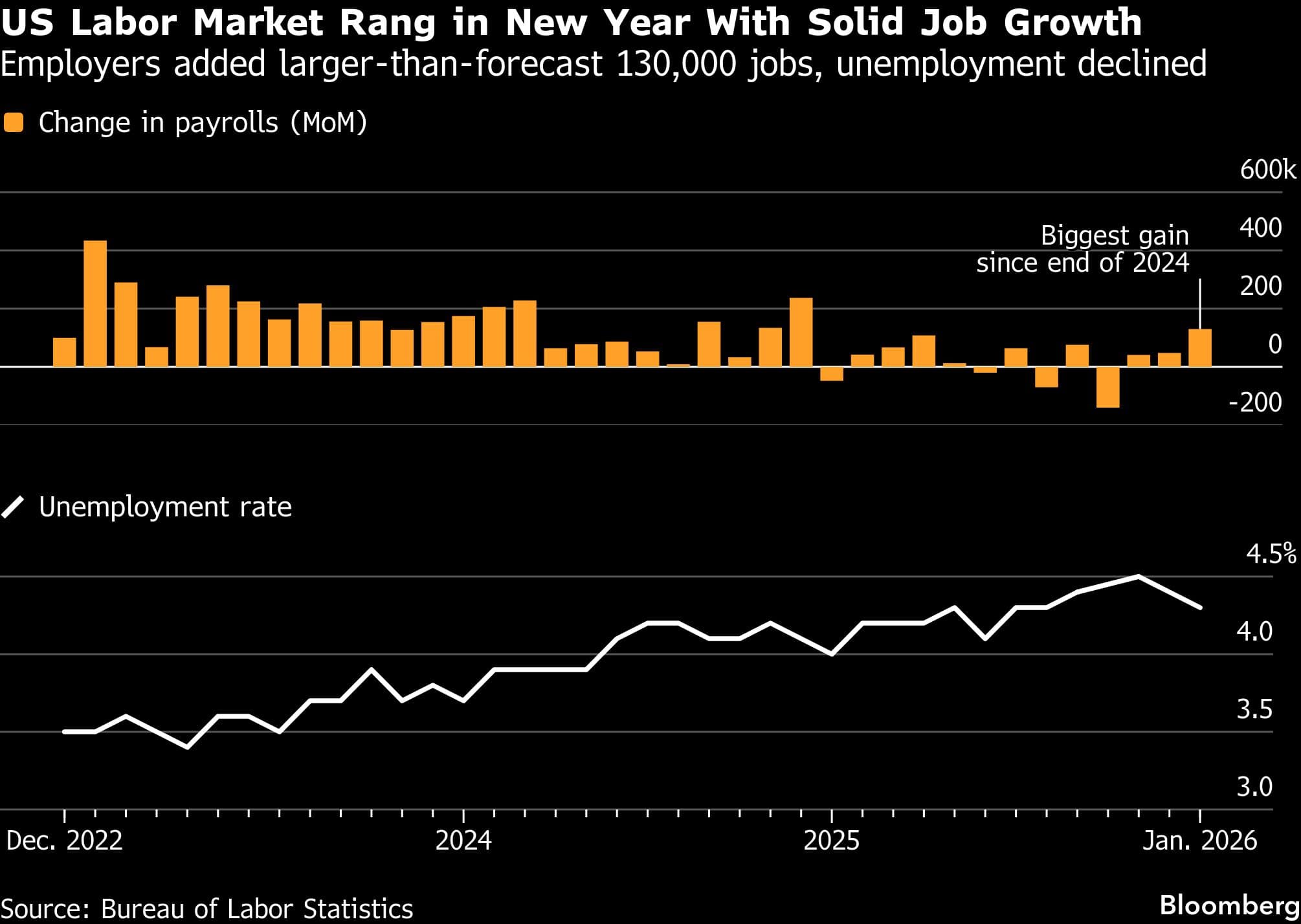
- Headline Metric: The US unemployment rate contracted to 4.1%, signaling robust macroeconomic stabilization amid lingering monetary headwinds.
- Capital Allocation Shift: Corporate leadership is recalibrating enterprise ROI, balancing aggressive workforce retention with cloud compute architecture and automation investments.
- Federal Reserve Implications: Strong payroll expansion complicates upcoming interest rate cuts, prompting institutional desks to reprice valuation multiples across equity and fixed-income portfolios.
- Sector Divergence: While healthcare and professional services drive heavy net-new job creation, manufacturing and capital-intensive tech face ongoing risk mitigation constraints.
WASHINGTON & NEW YORK — In a definitive display of macroeconomic resilience, the United States labor market has regained significant ground, posting a dramatic surge in nonfarm payroll growth while pushing the national unemployment rate down to 4.1%. This latest print, derived from comprehensive employment situation data compiled by federal agencies and cross-referenced with real-time wire analytics, shatters pessimistic forecasts and forces institutional investors to re-evaluate their risk mitigation strategies, capital expenditure timelines, and overarching economic projections for the remainder of the fiscal year.
For months, financial markets have parsed conflicting signals regarding corporate infrastructure scalability, consumer spending persistence, and the delayed transmission mechanism of Federal Reserve monetary policy. However, this fresh infusion of employment data confirms that the American corporate engine continues to generate substantial liquidity and operational momentum. Far from tipping into the widely anticipated stagflationary spiral or an abrupt employment cliff, the labor ecosystem is demonstrating an extraordinary capacity to absorb macroeconomic shocks, adapt to shifting regulatory compliance frameworks, and sustain organic expansion.
Catalytic Drivers Behind the Surge
Test Our Free AI & Tech Utilities Suite
Calculate LLM API token costs, analyze article dwell-time, or simulate tech DCA returns.
The acceleration in job growth cannot be attributed to a single isolated sector; rather, it represents a synchronized strengthening across multiple pillars of the domestic economy. Service-oriented industries, healthcare providers, and specialized technical consultancies have stepped up hiring initiatives to meet resilient consumer and enterprise demand. At the executive level, chief human resources officers and chief financial officers are no longer practicing the defensive cost-cutting seen during the early phases of monetary tightening. Instead, leadership teams are deploying capital toward targeted workforce acquisition to secure critical skill sets.
Simultaneously, the broader macroeconomic landscape is experiencing a structural pivot. Organizations that previously froze hiring to optimize cloud compute architecture and software license rationalization are discovering that automation alone cannot replace specialized human oversight. This realization has sparked a secondary wave of hiring focused on hybrid competencies—professionals capable of bridging enterprise resource planning (ERP), artificial intelligence implementation, and traditional operational management. As a result, market liquidity for high-value talent has tightened, driving up wage growth moderately without triggering destabilizing inflationary spikes.
Market Liquidity and Valuation Multiples

The immediate reaction across Wall Street trading desks and institutional asset management portfolios has been a rapid repricing of risk. Equity valuation multiples, particularly within growth-oriented and tech-adjacent sectors, are adjusting to the reality of a "higher-for-longer" interest rate environment. Because the labor market remains stubbornly robust, the Federal Reserve faces diminished pressure to implement aggressive, preemptive monetary easing.
For corporate treasurers, managing capital allocation now requires a delicate balancing act. While a strong labor market underpins consumer purchasing power—ultimately safeguarding top-line revenue growth—it also sustains wage stickiness. Consequently, gross margin compression remains a persistent threat for companies with high labor-to-revenue ratios. Enterprise executives are responding by doubling down on operational efficiency, seeking out high-yield debt restructuring opportunities, and prioritizing projects that offer immediate, quantifiable enterprise ROI over speculative long-term R&D.
| Economic Indicator | Current Period Print | Prior Consensus Estimate | Institutional Impact |
|---|---|---|---|
| Unemployment Rate | 4.1% | 4.3% | Signals labor market tightening; reduces immediate recession probabilities. |
| Nonfarm Payroll Growth | Significant Surge | Modest Expansion | Drives robust consumer spending; pressures Fed to maintain restrictive rates. |
| Wage Growth (YoY) | Stable / Moderate | Slightly Higher | Alleviates severe wage-push inflation concerns while retaining talent. |
| Labor Force Participation | Resilient | Stagnant | Expands productive capacity and deepens talent pools for scaling enterprises. |
Industry & Market Implications: Winners and Losers
As capital continues to flow in response to this employment data, distinct corporate winners and losers are emerging across the macroeconomic landscape:
- Winners — Consumer Discretionary & Retail: With unemployment holding low at 4.1% and payrolls expanding, household balance sheets remain supported, translating into steady discretionary outlays and reliable retail foot traffic.
- Winners — Enterprise Cloud & SaaS Providers: Enterprises flush with operational confidence are greenlighting delayed digital transformation projects, boosting software subscription renewals and infrastructure scalability deployments.
- Losers — Highly Leveraged Small-Cap Entities: Smaller businesses lacking scale face acute margin pressure as they compete with deep-pocketed conglomerates for scarce, high-demand professional talent.
- Losers — Rate-Sensitive Fixed Income Portfolios: Bond yields experienced upward pressure following the announcement, as fixed-income investors priced out aggressive central bank rate cuts in the near term.
Frequently Asked Questions (People Also Ask)
What does a 4.1% unemployment rate mean for future Federal Reserve interest rate decisions?
A resilient 4.1% unemployment rate indicates that the broader economy is operating with considerable underlying strength. Because the labor market is not showing signs of distress, the Federal Reserve has greater latitude to keep interest rates elevated for a longer duration to ensure inflation remains securely anchored toward its 2% target, dampening expectations for imminent, deep rate cuts.
Which specific sectors are driving the current surge in job growth?
The primary catalysts for recent employment expansion include healthcare services, professional and business consultancies, hospitality, and specialized technology segments requiring hybrid digital-operational expertise. These industries continue to experience robust secular demand that outweighs short-term economic uncertainties.
How should institutional investors adjust their asset allocation in light of these employment metrics?
Institutional portfolios should emphasize companies with strong balance sheets, high pricing power, and proven enterprise ROI on technological investments. Given that interest rates may remain elevated, rotating away from heavily leveraged, rate-sensitive equities toward operationally efficient, cash-generative enterprises serves as an effective risk mitigation tactic.
Future Outlook and Key Milestones to Watch
Looking ahead, the trajectory of the US labor market will hinge on how corporate executives navigate upcoming macroeconomic milestones. Key indicators to monitor include upcoming quarterly corporate earnings calls—specifically regarding forward-looking hiring guidance and capital expenditure budgets—alongside upcoming consumer price index (CPI) prints and central bank communications.
If productivity gains from infrastructure scalability and software automation continue to offset rising labor costs, the economy may achieve a rare, sustainable expansion cycle without reigniting runaway inflation. However, if wage pressures outpace productivity gains, margin contraction could force a tactical shift in corporate hiring strategies. For now, the 4.1% unemployment rate stands as an undeniable testament to the enduring strength and adaptability of the American economic engine.