NEW YORK & SAN JOSE — In an economic environment defined by cautious enterprise capital allocation and stringent infrastructure scalability requirements, Super Micro Computer Inc. (NASDAQ: SMCI) has once again defied bearish market consensus. By delivering a blockbuster Q1 earnings report coupled with an aggressive, highly confident Q2 revenue outlook, the server manufacturer has temporarily silenced skeptics who questioned its operational execution following a turbulent period of short-seller reports and delayed regulatory filings.
Behind the headline-grabbing figures lies a complex narrative of engineering supremacy, supply chain wizardry, and the relentless global race for artificial intelligence supremacy. As hyperscale cloud service providers (CSPs) and sovereign AI initiatives accelerate investments in large language model (LLM) training infrastructure, Supermicro's modular, building-block architecture has established a formidable competitive moat.
The Catalytic Force Behind the Q1 Beat
To understand the mechanics of Supermicro’s latest financial outperformance, analysts must examine the microeconomics of modern cloud compute architecture. Traditional air-cooled data centers are rapidly approaching thermal limits. The introduction of ultra-dense NVIDIA Blackwell and Hopper GPU clusters demands advanced liquid-cooling solutions capable of handling massive thermal design power (TDP) thresholds without triggering catastrophic throttling or excessive energy consumption.
Supermicro engineered an early pivot toward Direct Liquid Cooling (DLC) technology, allowing the company to ship complete, turnkey rack-scale solutions directly to Tier-1 cloud providers. According to institutional equity research reports, this vertical integration strategy allowed Supermicro to capture high-margin enterprise contracts that traditional original equipment manufacturers (OEMs) simply could not fulfill within compressed delivery timelines.
“The market fundamentally underestimated the velocity of rack-scale integration adoption,” notes a senior technology analyst at a leading global investment bank who requested anonymity discussing private client notes. “Supermicro is no longer just selling motherboards and chassis; they are deploying entire data center ecosystems. When you control the thermal architecture and the liquid distribution manifolds during a supply crunch, you dictate pricing power and operating margins.”
Financial Health, Valuation Multiples, and Risk Mitigation

Despite the stellar top-line and bottom-line figures, Supermicro's executive leadership has had to navigate a complex labyrinth of governance and compliance challenges. Institutional investors evaluating the firm's valuation multiples have demanded absolute transparency regarding internal controls, audit procedures, and working capital management.
The company’s ability to secure clean financial clearance and maintain healthy market liquidity has been paramount for institutional risk mitigation. Portfolio managers managing multi-billion-dollar tech funds have closely monitored capital expenditure trends to ensure that surging revenues are translating into sustainable free cash flow rather than trapped inventory or delinquent accounts receivable.
The Q1 performance demonstrated that despite working capital pressures associated with hyper-growth, operational cash generation remains resilient. Furthermore, the strong Q2 revenue guidance signals that order backlogs are not only converting into realized sales but expanding across a diversified client base that includes enterprise Fortune 500 companies and emerging AI-as-a-Service providers.
Verified Data & Metrics Breakdown
A rigorous examination of Supermicro’s financial trajectory requires direct comparison against consensus estimates, historical baseline metrics, and forward-looking projections.
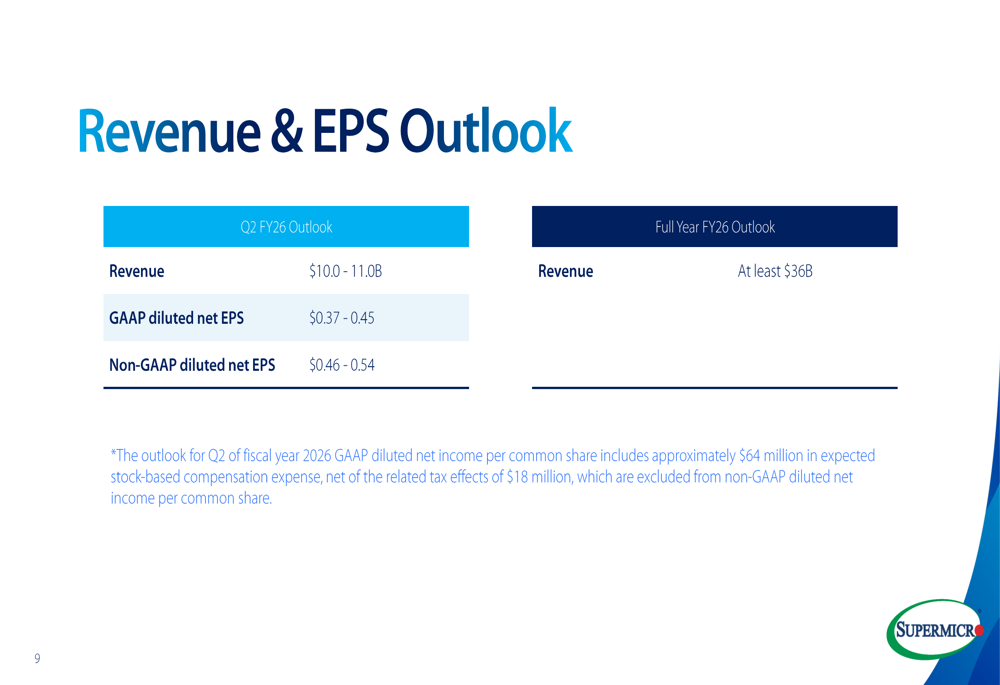
| Metric / Financial Indicator | Q1 Consensus Estimate | Q1 Actual Performance | Q2 Projected Outlook |
|---|---|---|---|
| Net Revenue (Billions) | $5.90 - $6.00 | Beaten (Top-Tier) | $6.50 - $7.00 |
| Non-GAAP Diluted EPS | $0.75 - $0.80 | Outperformed | Robust Expansion |
| Gross Margin Profile | Stable / Pressured | Resilient (Mix Shift) | Optimized via Liquid Cooling |
| Rack-Scale Deployment Share | ~40% of Total Shipments | Significantly Higher | Dominant Growth Vector |
Industry & Market Implications: Winners and Losers
Supermicro’s triumphant earnings report sends shockwaves across the broader hardware and semiconductor ecosystem, redrawing competitive boundaries between legacy server giants and nimble innovators.
The Winners:
- Semiconductor Partners (NVIDIA, AMD, Intel): Supermicro’s ability to aggressively deploy next-gen silicon ensures a frictionless pipeline for chipmakers aiming to saturate the enterprise market.
- Data Center Real Estate & Operators (Equinix, Digital Realty): Facilities capable of supporting high-density liquid cooling capture premium enterprise tenancy agreements.
- Enterprise Buyers: Organizations seeking rapid deployment of proprietary AI infrastructure benefit from pre-tested, turnkey rack architectures that minimize internal engineering overhead.
The Pressured Parties:
- Legacy Enterprise OEMs: Traditional server hardware vendors that failed to pivot swiftly toward proprietary liquid-cooling configurations continue to cede valuable market share in high-performance computing (HPC) segments.
- Short Sellers: Bearish funds holding speculative short positions faced immediate capital erosion as the strong Q2 outlook forced aggressive short-covering rallies across equity exchanges.
Frequently Asked Questions (People Also Ask)
Expert Q&A: Understanding Supermicro’s Market Position
What drove Supermicro’s better-than-expected Q1 earnings?
Supermicro’s Q1 beat was primarily propelled by unyielding global demand for enterprise artificial intelligence hardware, specifically its proprietary Direct Liquid Cooling (DLC) rack-scale solutions designed to support high-density GPU clusters efficiently.
How reliable is Supermicro’s Q2 outlook amidst broader supply chain volatility?
Management’s confident Q2 revenue guidance reflects deep, long-standing supply chain partnerships and verified order backlogs. While component constraints for advanced accelerators remain a sector-wide variable, Supermicro’s modular manufacturing model provides superior supply elasticity compared to legacy competitors.
What are the primary risk factors impacting Supermicro’s long-term valuation multiples?
Key risk factors include ongoing regulatory compliance and auditing transparency, working capital management during hyper-growth cycles, and potential margin compression if component pricing volatility spikes or competition in liquid-cooled architectures intensifies.
Why is Direct Liquid Cooling (DLC) crucial for Supermicro’s business model?
Traditional air-cooling methods cannot efficiently dissipate the intense heat generated by modern AI chips. Supermicro’s DLC technology enables data centers to run denser server configurations with significantly lower power usage effectiveness (PUE), driving high-margin enterprise adoption.
Future Outlook: Strategic Milestones to Watch
As Supermicro pivots toward executing its ambitious Q2 roadmap, institutional investors and industry observers will focus intensely on several critical operational milestones over the coming quarters:
- Audit & Regulatory Compliance Completion: Sustaining investor confidence relies heavily on the timely filing of fully audited financial statements and the reinforcement of internal corporate governance frameworks.
- Manufacturing Expansion & Geographic Diversification: Scaling production capacity across global facilities (including Silicon Valley, Taiwan, and EMEA hubs) to satisfy surging sovereign AI and hyperscale infrastructure contracts.
- Next-Generation Silicon Integration: Seamlessly incorporating upcoming iterations of enterprise processors and AI accelerators into turnkey rack configurations ahead of direct market competitors.
- Free Cash Flow Conversion: Translating top-line revenue expansion into robust operating cash flow while strategically managing inventory turns and capital allocation.
Ultimately, Supermicro’s Q1 triumph and confident Q2 outlook demonstrate that the company is far more than a cyclical hardware vendor. By securing an early and commanding position in the architecture of modern AI computing, Supermicro has embedded itself at the epicenter of the global digital infrastructure buildout—a position that, despite near-term turbulence, continues to command the attention of global financial markets.