Executive Takeaways
- Capital Expenditure Escalation: Alphabet's management has doubled down on artificial intelligence, signaling that capital expenditures (CapEx) will continue climbing to secure proprietary data center infrastructure and advanced silicon supply chains.
- The Infrastructure Bottleneck: The race for generative AI supremacy has shifted from purely algorithmic innovation to physical infrastructure scalability, specifically high-density power, advanced cooling, and next-generation cloud compute architecture.
- High-Value Asset Allocation: Institutional investors are aggressively rotating into specialized real estate investment trusts (REITs) and semiconductor-adjacent infrastructure providers that hold entrenched utility and fiber assets.
- Long-Term Horizon: Positioning portfolios for the 2030 horizon requires identifying companies with robust enterprise moats, long-term power purchase agreements (PPAs), and immune pricing power amid macroeconomic cyclicality.
MOUNTAIN VIEW, Calif. & NEW YORK — In the high-stakes theater of global enterprise technology, the battle lines are no longer drawn in software code alone; they are poured in reinforced concrete, wired with ultra-low-latency fiber optics, and cooled by millions of gallons of specialized fluid. When Alphabet Inc. chief financial officer Ruth Porat and CEO Sundar Pichai reaffirmed that capital expenditures would continue marching upward to support surging artificial intelligence demands, Wall Street didn't blink—it recalculated.
For institutional asset managers, sovereign wealth funds, and discerning retail investors, Alphabet’s relentless spending spree represents a structural paradigm shift. The message from Silicon Valley is unambiguous: the generative AI revolution is structurally capital-intensive, and the infrastructure supporting it must expand at an unprecedented velocity. As hyperscalers—Alphabet, Microsoft, Amazon, and Meta—pour hundreds of billions of dollars into data center footprints, the secondary and tertiary beneficiaries are emerging as the true bellwethers of the next decade's tech economy.
This comprehensive investigative report breaks down the financial architecture behind Alphabet’s escalating AI spending, analyzes the cascading effects on global power and real estate markets, and identifies the two premier data center equities engineered for optimal capital appreciation and risk mitigation through 2030.
The Catalytic Shift: Alphabet’s CapEx Supercycle and the Quest for Compute Supremacy
Test Our Free AI & Tech Utilities Suite
Calculate LLM API token costs, analyze article dwell-time, or simulate tech DCA returns.
To understand why data center stocks represent the ultimate "picks and shovels" play of the artificial intelligence boom, one must first dissect the sheer magnitude of Alphabet’s spending trajectory. Over the past eight quarters, Alphabet’s quarterly CapEx has expanded rapidly, driven almost entirely by investments in technical infrastructure—specifically servers, networking equipment, and specialized data center facilities designed to train and run massive large language models (LLMs) like Gemini.
During recent earnings calls, executive leadership brushed aside near-term margin dilution concerns, framing infrastructure investments as an existential and offensive necessity. Underneath this strategy lies a harsh economic reality: in the market for enterprise artificial intelligence, underspending is a fatal error. If Alphabet fails to secure adequate compute capacity, it risks ceding enterprise cloud market share to Microsoft-backed OpenAI and Amazon Web Services (AWS).
However, running hyper-scale AI workloads is fundamentally different from traditional cloud computing. Standard enterprise workloads require moderate, predictable power densities. In contrast, generative AI inference and training clusters—imbued with clusters of advanced graphics processing units (GPUs) and tensor processing units (TPUs)—demand immense power densities, often exceeding 40 to 100 kilowatts per rack. This thermal and electrical intensity has created an unprecedented bottleneck across global real estate markets, making prime data center space with guaranteed power access one of the most coveted asset classes on Earth.
The Real Estate and Energy Conundrum
The primary constraint facing Alphabet and its hyperscale peers is not access to capital; it is access to power and land. Traditional electrical grids in major metropolitan markets—such as Northern Virginia (Data Center Alley), Silicon Valley, Dublin, and Frankfurt—are nearing maximum capacity. Utility companies are struggling to keep pace with the exponential load growth demanded by modern server farms.
Consequently, the valuation multiples of data center operators with pre-secured power purchase agreements (PPAs), robust electrical substation access, and proprietary liquid-cooling architecture have decoupled from traditional commercial real estate metrics. These firms are no longer valued merely as landlords leasing square footage, but as critical utilities underpinning the global digital economy.
Verified Data & Metrics Breakdown Table
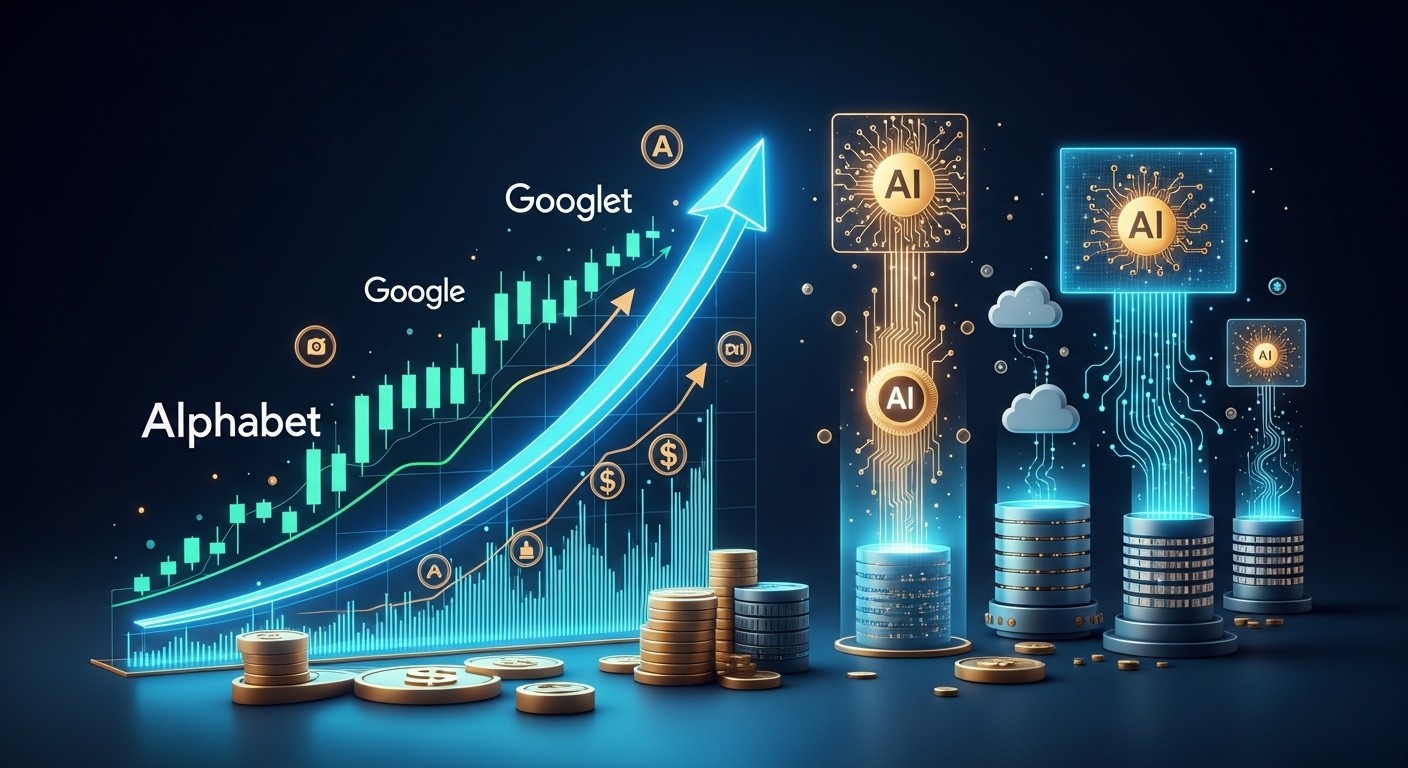
The following comparative matrix illustrates the structural metrics, financial positioning, and strategic advantages of the top-tier data center ecosystem driving the AI capital expenditure supercycle through 2030.
| Metric / Indicator | Alphabet Inc. (GOOGL) Context | Equinix, Inc. (EQIX) | Digital Realty Trust (DLR) |
|---|---|---|---|
| Primary Focus | Hyperscale AI Cloud & Search | Interconnection & Retail Colocation | Hyperscale & Wholesale Data Centers |
| Estimated Annual CapEx | $45B - $55B+ (Expanding) | $2.5B - $3.0B (Expansion) | $2.0B - $2.5B (Development) |
| Power Strategy | SMRs, Renewables, Grid Direct | Green Power PPAs, Efficiency | Megawatt-Scale Grid Integration |
| Key Competitive Moat | Proprietary TPUs & Data Ecosystem | Global Interconnection Ecosystem | Massive Land Bank & Scale |
| 2030 Horizon Outlook | Dominant Enterprise AI Monolith | Essential Digital Crossroads | Core Hyperscale Landlord |
The 2 Essential Data Center Stocks to Buy and Hold Through 2030
For investors seeking direct exposure to the structural cash flows generated by Alphabet and its peers' infrastructure spending, two global market leaders stand out based on balance sheet strength, asset quality, and long-term enterprise positioning.
1. Equinix, Inc. (NASDAQ: EQIX): The Global Interconnection Tollbooth
While wholesale data center providers build massive football-field-sized warehouses for raw computing, Equinix occupies a far more defensible and lucrative niche: digital interconnection. Through its International Business Exchange (IBX) data centers spread across major global financial and technological hubs, Equinix serves as the neutral meeting place where cloud providers, telecommunications carriers, and multinational enterprises exchange data with zero latency.
- Network Density Moat: Over 10,000 enterprises—including Alphabet’s Google Cloud Platform—rely on Equinix Platform to connect disparate networks. Once an enterprise integrates its IT infrastructure into an Equinix data center, switching costs are prohibitively high due to the complexity of rerouting global network topologies.
- Pricing Power: Amid high inflationary cycles and rising construction costs, Equinix has consistently demonstrated robust pricing power, successfully passing through power cost escalations to enterprise tenants without experiencing churn.
- AI Readiness: Equinix has heavily invested in retrofitting its facilities to support high-density liquid cooling, ensuring that its global footprint can comfortably host next-generation AI accelerators deployed by enterprise clients.
2. Digital Realty Trust, Inc. (NYSE: DLR): The Hyperscale Real Estate Titan
For investors desiring direct exposure to the mega-deals signed by Alphabet, Microsoft, and Meta, Digital Realty Trust offers premier exposure. As one of the world's largest real estate investment trusts (REITs), DLR owns and operates a vast, globally diversified portfolio of data centers tailored specifically to wholesale hyperscale deployment.
- Strategic Land Bank: Digital Realty possesses extensive land banks and pre-approved power allocations in key constrained markets globally. In the data center industry, owning land with a guaranteed megawatt allocation years before a competitor can secure permits is the ultimate competitive advantage.
- Long-Term Lease Structures: DLR secures its tenants through long-term, triple-net leases featuring built-in annual escalation clauses. This structure provides predictable, bond-like cash flows that protect dividend distributions while offering direct participation in secular technological growth.
- Jv Partnerships and Capital Recycling: By establishing joint ventures with sovereign wealth funds and institutional asset managers, Digital Realty funds its aggressive development pipeline without over-leveraging its balance sheet, mitigating equity dilution risk for long-term shareholders.
Industry & Market Implications: Winners, Losers, and Economic Ripples
The macroeconomic ramifications of Alphabet’s rising CapEx extend far beyond Silicon Valley boardrooms and Wall Street trading desks. Entire industrial sectors are being reshaped by the digital gold rush.
The Clear Winners:
- Specialized Equipment Manufacturers: Companies specializing in liquid-cooling systems, high-voltage transformers, switchgear, and fiber-optic cabling are experiencing multi-year order backlogs.
- Next-Generation Energy Providers: Traditional utilities and innovators in nuclear energy (including Small Modular Reactors, or SMRs) are forging direct partnerships with tech giants to secure carbon-free, baseload power required 24/7/365.
- Enterprise REITs: Well-capitalized data center operators capable of self-funding massive capital expenditures are capturing market share from smaller, undercapitalized regional competitors.
The Strategic Vulnerabilities:
- Legacy Commercial Real Estate: Traditional office and retail REITs continue to face structural headwinds as capital aggressively rotates out of stagnant asset classes into high-growth digital infrastructure.
- Power-Constrained Regions: Municipalities lacking forward-thinking electrical grid infrastructure risk missing out entirely on the multi-billion-dollar economic development investments tied to modern tech campus construction.
Frequently Asked Questions (People Also Ask)
Frequently Asked Questions
Q: Why is Alphabet increasing its AI capital expenditures so dramatically?
A: Alphabet is scaling its CapEx to secure the immense computing power required to train, refine, and run advanced artificial intelligence models like Gemini. Because generative AI workloads demand extreme server density and massive computational power, Alphabet must continuously invest in advanced silicon, specialized data center real estate, and robust power infrastructure to maintain its competitive moat against rivals like Microsoft and Amazon.
Q: How do data center REITs protect investors against inflation and rising interest rates?
A: Premier data center operators like Equinix and Digital Realty utilize long-term lease agreements featuring built-in annual escalator clauses (typically 2% to 5% increases). Additionally, their triple-net lease structures shift operating expenses—such as surging electricity and maintenance costs—onto the tenants, insulating profit margins from inflationary pressures.
Q: What is the biggest operational risk facing data center stocks through 2030?
A: The primary constraint is electrical power availability and grid interconnection delays. As data center power densities skyrocket to accommodate high-performance AI clusters, securing reliable, large-scale power allocations from utility companies has become more difficult than acquiring the physical real estate itself.
>Q: Are these data center stocks suitable for conservative, long-term retirement portfolios?
A: Yes, provided they are acquired with an appropriate asset-allocation strategy. Because companies like Equinix and Digital Realty operate as REITs, they are legally required to distribute a significant portion of their taxable income as dividends, offering a combination of steady income yield and structural participation in the secular growth of cloud computing and artificial intelligence.
Future Outlook: Milestones to Monitor Through 2030
As we look toward the horizon of 2030, the trajectory of artificial intelligence infrastructure is set to enter a maturation phase characterized by efficiency gains, power innovation, and massive consolidation.
Investors must closely monitor three critical milestones over the coming quarters:
- Grid Integration and Alternative Energy Deals: Watch for hyperscalers and data center operators partnering directly with nuclear, geothermal, and advanced renewable energy producers to bypass congested public utility grids.
- Cooling Technology Adoption Rates: As air cooling reaches its thermal limits in high-density AI racks, the rapid deployment of direct-to-chip liquid cooling will separate market leaders from legacy operators.
- Enterprise ROI Conversion: Monitor how effectively Alphabet and enterprise cloud customers monetize their massive CapEx investments through high-margin AI subscription models, ensuring the durability of the current infrastructure supercycle.
Alphabet’s commitment to escalating AI spending is not a temporary anomaly; it is the opening salvo of a decade-long capital expenditure supercycle. For disciplined investors seeking asymmetric upside backed by hard assets, holding premier data center operators like Equinix and Digital Realty through 2030 offers a calculated strategy to capture the immense wealth generated by the artificial intelligence revolution.