Executive Takeaways
Test Our Free AI & Tech Utilities Suite
Calculate LLM API token costs, analyze article dwell-time, or simulate tech DCA returns.
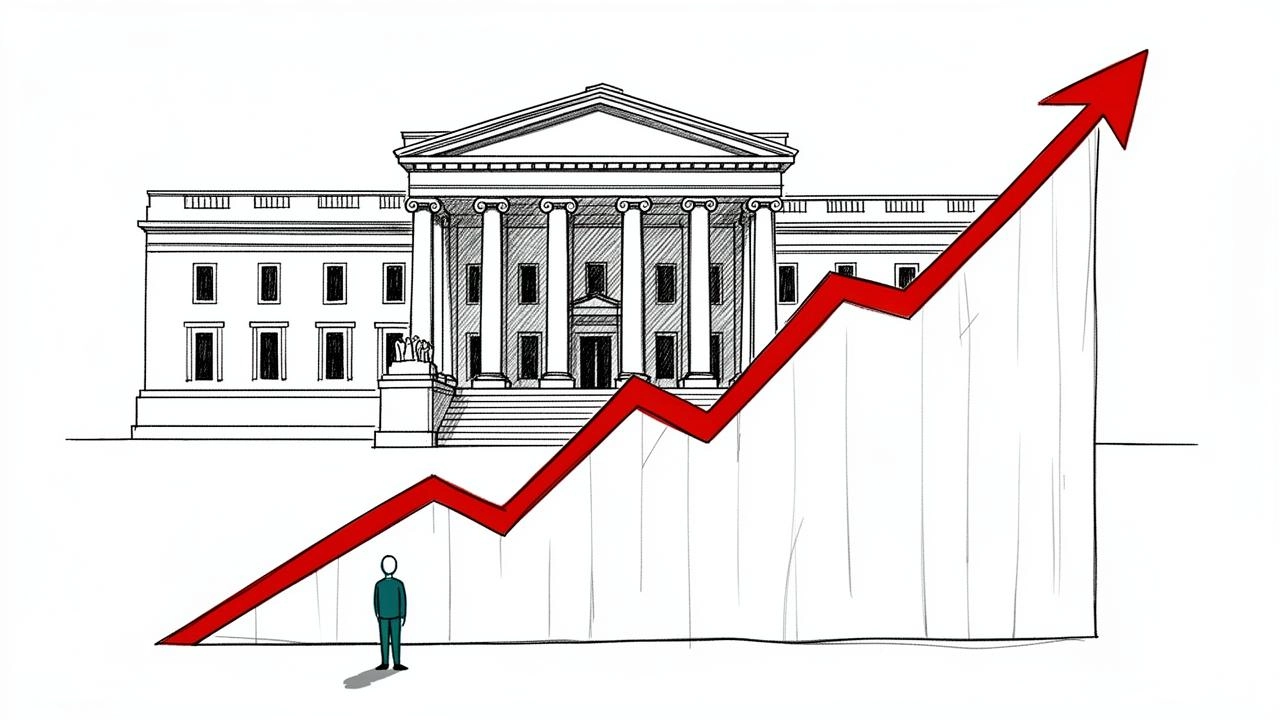
- Refinancing Wall Crisis: Long-term U.S. Treasury yields have breached critical resistance levels as the federal government faces a massive rollover wave of low-coupon pandemic-era debt, threatening to push annual net federal interest expense past $1.2 trillion.
- Dealer Balance Sheet Strain: Primary dealer absorption capacity is reaching leverage limits under current regulatory frameworks, worsening auction "tails" and increasing volatility across sovereign benchmark yield curves.
- Enterprise Capital Squeeze: The surge in risk-free benchmark rates has elevated the Weighted Average Cost of Capital (WACC) across Fortune 500 enterprises, forcing sharp reductions in capital expenditure, cloud compute infrastructure expansion, and corporate share buybacks.
- Structural Portfolio Reallocation: Institutional asset managers are executing sweeping capital allocation pivots, shifting out of long-duration sovereign paper into private credit, high-grade short-duration cash equivalents, and inflation-hedged real assets.
The Fiscal Trap: How Long-Term Yields Exposed Washington's Debt Structure

On August 24, 2026, global capital markets confronted a stark reality that institutional fixed-income trading desks had been pricing in for months: the cost of servicing the United States' $36.2 trillion gross national debt has reached an inflection point. Long-dated Treasury yields—specifically the benchmark 10-year note and 30-year bond—have broken out to high-conviction levels, driven not by cyclical inflation spikes, but by the relentless supply of new debt required to fund expanding federal deficits.
For more than a decade, Washington benefited from historically suppressed interest rates, enabling the U.S. Department of the Treasury to issue debt with sub-2% coupons. However, as those low-yielding obligations reach maturity across the 2026–2027 fiscal window, the Treasury must refinance hundreds of billions of dollars per quarter at prevailing rates hovering well above 5.00%. This structural repricing creates a compounding feedback loop: higher yields inflate government debt servicing costs, expanding the deficit, which in turn demands even larger Treasury auction sizes.
The Congressional Budget Office (CBO) and financial market analysts warn that net annual interest payments are rapidly outpacing the national defense budget and threatening discretionary spending allocations. Unlike previous yield spikes driven by aggressive Federal Reserve monetary tightening, the 2026 yield surge is structural, fueled by an expanding "term premium"—the extra compensation institutional investors demand for holding long-duration sovereign paper in the face of structural fiscal expansion.
Anatomy of Market Friction: Auction Tails and Dealer Capacity Constraints
The friction points in funding America's fiscal posture are most evident at the primary dealer level. The 24 Wall Street institutions designated as primary dealers—obligated to participate directly in Treasury auctions—are encountering operational leverage constraints under current regulatory compliance standards, including the Supplementary Leverage Ratio (SLR).
During recent 10-year note and 30-year bond auctions, primary dealers were forced to absorb an uncharacteristically high percentage of supply as foreign sovereign appetite continued its decade-long structural decline. Central banks in Tokyo and Beijing, historically the largest foreign holders of U.S. debt, have curtailed purchases due to domestic yield normalization policies and geopolitical reserve diversification strategies.
This dynamic has manifested in consistent auction "tails"—where the final high yield awarded at auction exceeds the pre-auction "when-issued" yield—indicating weak end-user demand. To bridge the gap, hedge funds engaged in basis trades (leveraging small price discrepancies between cash Treasuries and Treasury futures) have become the marginal buyers. However, this private capital is notoriously hot; if repo market liquidity tightens or volatility spikes, these leveraged positions unwinding can rapidly amplify market dislocation.
Data & Metrics Breakdown: US Sovereign Debt & Yield Evolution
The structural transformation of the U.S. sovereign debt market over the past three years underscores the escalating scale of federal financing requirements and its systemic impact on global asset markets:
| Financial Metric / Market Benchmark | CY 2024 | CY 2025 | August 2026 (Current) | Two-Year Structural Shift |
|---|---|---|---|---|
| Total U.S. Gross Public Debt | $34.20 Trillion | $35.15 Trillion | $36.25 Trillion | +$2.05 Trillion (+6.0%) |
| 10-Year Treasury Yield (Benchmark) | 4.15% | 4.55% | 5.12% | +97 Basis Points |
| 30-Year Treasury Yield (Long Bond) | 4.30% | 4.75% | 5.38% | +108 Basis Points |
| Net Annual Federal Interest Cost | $882 Billion | $1.02 Trillion | $1.21 Trillion | +$328 Billion (+37.2%) |
| Federal Debt-to-GDP Ratio | 121.8% | 123.5% | 126.1% | +4.3 Percentage Points |
| Average 10Y Auction Tail Spread | 0.8 bps | 1.6 bps | 3.4 bps | +2.6 Basis Points |
Corporate America Feels the Squeeze: Capital Allocation and Enterprise ROI
The yield surge in risk-free sovereign debt filters directly through the broader capital stack, raising borrowing costs for non-financial corporations, commercial real estate developers, and technology enterprises.
1. Compressed Valuation Multiples and Rising Hurdle Rates
Because the 10-year Treasury yield serves as the foundational risk-free rate in discounted cash flow (DCF) models, higher benchmark yields automatically elevate enterprise Weighted Average Cost of Capital (WACC). As discount rates rise, the present value of future earnings declines, forcing a broad contraction in equity valuation multiples, particularly for high-growth tech firms reliant on cash flows expected years in the future.
2. Capex Rationalization in High-Growth Tech
Large-scale technology firms, currently engaged in massive capital expenditure cycles to build out AI and cloud compute architecture, face stricter return-on-investment (ROI) thresholds. Datacenter buildouts, advanced semiconductor acquisitions, and energy infrastructure projects that were economically viable at a 3.5% hurdle rate are being re-evaluated or deferred as corporate bond yields approach 6.5% to 7.0%.
3. Commercial Real Estate and Corporate Debt Refinancing
A corporate refinancing wave is hitting the market as 5-year and 7-year syndicated loans and high-yield debt issued during the low-rate environment of 2021 mature. Companies unable to pass along higher debt servicing costs through pricing power face debt restructurings, balance sheet de-leveraging, or reduced capital allocation to research and development (R&D).
Frequently Asked Questions (People Also Ask)
How do rising US Treasury yields directly impact federal government spending and fiscal policy?
When U.S. Treasury yields rise, the federal government must pay higher coupon rates on new debt and maturing bonds that are refinanced. This increases the federal government's net interest expense, which now exceeds $1.2 trillion annually. As mandatory interest payments consume a larger share of federal tax revenues, lawmakers face difficult trade-offs: they must either enact unpopular spending cuts across discretionary and entitlement programs, implement tax hikes, or issue even more debt, which further exacerbates the supply-demand imbalance in fixed-income markets.
Why are high Treasury yields spilling over into corporate debt and mortgage rates?
U.S. Treasury yields act as the foundational "risk-free rate" benchmark for global financial markets. All private borrowing—including corporate bonds, commercial paper, bank loans, and 30-year fixed residential mortgages—is priced at a credit risk premium (spread) above the corresponding Treasury yield curve. When 10-year Treasury yields rise, mortgage lenders and corporate debt issuers must raise their interest rates proportionally to remain competitive and attract capital, driving up borrowing costs across the entire real economy.
What is term premium, and why is it driving sovereign debt market volatility in 2026?
The term premium is the extra compensation or yield that investors demand for holding a long-term bond (such as a 10-year or 30-year Treasury) rather than rolling over a series of short-term bonds over the same time horizon. In 2026, term premiums are expanding significantly due to heightened market perception of fiscal risk, unpredictable fiscal trajectories, continuous massive auction supply, and uncertain long-term inflation dynamics. A higher term premium pushes long-term yields up even if short-term Federal Reserve policy rates remain static.
How are institutional asset managers adjusting portfolio capital allocation to mitigate Treasury yield risks?
Institutional investors are executing several risk mitigation strategies to insulate portfolios from sovereign yield volatility:
- Duration Shortening: Decreasing portfolio duration by shifting into short-term Treasury bills and high-grade cash equivalents to capture attractive yield without exposing capital to price declines on long-term bonds.
- Private Credit Expansion: Reallocating capital from public fixed income to floating-rate private credit instruments, which adjust higher as benchmark rates rise, offering downside protection.
- Real Assets and Infrastructure: Directing institutional capital into physical assets—such as industrial infrastructure, energy, and inflation-linked real estate—that deliver cash flows tied to nominal economic growth.
Future Outlook: The Trilemma Facing Fiscal and Monetary Authorities
As markets navigate the second half of 2026, economic policy faces a classic "trilemma." Sovereign debt policy, monetary policy, and economic growth objectives are in direct tension. The Treasury Department must balance auction sizes between short-duration bills and long-duration coupon bonds. However, over-relying on Treasury bills risks exceeding the recommended 20% to 25% threshold of total debt stock, exposing the government to severe short-term rollover and interest-rate volatility risk.
Concurrently, the Federal Reserve faces a delicate balancing act. While rate cuts can lower short-term funding costs via the Secured Overnight Financing Rate (SOFR), aggressively cutting rates while fiscal deficits remain structurally elevated could unanchor long-term inflation expectations, driving long-term yields even higher via term premium expansion.
Key milestones to watch over the coming quarters include the Treasury's upcoming Quarterly Refunding Statements, adjustments to primary dealer leverage restrictions (SLR reform), and international central bank reserve rebalancing trends. Without meaningful structural fiscal consolidation or regulatory adjustments to absorb supply, the cost of financing Washington's debt will remain a primary source of volatility across global financial markets.