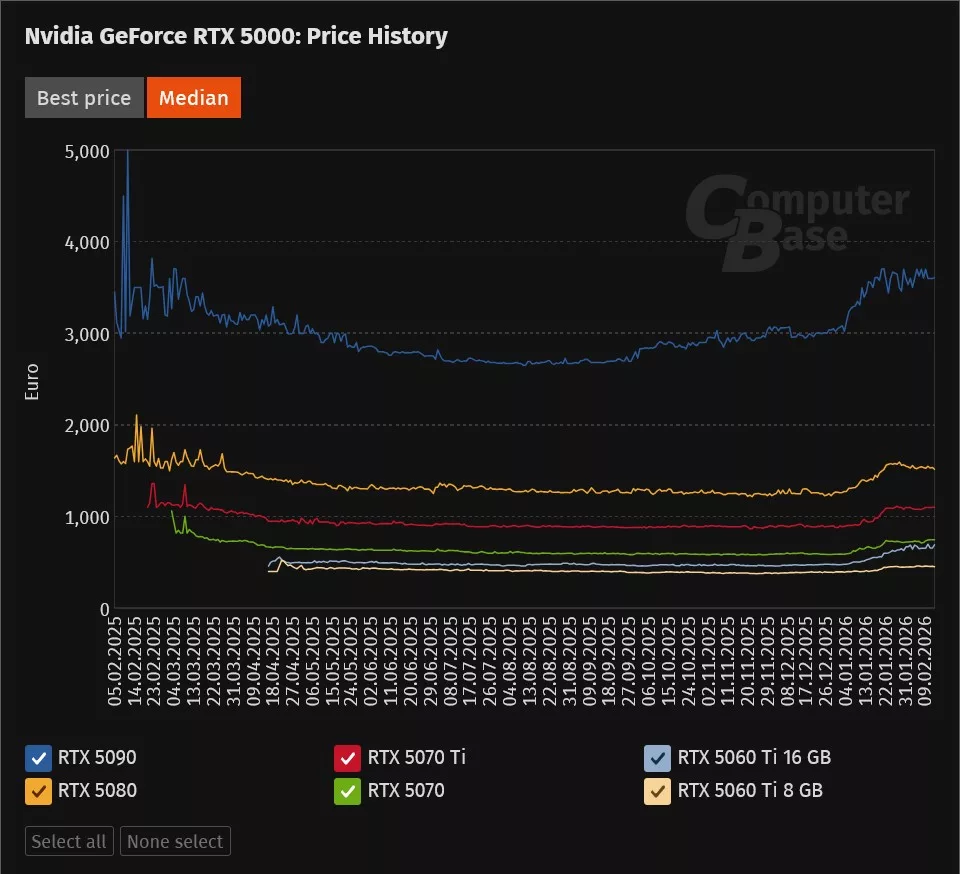
WASHINGTON & SAN FRANCISCO — In a development that has sent immediate shockwaves through global consumer electronics markets and institutional equities, supply chain manifests and tier-1 component distributors confirm that NVIDIA Corporation’s flagship GeForce RTX 50-series graphics processing units face an impending retail price adjustment of up to $500 this week. This unprecedented upward repricing—driven by a convergence of constrained advanced packaging capacity, escalating wafer costs at Taiwan Semiconductor Manufacturing Company (TSMC), and fierce enterprise competition for silicon real estate—signals a profound structural shift in how semiconductor giants allocate resources between consumer gaming and high-margin artificial intelligence infrastructure.
For months, financial analysts, boutique system integrators, and enterprise procurement officers have monitored the delicate balance of fab capacity. However, the sheer magnitude of this anticipated cost inflation shatters prior pricing models. As retail channels prepare for imminent updates, market participants are forced to re-evaluate capital allocation strategies, consumer discretionary spending elasticity, and the broader valuation multiples of the hardware ecosystem.
Executive Takeaways
- Unprecedented Price Escalation: Top-tier RTX 50-series configurations are slated for retail bumps of up to $500, fundamentally altering the total cost of ownership for enthusiast-grade custom builds and corporate graphics workstations.
- The Foundry Bottleneck: The repricing is directly tied to acute capacity constraints at TSMC, where high-performance consumer silicon must compete directly with hyper-profitable enterprise AI accelerators like the Blackwell and Hopper architectures.
- Macroeconomic & Market Impact: Enterprise ROI calculations for local machine-learning development rigs face sudden friction, while consumer demand elasticity faces its most severe stress test in hardware history.
- Strategic Risk Mitigation: Major system integrators and institutional buyers are accelerating forward-purchasing agreements to lock in inventory before distributor price lists update mid-week.
The Anatomy of a Supply Chain Shock: Catalysts Behind the $500 Hike
Test Our Free AI & Tech Utilities Suite
Calculate LLM API token costs, analyze article dwell-time, or simulate tech DCA returns.
To understand the mechanics driving this week’s price adjustment, one must examine the macroeconomic realities governing modern semiconductor fabrication. NVIDIA does not manufacture its own silicon; instead, it relies heavily on TSMC’s cutting-edge nodes. The RTX 50-series relies on bespoke process technology that requires extreme precision, high-density lithography, and advanced packaging techniques such as Chip-on-Wafer-on-Substrate (CoWoS).
However, the global demand for AI compute architecture has completely saturated CoWoS and 3nm/4nm wafer allocations. Hyperscale cloud providers and enterprise tech giants continue to secure massive blocks of foundry capacity to fuel enterprise AI deployment. Consequently, consumer graphics cards are effectively squeezed out of priority lanes. To secure wafer allocation and offset surging input costs—including raw materials, specialized substrates, and stringent regulatory compliance expenditures—channel partners and distributors are implementing aggressive price adjustments.
Industry insiders report that the price hike is not merely a margin-expansion exercise by board partners (such as ASUS, MSI, and Gigabyte), but a direct reflection of rising baseline component costs. VRAM pricing, specifically GDDR7 memory modules required for next-generation architectures, has experienced significant upward pressure due to constrained manufacturing yields and prioritized enterprise memory supply.
Verified Data & Metrics Breakdown

The following comparative matrix outlines the structural shifts in pricing, architecture demands, and market positioning between previous-generation flagships and the upcoming RTX 50-series rollout:
| Metric / Specification | GeForce RTX 4090 (Launch Era) | GeForce RTX 50-Series (Projected Post-Hike) | Market & Financial Implication |
|---|---|---|---|
| Flagship MSRP / Realized Price | $1,599 (Base MSRP) | $1,999 – $2,499+ (Up to $500 premium) | Substantial barrier for consumer adoption; compression of gamer addressable market. |
| Foundry & Node Allocation | TSMC 4N (Optimized Custom Node) | Next-Gen TSMC Process with Advanced CoWoS | Direct competition with high-margin enterprise AI accelerators for wafer space. |
| Memory Subsystem | GDDR6X (Standard High-Performance) | GDDR7 (Next-Gen High-Bandwidth) | Elevated bill-of-materials (BOM) cost due to tight memory fab yields. |
| Corporate Procurement Impact | Moderate workstation deployment | Strict capital expenditure re-evaluation | Prohibitive pricing forces enterprises toward cloud compute architecture. |
Industry & Market Implications: Winners, Losers, and Economic Realities
The impending price surge reverberates far beyond the enthusiast gaming community, directly impacting corporate IT budgets, system integrators, and broader financial market sentiment.
Corporate IT and Local AI Development
While enterprise data centers rely on rack-mounted accelerators like NVIDIA H100 and Blackwell B200 systems, thousands of financial institutions, engineering firms, and software startups utilize high-end GeForce RTX cards for local model prototyping, computer vision training, and financial modeling. A $500 price hike per workstation disrupts corporate capital allocation models, forcing Chief Technology Officers to weigh local infrastructure scalability against cloud-based alternatives hosted on AWS, Azure, or Google Cloud.
System Integrators and Retail Channels
Boutique PC builders and tier-2 hardware vendors face severe margin compression. Because consumer price sensitivity limits their ability to pass the entire $500 cost increase directly to retail buyers without cratering volume, integrators must absorb a portion of the shock or pivot their product mixes toward mid-range configurations. This creates acute inventory management challenges, threatening market liquidity for high-end stock units.
NVIDIA’s Financial Strategy
From a valuation perspective, this pricing adjustment underscores NVIDIA’s unmatched pricing power. By allowing consumer hardware prices to rise, the firm ensures that consumer-facing product lines maintain profitability profiles that compete favorably with enterprise allocations. For equity analysts, this demonstrates robust risk mitigation against cyclical downturns in PC gaming, cementing NVIDIA's status as a dominant multi-market monolith.
Frequently Asked Questions (People Also Ask)
Why are NVIDIA RTX 50-series cards experiencing such a sharp price increase?
The price surge is driven by a combination of constrained TSMC foundry capacity, fierce competition for advanced packaging (CoWoS) with enterprise AI hardware, higher production costs for GDDR7 memory, and broader macroeconomic inflationary pressures affecting raw material procurement and logistics.
Will this price hike affect enterprise AI servers or only consumer gaming GPUs?
Enterprise data center accelerators operate under entirely different pricing structures and long-term contracts. However, the root cause of the consumer price hike is the heavy industrial demand for the same underlying foundry and packaging resources, meaning enterprise allocation priorities indirectly dictate consumer silicon pricing.
Should corporate buyers and gamers purchase current inventory immediately?
Financial analysts and supply chain auditors suggest that locking in hardware procurement orders prior to the mid-week distributor list updates is a prudent risk-mitigation strategy to avoid immediate margin exposure.
Are competitor hardware manufacturers expected to follow NVIDIA’s pricing lead?
As industry-wide foundry and component cost pressures impact the entire semiconductor ecosystem, competing GPU manufacturers face similar cost structures. Whether they match the magnitude of NVIDIA's adjustment will depend on their respective market share strategies and existing inventory commitments.
Future Outlook and Key Milestones to Watch
As the market digests this week’s repricing, financial markets and tech analysts will closely monitor several critical indicators over the coming quarters. First, retail sell-through rates will test the outer limits of consumer demand elasticity; if enthusiasts reject the revised price points, NVIDIA and its partners may face inventory buildup despite supply constraints.
Second, observers will track TSMC’s quarterly capacity expansions and yield improvements on advanced nodes. Any easing of foundry bottlenecks could alleviate input cost pressures by late fiscal year 2025. Finally, corporate IT spending reports will reveal whether enterprise adoption of local developer workstations slows in favor of centralized cloud architecture.
For now, the $500 silicon shock stands as a stark reminder of the new economic reality governing high-performance computing: in an era defined by artificial intelligence and finite advanced manufacturing capacity, every consumer hardware component must compete directly with the insatiable capital outlays of the global technology sector.