Executive Takeaways
- Hawkish Pivot: Federal Reserve Chair Kevin Warsh signaled an unyielding commitment to the central bank's 2% inflation target, pouring cold water on market expectations of an imminent monetary pivot.
- Equities Retreat: Wall Street's major indices—led by the S&P 500 and Nasdaq—closed lower as institutional investors recalibrated risk premiums, discount rates, and valuation multiples.
- Capital Reallocation: Fixed-income desks saw surging yields as smart money shifted toward capital preservation strategies, prioritizing risk mitigation over growth equity speculation.
- Structural Realities: Corporate treasurers face rising debt-servicing costs, forcing a rigorous re-evaluation of capital allocation, operational efficiency, and infrastructure scalability.
NEW YORK — The immutable law of financial gravity caught up with Wall Street last month, as a sobering address from Federal Reserve Chair Kevin Warsh dismantled the lingering investor optimism that had fueled months of speculative fervor. Equity indices slid across the board following Warsh's unequivocal statement that inflationary pressures are not subsiding at the velocity required by the Federal Open Market Committee (FOMC). For institutional asset managers, corporate strategists, and leveraged investors, the message was unmistakable: the era of cheap liquidity is permanently in the rearview mirror, and the central bank’s war on inflation remains front and center.
The market reaction was swift and unforgiving. Benchmark indices surrendered early gains within minutes of the Fed Chair's remarks at a macroeconomic symposium in Washington. The S&P 500, the tech-heavy Nasdaq Composite, and the blue-chip Dow Jones Industrial Average all retreated into negative territory by the closing bell. Trading desks reported an abrupt spike in volatility, with institutional block trades reflecting a broad-based defensive rotation. As market liquidity adjusted to a higher-for-longer interest rate paradigm, portfolios everywhere underwent a painful stress test against the realities of enduring monetary tightening.
The Catalyst: Dissecting Chair Warsh’s Hardline Stance
The turning point for investor sentiment arrived mid-morning when Fed Chair Warsh took the podium to deliver a comprehensive assessment of the macroeconomic landscape. Eschewing the nuanced rhetoric that often characterizes central bank communications, Warsh delivered a blunt diagnostic: core consumer price metrics remain uncomfortably elevated, labor market resilience continues to outpace projections, and aggregate demand is stubbornly robust.
"Our statutory mandate is price stability," Warsh emphasized during his address. "Prematurely declaring victory over inflation is a historical policy error we are determined to avoid. The path to our 2% target requires sustained, disciplined monetary restraint, and we will not hesitate to maintain restrictive policy settings for as long as necessary to anchor long-term expectations."
This uncompromising stance blindsided traders who had been pricing in a dovish pivot by mid-year. Over the prior quarter, speculative market segments had aggressively front-run anticipated rate cuts, betting that softening commodity prices would give the FOMC political and economic cover to ease financial conditions. Warsh’s remarks effectively reset these expectations, forcing Wall Street quantitative models to recalculate discount rates across every major asset class.
The implications for corporate finance are profound. As the risk-free rate anchors at higher levels, enterprise cost-of-capital calculations must adjust accordingly. Chief Financial Officers across the Fortune 500 are finding that traditional debt-issuance playbooks no longer apply. Capital allocation strategies that relied on low-cost leverage are being shelved in favor of cash-flow-driven operational resilience and disciplined balance-sheet management.
Market Mechanics: How Wall Street Responded
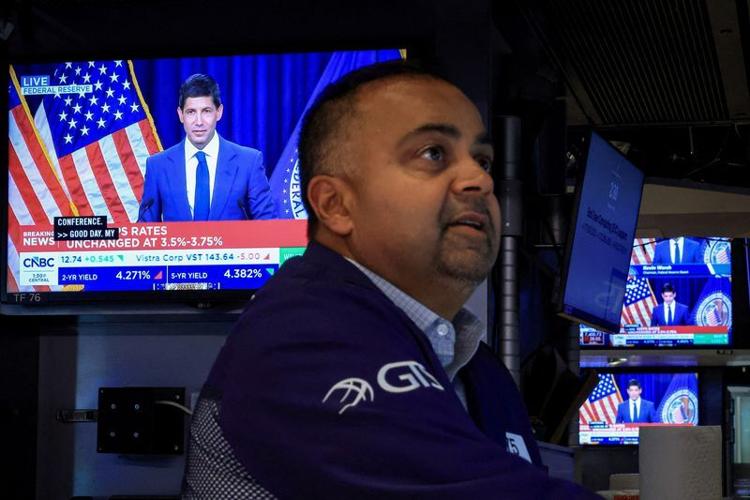
The immediate fallout on the trading floor was characterized by aggressive de-risking. Growth stocks, particularly within the technology and biotechnology sectors, bore the brunt of the sell-off. Because high-growth equities derive a significant portion of their theoretical valuation from distant future cash flows, they are acutely sensitive to shifts in the discount rate. As Warsh reaffirmed the Fed's hawkish trajectory, valuation multiples compressed rapidly.
| Market Index / Metric | Pre-Address Sentiment | Post-Address Close | Primary Driver |
|---|---|---|---|
| S&P 500 | Cautiously Optimistic (+0.4%) | Lower (-1.2%) | Broad multiple compression & liquidity drain |
| Nasdaq Composite | Tech-Led Momentum (+0.8%) | Lower (-1.8%) | Rising discount rates impacting long-duration assets |
| U.S. 10-Year Treasury Yield | Stagnant at 4.22% | Spiked to 4.38% | Repricing of terminal interest rate expectations |
| CBOE Volatility Index (VIX) | Subdued (13.5) | Elevated (16.8) | Hedge buying and downside protection demand |
In the fixed-income market, the sell-off in U.S. Treasuries was equally dramatic. Yields surged across the curve as bond vigilantes forced a repricing of debt instruments. The benchmark 10-year Treasury yield climbed over 15 basis points in a single session, reflecting the market's realization that policy rates will remain restrictive well into the foreseeable future. This upward movement in yields sent shockwaves through residential mortgage markets, commercial real estate refinancing desks, and corporate credit spreads.
Industry & Market Implications: Winners and Losers
Every macroeconomic shift creates distinct economic beneficiaries and casualties. The Warsh Doctrine is no exception, drawing sharp lines between companies capable of thriving in a high-rate environment and those structurally dependent on ultra-loose monetary policy.
The Winners: Financial Institutions and Cash-Rich Enterprises
- Tier-1 Commercial Banks: Institutions with robust net interest margins (NIM) and diversified deposit bases continue to generate substantial net interest income. High short-term rates allow these banks to extract favorable yields on reserves and variable-rate lending portfolios.
- Enterprise Software Giants with Fortress Balance Sheets: Technology conglomerates boasting pristine balance sheets, zero net debt, and massive cash reserves are insulated from rising borrowing costs. Furthermore, they are capitalizing on high-yield cash management vehicles.
- Energy and Commodity Majors: Real-asset businesses with strong pricing power and inflation-hedged revenue models remain resilient, absorbing input cost pressures while maintaining robust free cash flow yields.
The Losers: Leveraged Entities and Speculative Growth
- High-Burn Tech and Biotech Startups: Early-stage enterprises reliant on continuous venture capital injections or debt financing are facing existential liquidity crunches. Valuation markdowns are accelerating as private market investors demand profitability over top-line growth.
- Commercial Real Estate (CRE): Office and retail property portfolios facing upcoming debt maturities are encountering severe refinancing friction. Higher capitalization rates and restrictive lending standards are triggering mandatory asset liquidations and debt restructurings.
- Highly Leveraged Industrials: Manufacturing and supply chain operators saddled with legacy floating-rate debt are seeing profit margins squeezed by escalating debt-servicing obligations.
Frequently Asked Questions (People Also Ask)
Why did Wall Street react so negatively to Fed Chair Warsh’s inflation remarks?
Wall Street's negative reaction stemmed from the realization that Federal Reserve Chair Kevin Warsh has no intention of cutting interest rates in the near term. Investors had heavily bet on an impending monetary pivot to boost equity valuations. Warsh’s reaffirmation of the strict 2% inflation goal and his warning against premature policy easing forced algorithmic and institutional traders to aggressively reprice risk, resulting in widespread multiple compression.
What does the "2% inflation goal" mean for everyday corporate borrowing costs?
The 2% inflation goal acts as the operational benchmark for the Federal Open Market Committee when setting the federal funds rate. To drive inflation down to this target, the Fed maintains restrictive monetary policy, which keeps benchmark interest rates elevated. Consequently, corporate borrowers face higher costs across revolving credit facilities, commercial paper issuance, and corporate bond syndications, directly impacting bottom-line profitability and capital expenditure budgets.
How does a hawkish Federal Reserve impact tech sector valuation multiples?
Technology sector valuations are heavily weighted toward future cash flows. When the Federal Reserve signals higher-for-longer interest rates, the discount rate applied to those future earnings increases significantly in financial models. This mathematical adjustment reduces the present value of future profits, leading directly to lower share prices and compressed price-to-earnings (P/E) multiples across the sector.
What are the primary risk mitigation strategies for institutional portfolios in this environment?
Institutional portfolio managers are executing rigorous risk mitigation by reallocating capital into short-duration fixed income, high-quality dividend-paying equities, and cash equivalents offering attractive risk-free yields. Furthermore, desks are utilizing derivative overlays, such as put options and volatility hedges, to protect against downside tail risk while selectively pruning structurally impaired, high-leverage holdings.
Future Outlook: Milestones and Key Indicators to Watch
As Wall Street digests the new macroeconomic reality dictated by the Warsh Doctrine, market participants must shift their focus from speculative forecasting to rigorous data tracking. The trajectory of equities and fixed-income assets over the coming quarters will depend entirely on incoming economic prints.
Key milestones and indicators to monitor include:
- Core PCE and CPI Releases: The Personal Consumption Expenditures (PCE) price index remains the Fed’s preferred inflation gauge. Consecutive months of decelerating core readings are mandatory before the FOMC will alter its restrictive stance.
- Employment and Wage Growth Data: Nonfarm payroll reports and Average Hourly Earnings figures will dictate labor market tightness. Persistent wage pressures signal ongoing domestic demand that could force further policy tightening.
- Corporate Credit Spread Widening: Monitoring high-yield and investment-grade spreads will provide critical insight into financial stress within corporate debt markets, highlighting potential liquidity bottlenecks before they cascade into systemic events.
- FOMC Dot Plot and Press Conferences: Future quarterly economic projections from central bank officials will serve as the definitive roadmap for terminal rate expectations and the ultimate timeline for monetary easing.
Ultimately, the latest market correction serves as a sharp reminder that macroeconomic fundamentals—not speculative momentum—dictate long-term asset values. As Chair Warsh and the Federal Reserve maintain their steadfast defense of price stability, corporate boardrooms and institutional investors alike must master the operational disciplines required to thrive in a high-vigilance economic landscape.