South Africa Reels Under Shockwave of Gun Violence as Twin Mass Shootings Claim 27 Lives: Inside the Deepening Security and Economic Crisis
JOHANNESBURG — South Africa’s worsening law-and-order crisis reached a grim new inflection point overnight as back-to-back mass shootings left 27 people dead and multiple others critically wounded. The coordinated and cold-blooded nature of the massacres has reignited nationwide outrage, piling fresh pressure on President Cyril Ramaphosa’s government to confront rampant illegal firearm trafficking and systemic policing failures that increasingly threaten the continent’s most industrialised economy.
According to preliminary operational reports from the South African Police Service (SAPS), the carnage unfolded across two separate scenes under eerily similar circumstances. Heavily armed assailants wielding military-grade assault rifles and high-capacity handguns stormed social gatherings, opening fire indiscriminately on patrons and residents before fleeing under the cover of darkness. Emergency medical personnel described chaotic and harrowing scenes, with victims sustaining catastrophic high-velocity bullet wounds.
Executive Summary: The Dual Massacres at a Glance
- Confirmed Fatalities: 27 verified deaths across two coordinated or closely timed shooting incidents; several victims remain in critical care at provincial trauma centers.
- Modus Operandi: Tactical ambushes executed by multiple masked gunmen utilising automatic and semi-automatic firearms; shell casings of 9mm and 7.62mm calibers recovered at the scenes.
- Law Enforcement Mobilisation: The SAPS National Joint Operational and Intelligence Structure (NatJOINTS) has activated a 72-hour emergency response plan, deploying elite tactical teams and specialised forensic detectives.
- Economic & Market Exposure: Surging violent crime threatens South Africa’s sovereign risk profile, with international investors monitoring potential disruptions to logistics, retail, and tourism corridors.
Anatomy of the Attacks: Bloodshed in Minutes
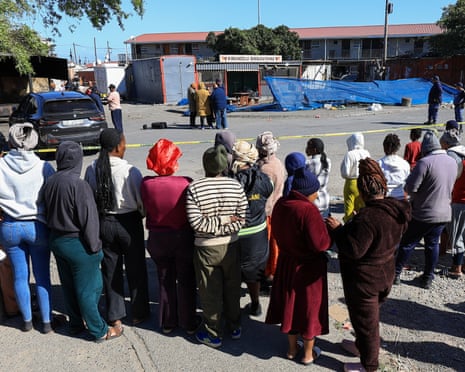
The first incident occurred late in the evening when unidentified gunmen descended on a bustling local establishment. Witnesses recounted how multiple assailants surrounded the perimeter, systematically cutting off escape routes before releasing a barrage of gunfire. Panic swept through the crowd as dozens dropped to the floor; when the dust settled, more than a dozen individuals lay dead on the spot, with emergency services transporting survivors fighting for their lives.
Hours later, a second shooting erupted in another densely populated community, claiming the remaining victims in an execution-style assault. Local community leaders reported hearing rapid automatic gunfire lasting several uninterrupted minutes. While investigators have yet to formally establish an operational link between the two massacres, authorities concede the brazen nature of both hits indicates organized criminal networks, gang retribution, or syndicate extortion schemes run with ruthless precision.
“The level of sheer brutality and calculated execution witnessed in these incidents is completely unacceptable,” stated senior police officials speaking at a joint press briefing. “We have deployed multidisciplinary task teams, including crime intelligence, forensic ballistics, and tactical units, to hunt down the perpetrators. No resource will be spared to bring those responsible to justice.”
The Underlying Threat: Gang Cartels, Extortion Rackets, and Illicit Arms
Mass shootings have become a devastatingly frequent occurrence across South Africa, a nation grappling with one of the highest per-capita homicide rates in the world. Criminologists and security analysts point to a confluence of structural vulnerabilities: a flood of untraceable military-grade weapons smuggled through porous regional borders, rogue elements within private security frameworks, and the exponential growth of local protection syndicates.
Protection rackets—frequently referred to as the “construction and business mafias”—have migrated aggressively into township economies, targeting tavern operators, logistics fleets, and small enterprise hubs. Establishments that refuse to pay weekly extortion fees or fall behind on criminal levies are routinely targeted in targeted assassination campaigns designed to enforce compliance across entire neighborhoods.
Economic Fallout: The Billions Lost to Violent Crime
Beyond the immense human tragedy, the recurring wave of violent crime poses a direct structural drag on South Africa’s macroeconomic recovery. The World Bank has previously estimated that crime and violence consume upwards of 10% of South Africa’s gross domestic product (GDP) annually through direct costs, lost productivity, and inflated private security expenditures.
| Security Metric | Verified Data / Benchmark | Strategic Implication |
|---|---|---|
| Immediate Fatalities | 27 confirmed dead (two separate shootings) | Severe public alarm; immediate pressure on police cabinet leadership. |
| Ballistic Indicators | High-caliber semi-automatic rifles & 9mm handguns | Highlights the unchecked inflow of black-market military arms. |
| National Homicide Rate | Over 75 murders recorded per day nationally | Depresses consumer sentiment; inflates sovereign operational risk. |
| Economic Cost of Crime | ~10% of national GDP annually (World Bank data) | Deters Foreign Direct Investment (FDI); stunts township commercial growth. |
South Africa’s sprawling private security industry now outnumbers the national police force by an estimated four-to-one ratio, creating an uneven safety landscape where affluent suburbs rely on armed private contractors while historically marginalized working-class townships remain largely unprotected. For international rating agencies and multinational corporations, security risks remain a persistent deterrent to long-term direct capital commitments.
Political Heat Turns on Government of National Unity
The tragedy serves as an acute test for South Africa’s Government of National Unity (GNU), formed following the watershed May 2024 elections. Opposition parties and civil society organizations have leveled harsh criticism at the executive branch, demanding a total overhaul of crime intelligence gathering and an aggressive purge of corrupt actors within the security cluster.
Community watch groups have announced plans for mass demonstrations outside provincial police headquarters, decrying chronic delays in emergency response times and an inability to protect innocent civilians. Without aggressive intervention to disarm criminal cartels and seal smuggling corridors, South Africa faces the harrowing prospect of further bloodshed in an escalating war for territorial dominance.
Frequently Asked Questions (FAQ)
What triggered the two mass shootings that killed 27 people?
While definitive motives remain under investigation by specialized SAPS detectives, preliminary intelligence points to targeted gang retribution, syndicate extortion rackets, or territorial disputes. Assailants entered the venues with high-powered assault weapons, indicating planned executions rather than spontaneous violence.
How is the South African government responding to the surge in mass shootings?
Law enforcement authorities have initiated a 72-hour operational activation plan, deploying elite tactical teams, national intelligence agents, and forensic ballistics experts to track down the suspects. Politically, the administration faces mounting demands to institute stricter firearm tracing, eliminate illegal arms networks, and deploy military-backed stabilization units to high-risk zones.