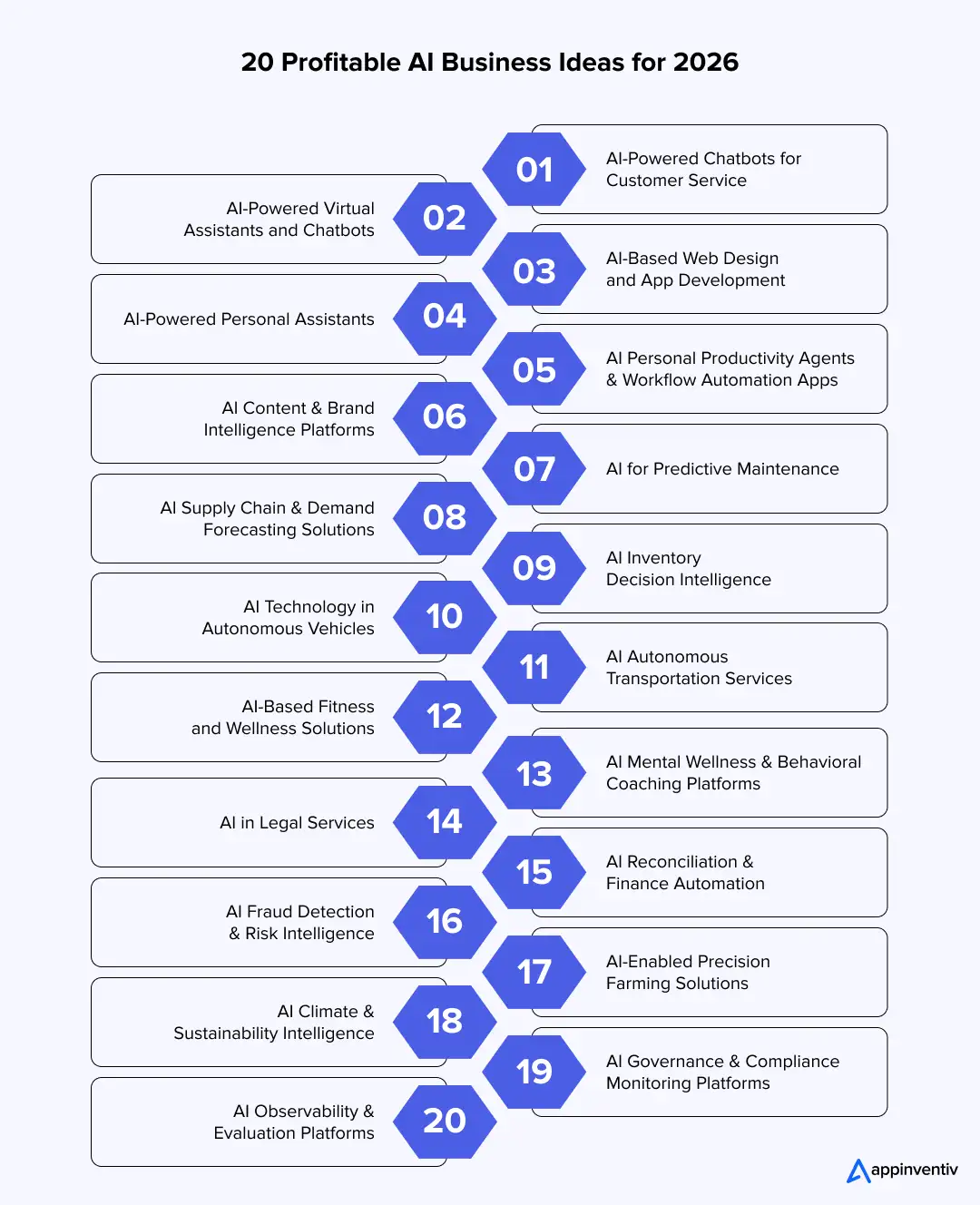
The 2026 Artificial Intelligence Gold Rush: 20 Profitable AI Business Ideas Reshaping Enterprise Architecture and Venture Capital Allocations
As enterprise software budgets pivot decisively toward autonomous agentic workflows and real-time predictive intelligence, a new class of high-margin startups is commanding extraordinary valuation multiples. Drawing from proprietary market intelligence and recent sector analysis from Appinventiv, this exhaustive investigation maps the 20 most commercially viable AI business models poised to dominate capital deployment through the end of the decade.
Executive Takeaways
- Enterprise ROI Pivot: The market has officially transitioned from exploratory generative AI experiments to hard-nosed infrastructural ROI, prioritizing automation models that permanently strip overhead costs and eliminate workflow friction.
- Capital Allocation Shift: Venture capital and private equity syndicates are favoring capital-efficient B2B SaaS architecture, deep verticalized machine learning models, and compliance-first regulatory tech over general-purpose foundational wrappers.
- Infrastructure Scalability: Cloud compute architecture and edge-computing deployment costs are declining, widening gross margins for software-as-a-service providers that successfully integrate proprietary operational data.
The 2026 Macroeconomic Landscape: From Hype to Hard Balance Sheets
The macroeconomic consensus governing the technology sector has undergone a fundamental structural shift. Gone are the speculative, open-ended explorations of foundational large language models funded by cheap venture capital. In their place stands a rigorous, metrics-driven procurement environment where corporate treasurers and chief information officers demand demonstrable margin expansion, frictionless workflow integration, and ironclad regulatory compliance before authorizing software budgets.
According to recent industry data published by Appinventiv, the most profitable AI business models for 2026 are those engineered to solve acute friction points within traditional enterprise pipelines. Whether optimizing supply chain volatility, automating complex legal and financial compliance audits, or synthesizing unstructured operational telemetry into actionable corporate strategy, today's successful founders are building mission-critical utilities rather than consumer-facing novelties. As enterprise software budgets absorb billions in recurring licensing fees, understanding the granular mechanics of these 20 distinct business models is essential for founders, corporate strategists, and institutional investors alike.
Comprehensive Breakdown of the 20 Profitable AI Business Ideas for 2026
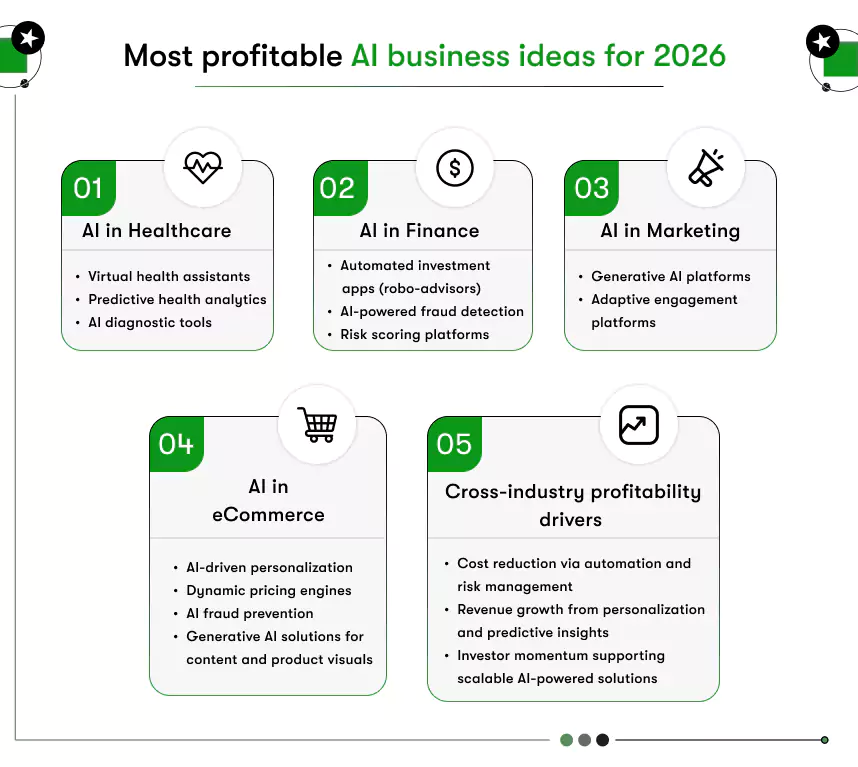
1. Autonomous Enterprise Workflow Orchestrators
Moving far beyond simple chatbot interfaces, these platforms deploy multi-agent systems capable of executing complex, cross-departmental business processes—such as automated enterprise resource planning (ERP) reconciliation and supply chain rerouting—without human intervention. Profitability stems from tiered consumption pricing models tied directly to workflow execution volume.
2. Verticalized Legal & Regulatory Compliance Engines
Designed specifically for heavily regulated sectors like fintech, healthcare, and aerospace, these AI engines continuously scan changing international statutes and cross-reference them against internal corporate documentation, drastically reducing legal exposure and high-priced billable hours.
3. Predictive Supply Chain & Inventory Optimization Suites
Leveraging real-time global trade data, macroeconomic indicators, and IoT telemetry, these B2B platforms accurately forecast logistical bottlenecks, permitting multinational corporations to optimize working capital and minimize expensive warehouse carrying costs.
4. AI-Powered Cybersecurity Threat Hunting & Remediation
With threat actors increasingly utilizing generative code to launch sophisticated, polymorphic cyberattacks, defensive startups deploy autonomous machine learning models that isolate and neutralize network anomalies at machine speed, commanding premium enterprise SaaS pricing.
5. Personalized Hyper-Targeted Synthetic Media Marketing Platforms
Marketers no longer rely on static campaigns. These platforms dynamically generate localized video, audio, and textual ad variants tailored to micro-demographics in real-time, driving unprecedented conversion rates and lowering customer acquisition costs (CAC).
6. Automated Medical Diagnostic & Patient Triage Assistants
Operating at the intersection of healthtech and machine learning, these secure applications ingest electronic health records (EHR) and diagnostic imagery to assist clinical professionals in early detection, creating highly lucrative enterprise contracts with hospital networks.
7. Next-Generation EdTech Adaptive Tutoring Ecosystems
Moving past rigid e-learning modules, these platforms diagnose individual student cognitive gaps in real time, dynamically rewriting curriculum and pacing instruction for both K-12 institutions and corporate continuous learning programs.
8. Real-Time Algorithmic Financial Auditing & Fraud Detection
By continuously analyzing millions of micro-transactions, general ledger entries, and communication channels, these AI engines flag anomalous financial behavior instantly, mitigating corporate malfeasance and lowering institutional insurance premiums.
9. PropTech Automated Valuation & Real Estate Asset Intelligence
Commercial and residential real estate portfolios require constant valuation updates. These models ingest local zoning laws, historical transactional data, foot-traffic telemetry, and climate risk assessments to deliver institutional-grade asset valuations.
10. Autonomous Agricultural Yield & Resource Optimization
AgTech startups utilizing computer vision and drone telemetry deliver hyper-local soil and crop health diagnostics to agribusinesses, driving sustainability targets while drastically cutting fertilizer, water, and pesticide expenditures.
11. Intelligent Contract Lifecycle Management (CLM) Systems
Beyond simple digital signatures, these platforms parse legacy and incoming enterprise contracts, automatically flagging unfavorable liability clauses, renewal dates, and compliance discrepancies, converting unstructured text into actionable business intelligence.
12. AI-Driven HR Recruitment & Talent Retention Analytics
Addressing chronic labor market friction, these platforms screen inbound talent portfolios while continuously monitoring employee engagement metrics via internal communication metadata to predict and prevent costly enterprise churn.
13. Conversational Commerce & Advanced E-Commerce Personalization
E-commerce retailers are deploying deep contextual recommendation engines that act as expert virtual shopping assistants, drastically increasing average order values (AOV) and cart completion rates across high-ticket retail sectors.
14. Cloud Compute Infrastructure Cost Optimization (FinOps)
As corporate cloud bills skyrocket, AI-driven FinOps tools autonomously monitor cloud infrastructure utilization, dynamically scaling server workloads and eliminating idle computing instances to save enterprises millions in wasted capital.
15. Autonomous Code Refactoring & Legacy Software Modernization
Legacy banking and government infrastructure relies on decades-old programming languages. AI models trained on enterprise codebases safely translate, refactor, and test legacy code into modern, maintainable microservices architectures.
16. ESG (Environmental, Social, and Governance) Data Aggregation & Reporting
With mandatory global ESG reporting standards coming into full force, these software suites scrape supply chain and operational data to automatically generate audited, regulation-compliant corporate sustainability disclosures.
17. Hyper-Localized Weather Risk Modeling for InsurTech
Property and casualty insurers deploy hyper-granular meteorological machine learning models to price climate-related risks accurately, protecting underwriting balance sheets against unprecedented weather volatility.
18. AI-Enabled Intellectual Property & Patent Landscape Mapping
R&D-heavy enterprises utilize deep patent-scanning algorithms to map global intellectual property whitespace, preventing costly patent infringement litigation and accelerating proprietary product development.
19. Automated Customer Experience (CX) Sentiment & Root-Cause Analytics
Moving beyond basic customer satisfaction (CSAT) scores, these platforms analyze sentiment inflection points across multi-channel customer service interactions to pinpoint systemic product and service failures.
20. Proprietary Domain-Specific LLM Fine-Tuning & Hosting Services
B2B infrastructure providers that securely ingest an enterprise's proprietary, confidential data to fine-tune open-weights models on-premise, guaranteeing data sovereignty and intellectual property protection.
Verified Data & Metrics Breakdown
To quantify the commercial velocity of the 2026 AI landscape, the following comparative matrix outlines key operational metrics, target enterprise verticals, typical margin profiles, and primary monetization mechanisms across the sector.
| Business Category | Primary Target Vertical | Average Gross Margin | Monetization Model | Enterprise Scalability Rating |
|---|---|---|---|---|
| Autonomous Workflow Orchestrators | Enterprise SaaS / Operations | 82% - 88% | Consumption & API Volume Tiers | High |
| Regulatory Compliance Engines | Fintech, Legal, Healthcare | 78% - 85% | Annual Software Licensing (SaaS) | Very High |
| Predictive Supply Chain Suites | Logistics, Manufacturing, Retail | 75% - 82% | Tiered Enterprise Subscription | High |
| Cybersecurity Threat Hunting | Enterprise IT & Defense | 85% - 90% | Per-Endpoint / Seat Licensing | Exceptional |
| Cloud FinOps & Infrastructure | CTO Offices / IT Infrastructure | 80% - 86% | Percentage of Cost Savings / SaaS | High |
Industry & Market Implications: Winners, Losers, and Capital Flows
The maturation of these 20 business models is producing stark bifurcations across the global economy. The winners are agile, technically sophisticated B2B software enterprises that successfully anchor their value propositions to measurable cost reduction and workforce efficiency. These firms command valuation multiples frequently exceeding 15x to 25x forward annualized recurring revenue (ARR), attracting intense venture capital and private equity syndication.
Conversely, the losers are legacy consulting firms and traditional business process outsourcing (BPO) providers whose core business models rely on billable hours spent executing routine, highly automatable clerical tasks. As enterprises embrace autonomous AI orchestrators, low-value administrative labor arbitrage is rapidly eroding. Furthermore, foundational software providers offering undifferentiated general-purpose text wrappers face severe margin compression as hyperscale cloud providers bake basic AI capabilities directly into their core operating tiers.
Frequently Asked Questions (People Also Ask)
What are the most capital-efficient AI business models to launch in 2026?
Capital efficiency is highest in B2B vertical SaaS models that leverage open-weights foundational models combined with proprietary, domain-specific training data. Founders who avoid the exorbitant capital expenditures associated with training frontier models from scratch—focusing instead on specialized fine-tuning, workflow orchestration, and strict regulatory compliance—achieve faster paths to positive cash flow.
How do B2B enterprises evaluate AI software ROI before procurement?
Enterprise procurement committees and chief information officers evaluate AI solutions based on three strict metrics: direct reduction in operational expenditure (OpEx), percentage decrease in human error rates, and compliance with data sovereignty frameworks such as GDPR and the EU AI Act. Solutions that cannot demonstrate a quantifiable payback period within 6 to 12 months face immediate budget rejection.
Are generic AI wrapper startups still viable investment targets for venture capital?
Venture capital syndicates have largely abandoned un-defensible AI wrapper startups that rely entirely on third-party API calls without proprietary data moats, workflow integration, or specialized domain workflows. Investors now demand robust data network effects, proprietary algorithmic architecture, and deep enterprise systems integration.
What role does regulatory compliance play in modern AI software valuation?
Regulatory compliance is a primary valuation driver. Software startups equipped with built-in audit trails, data privacy controls, and adherence to international regulatory frameworks command significantly higher valuation multiples because they de-risk enterprise deployment and shorten long corporate sales cycles.
Future Outlook: Milestones and Strategic Watchpoints
As the market moves deeper into the latter half of the decade, several critical technological and regulatory milestones will dictate the ultimate commercial success of these AI business ventures. First, the widespread deployment of edge-computing hardware will decentralize machine learning inference, reducing latency and cloud infrastructure costs for industrial and IoT-driven startups.
Second, impending international standardization regarding AI liability and intellectual property copyright will crystallize compliance frameworks, weeding out non-compliant players while rewarding institutional-grade providers. For investors and operators alike, the imperative is clear: capital must be deployed toward intelligent automation that solves tangible economic friction, drives verifiable productivity gains, and embeds itself inextricably into the core operational workflow of the modern global enterprise.