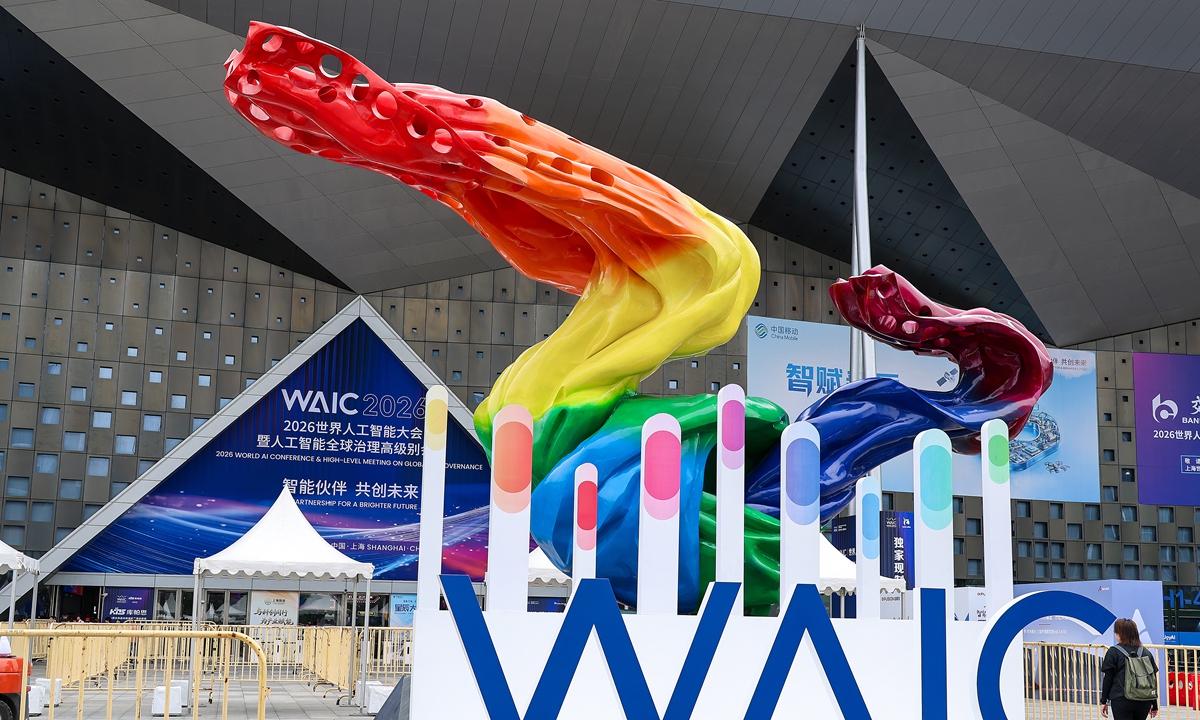
The AI Hype Cycle Ends Here: Over 300 Real-World AI Products Set to Shock Global Markets at WAIC 2026
BEIJING — In what is being hailed as a watershed moment for the global technology sector, the World Artificial Intelligence Conference (WAIC) is preparing to host the global debut of more than 300 cutting-edge AI products. This massive influx of innovation marks a decisive pivot from speculative, generative "novelty" software toward tangible, commercial-grade applications designed to reinvent the global industrial complex.
According to official disclosures, the event—held amidst intensifying technological competition between the world’s leading economies—will showcase how artificial intelligence is shifting from high-cost data centers directly onto the factory floor, the operating room, and the autonomous supply chain. With capital markets demanding path-to-profitability proof from tech conglomerates, WAIC 2026 is poised to be the ultimate proving ground for practical AI monetization.
The Pragmatic Pivot: Why WAIC 2026 Matters to Wall Street and Beyond
For the past three years, venture capital and enterprise spend have poured billions into training massive Large Language Models (LLMs). However, institutional investors have increasingly asked a pressing question: When will these investments show measurable returns on corporate balance sheets?
WAIC 2026 intends to answer that question. Unlike previous years, which focused heavily on abstract algorithmic capabilities and artistic generative AI, this year’s exhibition centers on "embodied AI" and vertical-specific integration. From humanoid robots capable of precision manufacturing to real-time generative design software for heavy industry, the focus is squarely on operational efficiency, labor cost mitigation, and scalable commercialization.
Executive Summary of Key WAIC Developments:
- Unprecedented Scale: Over 300 global debuts, making this the largest concentrated release of enterprise-ready AI solutions in history.
- The Rise of Physical AI: A major focus on humanoid robotics and autonomous systems capable of operating in unstructured human environments.
- Sectoral Integration: Direct applications across manufacturing, healthcare, logistics, and localized edge-computing hardware.
- Geopolitical Stakes: Highlighting China's aggressive manufacturing integration of AI, posing a direct competitive challenge to Western software-centric models.
Mapping the Evolution: WAIC's Shifting Trajectory
The scale of this year's conference underscores a broader macroeconomic trend: the democratization and industrialization of AI tools. The table below illustrates how the focus of WAIC has evolved over the last three years, reflecting the global market's transition from theoretical curiosity to hard economic integration.
| Metric / Focus Area | WAIC 2024 | WAIC 2025 | WAIC 2026 (Current) |
|---|---|---|---|
| Global Debuts | ~120 Products | ~200 Products | 300+ Products |
| Primary Theme | LLM Training & Chatbots | Multimodal AI & Agents | Practical Applications & Embodied AI |
| Dominant Sector | Consumer SaaS & Coding | Enterprise Productivity Software | Industrial Robotics, Biotech & Edge Hardware |
| Investor Focus | Compute Capacity (GPUs) | API Integration & Security | ROI, Unit Economics & Monetization |
Key Frontiers: Humanoid Robots and Industrial Edge Compute
Among the 300-plus products slated for global debuts, industry insiders point to two sectors that will dominate media coverage and investor attention: Embodied AI (Robotics) and Industrial Edge Compute Hardware.
1. Embodied AI takes the Factory Floor
Leading robotics firms are set to unveil next-generation humanoid robots equipped with advanced sensory feedback systems. Unlike their predecessors, which operated in highly controlled laboratory environments, the robots debuting at WAIC 2026 are built for deployment in logistics warehouses and automotive assembly lines. Utilizing highly specialized local models, these machines can adapt to shifting physical tasks without requiring manual reprogramming, promising to revolutionize global supply chains facing chronic labor shortages.
2. Low-Latency Edge AI Hardware
As data transmission costs and latency remain bottlenecks for cloud-based AI, hardware manufacturers are showcasing localized silicon solutions. These new chips allow complex AI inference to happen directly on consumer devices and industrial machinery without relying on a constant connection to centralized cloud servers. This transition is expected to drastically lower operational costs while addressing long-standing data privacy concerns for multinational corporations.
Global Implications: The US-China Tech Divergence
The strategic location and timing of the WAIC event highlight a fascinating divergence in the global AI race. While Silicon Valley continues to focus heavily on foundational model capabilities and consumer-facing application layers, Asian tech hubs are doubling down on physical integration.
"The West has built the brains, but the East is building the nervous system and the limbs," says one prominent technology analyst. By embedding AI directly into its vast manufacturing ecosystem, China aims to secure a dominant position in the physical application of AI, insulating its supply chains against external economic shocks and rising labor costs.
This technological division will likely force global enterprise buyers to navigate a complex regulatory landscape, choosing between highly efficient physical AI systems developed under Eastern industrial frameworks and Western software platforms built around strict data compliance standards.
Looking Ahead: The Commercial Imperative
As the curtains rise at WAIC, the message to global markets is clear: the era of speculative AI valuations is drawing to a close. The companies that survive the next phase of the market cycle will not be those with the largest parameters or the loudest marketing campaigns, but those that can deliver quantifiable, bottom-line value to traditional industries. With 300 new practical tools entering the global arena, the real-world AI revolution has officially begun.
Frequently Asked Questions (FAQ)
1. Why is the focus of WAIC shifting from software to physical and practical AI applications?
The shift is driven by economic necessity and market maturity. After years of heavy capital investment in generative AI, institutional investors are demanding clear returns on investment (ROI). Practical, physical AI—such as industrial robotics, edge hardware, and vertical-specific enterprise tools—offers direct cost savings, labor efficiencies, and clear monetization pathways that general-purpose chatbots cannot match.
2. How will the debut of these 300+ products affect global technology supply chains?
The introduction of highly localized, low-latency edge AI hardware and advanced embodied robotics will likely accelerate the automation of manufacturing and logistics. This will reduce dependency on manual labor in manufacturing hubs and push multinational corporations to upgrade their existing industrial infrastructure to stay competitive against early adopters of these integrated AI technologies.