Executive Takeaways
- Breakthrough Architecture: Microsoft unveiled a novel multi-model agentic security system engineered to detect, isolate, and neutralize cyber threats at autonomous speeds, bypassing traditional human-in-the-loop latency.
- Benchmark Supremacy: Led by Taesoo Kim, VP of Agentic Security, the proprietary system has shattered records on leading industry security benchmarks, signaling a paradigm shift in enterprise risk mitigation.
- Capital Expenditure & ROI: The release accelerates enterprise cloud compute architecture investments, redefining cybersecurity valuation multiples and enterprise software pricing power.
- Macro Timeline: Debuting amid major industry realignments—including concurrent infrastructure transitions such as the planned May 15, 2026, Grok model retirement—the platform resets competitive dynamics across the global tech sector.
WASHINGTON & REDMOND — In the high-stakes theater of global cybersecurity, the asymmetry has long favored the aggressor. Threat actors leverage automated scripts, polymorphic malware, and generative AI to mount attacks at machine speed, while corporate defenders are routinely hamstrung by alert fatigue, siloed telemetry, and manual remediation cycles. Today, that kinetic advantage has shifted.
Microsoft Corporation formally unveiled its next-generation multi-model agentic security system, an autonomous defense architecture designed to reason across disparate threat surfaces, orchestrate countermeasures, and neutralize sophisticated attacks in real time. Spearheaded by Taesoo Kim, Vice President of Agentic Security at Microsoft, the system’s debut coincides with a landmark achievement: sweeping the top tier of leading industry benchmarks in autonomous threat detection and remediation.
For institutional investors, corporate boards, and Chief Information Security Officers (CISOs), the launch represents more than a technical milestone; it is a fundamental inflection point for enterprise risk mitigation, cloud compute architecture, and capital allocation strategies across the technology sector.
The Genesis of Agentic Defense: Moving Beyond Static Rules
Test Our Free AI & Tech Utilities Suite
Calculate LLM API token costs, analyze article dwell-time, or simulate tech DCA returns.
For decades, enterprise security relied on deterministic rules, signature matching, and heuristic analysis. While these mechanisms served legacy networks, the proliferation of cloud-native environments, interconnected supply chains, and LLM-driven corporate workflows rendered static defenses obsolete. The modern threat landscape demands cognitive agility—the ability of a security system to observe complex anomalies, hypothesize attacker intent, and execute multi-step containment strategies without human intervention.
Microsoft’s multi-model agentic security framework addresses this imperative by deploying a coordinated ensemble of specialized AI models. Rather than relying on a single monolithic large language model, the system utilizes a hierarchical architecture where distinct agentic models handle specific telemetry streams—ranging from endpoint behavior and identity access patterns to cloud infrastructure API calls and network traffic anomalies.
According to internal technical briefings and benchmark disclosures overseen by Taesoo Kim’s division, this collaborative model allows the system to cross-reference ambiguous signals with unprecedented fidelity. When a zero-day exploit or advanced persistent threat (APT) attempts lateral movement within an enterprise network, the agentic cluster does not merely flag the anomaly; it constructs a dynamic attack graph, predicts the adversary’s next vector, and isolates compromised subnets instantaneously.
Decoding the Benchmark Supremacy
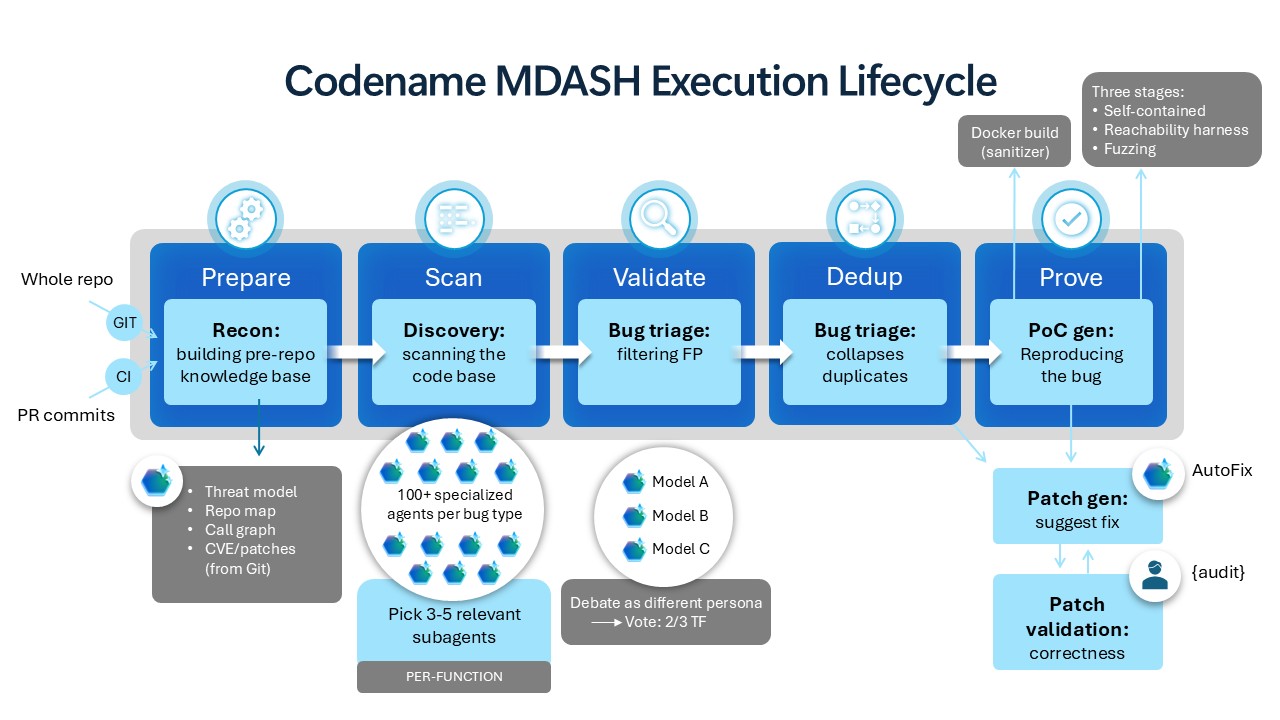
The credibility of any enterprise security architecture hinges on rigorous, standardized evaluation. Microsoft’s system was subjected to rigorous stress-testing against elite industry benchmarks that simulate multi-stage, adversarial campaigns executed by autonomous red teams.
The results mark a decisive departure from existing commercial offerings. By scoring at the absolute apex of these evaluations, Microsoft has demonstrated that multi-model orchestration can dramatically reduce Mean Time to Detect (MTTD) and Mean Time to Respond (MTTR). In simulated corporate environments, the agentic system compressed the remediation lifecycle from hours of manual SOC (Security Operations Center) triage to mere milliseconds of autonomous containment.
This operational velocity is vital for protecting high-value enterprise infrastructure. As cybercriminals weaponize AI to accelerate phishing, credential stuffing, and supply chain infiltration, human analysts are physically incapable of processing data at the required scale. Microsoft’s system bridges this cognitive gap, establishing a new operational baseline for defense at AI speed.
Verified Data & Specifications Breakdown
To contextualize Microsoft’s market positioning and the technical scope of the new agentic security framework, the following comparative matrix outlines key operational parameters, infrastructure requirements, and benchmark metrics.
| Metric / Parameter | Traditional SOC Architecture | Legacy LLM Security Tools | Microsoft Multi-Model Agentic System |
|---|---|---|---|
| Mean Time to Detect (MTTD) | Hours to Days | Minutes | Sub-second / Real-time |
| Mean Time to Respond (MTTR) | Hours (Manual Playbooks) | Minutes (Semi-automated) | Milliseconds (Autonomous) |
| Model Architecture | Deterministic Rules / SIEM | Single General-Purpose LLM | Hierarchical Multi-Model Ensemble |
| Benchmark Performance | Baseline Industry Average | Competitive on Narrow Tasks | Top-Ranked Industry Leader |
| Primary Leadership | Fragmented IT / Security Teams | Various AI Vendors | Taesoo Kim (VP Agentic Security) |
Industry & Market Implications: Capital Allocation and Competitive Dynamics
The commercial rollout of Microsoft’s agentic security architecture triggers immediate ripple effects across global financial markets, enterprise software valuations, and cloud compute infrastructure spending.
1. Enterprise ROI and Budget Realignment
For enterprise buyers, cybersecurity spending has traditionally been viewed as a mandatory cost center—an insurance policy against catastrophic operational disruption. Microsoft’s autonomous system reframes this calculus. By drastically reducing the labor overhead required for Level-1 and Level-2 SOC triage, the platform delivers verifiable enterprise ROI. Corporations can reallocate human capital from tedious log analysis to strategic threat intelligence and architecture hardening.
2. Cloud Compute Architecture and Infrastructure Scalability
Running multi-model agentic ensembles in real time places extraordinary demands on underlying cloud compute architecture. The processing required to continuously evaluate global telemetry streams, maintain stateful context of enterprise networks, and execute autonomous API calls requires massive, low-latency GPU/TPU clusters. This dynamic reinforces the economic moat of hyperscale cloud providers, cementing Microsoft Azure’s strategic advantage as the preferred substrate for mission-critical AI workloads.
3. Valuation Multiples and M&A Pressure
In the public markets, cybersecurity valuation multiples have long rewarded pure-play vendors boasting high Annual Recurring Revenue (ARR) growth and superior Net Retention Rates (NRR). However, the introduction of natively integrated, multi-model agentic systems by platforms with deep enterprise distribution—such as Microsoft—pressures point-solution vendors. Point products that fail to integrate into autonomous orchestration frameworks risk commoditization, potentially accelerating industry consolidation and strategic M&A activity.
Macro Context and Sector Timing
The timing of Microsoft’s announcement is emblematic of an industry undergoing rapid, structural transformation. Occurring alongside major technological realignments—such as the scheduled May 15, 2026, retirement of legacy models like Grok, and ongoing shifts in foundational AI governance—the cybersecurity sector is experiencing a generational weeding-out of obsolete paradigms.
Regulatory compliance is another critical vector. With frameworks like the European Union’s Artificial Intelligence Act and stringent U.S. Securities and Exchange Commission (SEC) cyber disclosure rules enforcing strict accountability, enterprises require defensible, auditable security mechanisms. Microsoft’s agentic framework incorporates native audit trails, ensuring that every autonomous containment action is fully transparent and traceable for regulatory review.
Frequently Asked Questions (People Also Ask)
Frequently Asked Questions
What is a multi-model agentic security system?
Unlike traditional single-model AI tools, a multi-model agentic system deploys a coordinated collective of specialized AI agents. Each agent is optimized for a distinct security domain (e.g., endpoint telemetry, identity management, cloud API monitoring) and communicates autonomously to reason through complex, multi-stage cyber attacks without human intervention.
How does Microsoft’s system achieve top benchmark rankings?
Under the direction of Taesoo Kim, VP of Agentic Security, Microsoft integrated advanced reasoning capabilities, real-time telemetry ingestion, and hierarchical model collaboration. This allows the system to detect zero-day anomalies and execute countermeasures at speeds that bypass human latency and legacy rule-based bottlenecks.
What are the primary financial and operational impacts for enterprise buyers?
Enterprise buyers benefit from significantly reduced Mean Time to Detect (MTTD) and Mean Time to Respond (MTTR), driving tangible ROI by lowering SOC labor overhead and mitigating the severe financial risks associated with enterprise data breaches and ransomware incidents.
How does this impact cloud compute infrastructure requirements?
Running continuous, multi-model agentic inference across vast enterprise networks demands high-performance, low-latency cloud architecture. This dynamic increases enterprise demand for scalable hyperscale cloud services, reinforcing the market position of major cloud providers.
Future Outlook: The Road Ahead for Autonomous Defense
As Microsoft integrates its multi-model agentic security system into its broader enterprise security portfolio, the industry enters uncharted territory. The next twelve to eighteen months will serve as the ultimate proving ground as Global 2000 organizations deploy autonomous defense at scale.
Key milestones and indicators for institutional observers to monitor include:
- Adoption Velocity: The rate at which Fortune 500 CISOs transition from semi-automated SOC playbooks to fully autonomous agentic containment.
- Adversarial Adaptation: How threat groups evolve their tactics in response to sub-second, machine-speed defense mechanisms.
Ecosystem Integration: The expansion of Microsoft’s partner ecosystem, enabling third-party security vendors to interoperate seamlessly within the agentic framework. - Regulatory Acceptance: Formal accreditation of autonomous AI security logs by global compliance bodies and insurance underwriters.
One reality is now indisputable: the era of manual, human-paced cybersecurity has drawn to a close. With its multi-model agentic breakthrough, Microsoft has established a formidable new standard for enterprise protection—proving that in the modern digital economy, the ultimate defense is executed at AI speed.