Executive Takeaways
- The Paradigm Shift: Following the landmark March 2022 Bank Policy Institute (BPI) blueprint authored by Andrew Kennedy, global financial institutions have accelerated their transition from castle-and-moat perimeter security to continuous, identity-centric "Adaptive Trust."
- Capital Allocation & Infrastructure ROI: Tier-1 banks are reallocating billions in technology budgets toward automated micro-segmentation, continuous behavioral analytics, and cryptographic identity verification to mitigate escalating systemic cyber risks.
- Regulatory Convergence: Federal agencies, including the SEC, OCC, and Federal Reserve, are increasingly weaponizing cybersecurity postures, making Zero Trust Architecture (ZTA) a mandatory baseline for maintaining market liquidity and operational resilience.
- The Friction Paradox: Engineering teams face the delicate challenge of enforcing strict, real-time access controls without introducing latency that damages high-frequency trading execution and institutional client onboarding experiences.
For decades, the architectural blueprint of Wall Street’s digital fortress relied on a foundational, fatal assumption: that once a user, application, or device punched through the corporate firewall, they could be inherently trusted. That perimeter-based model—akin to a heavily guarded medieval castle protecting a soft, vulnerable interior—officially collapsed under the weight of cloud migration, remote workforces, and sophisticated nation-state threat actors. The tipping point crystallized in the early spring of 2022, notably marked by the publication of Andrew Kennedy’s seminal white paper, Adaptive Trust: Zero Trust Architecture in a Financial Services Environment, released by the Bank Policy Institute (BPI) on March 21, 2022.
Today, as Chief Information Security Officers (CISOs) across global systemically important banks (G-SIBs) grapple with an unforgiving threat landscape, the principles outlined in that foundational BPI text have transformed from theoretical risk mitigation strategies into absolute baseline operational mandates. This investigative report examines the structural mechanics of Adaptive Trust, the immense financial and operational capital required to overhaul legacy mainframe and hybrid-cloud infrastructures, and the profound implications for institutional valuation multiples and regulatory compliance.
The Catalyst: Why Legacy Perimeters Failed Modern Finance
Test Our Free AI & Tech Utilities Suite
Calculate LLM API token costs, analyze article dwell-time, or simulate tech DCA returns.
To understand the urgency driving the adoption of Zero Trust Architecture (ZTA), one must examine the fundamental mismatch between legacy enterprise architecture and modern financial workflows. Historically, financial institutions built sprawling internal networks where perimeter defenses—firewalls, VPNs, and intrusion detection systems—did the heavy lifting. However, the relentless pursuit of digital transformation, API-driven open banking, multi-cloud migrations, and post-pandemic remote operations utterly dismantled this boundary.
When Andrew Kennedy published his analysis through the Bank Policy Institute in March 2022, the financial sector was reeling from a series of high-profile supply-chain compromises and sophisticated lateral movement attacks. Threat actors no longer needed to breach the front gate through brute force; they exploited compromised credentials or unpatched edge devices to slip quietly inside the network, moving laterally through flat internal architectures until they reached crown-jewel assets: core ledger databases, algorithmic trading engines, and customer Personally Identifiable Information (PII).
The BPI framework directly challenged the industry to abandon implicit trust. Under a true Zero Trust paradigm—summarized by the mantra "Never trust, always verify, continuously monitor"—every access request, regardless of whether it originates from inside or outside the physical corporate network, must be authenticated, authorized, and encrypted before access is granted. Furthermore, authorization is not a one-time event upon login; it is a continuous, dynamic calculation based on user identity, device health, behavioral analytics, and contextual risk factors.
Deconstructing Adaptive Trust: Core Technical Pillars
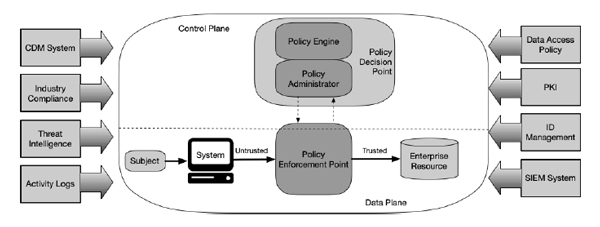
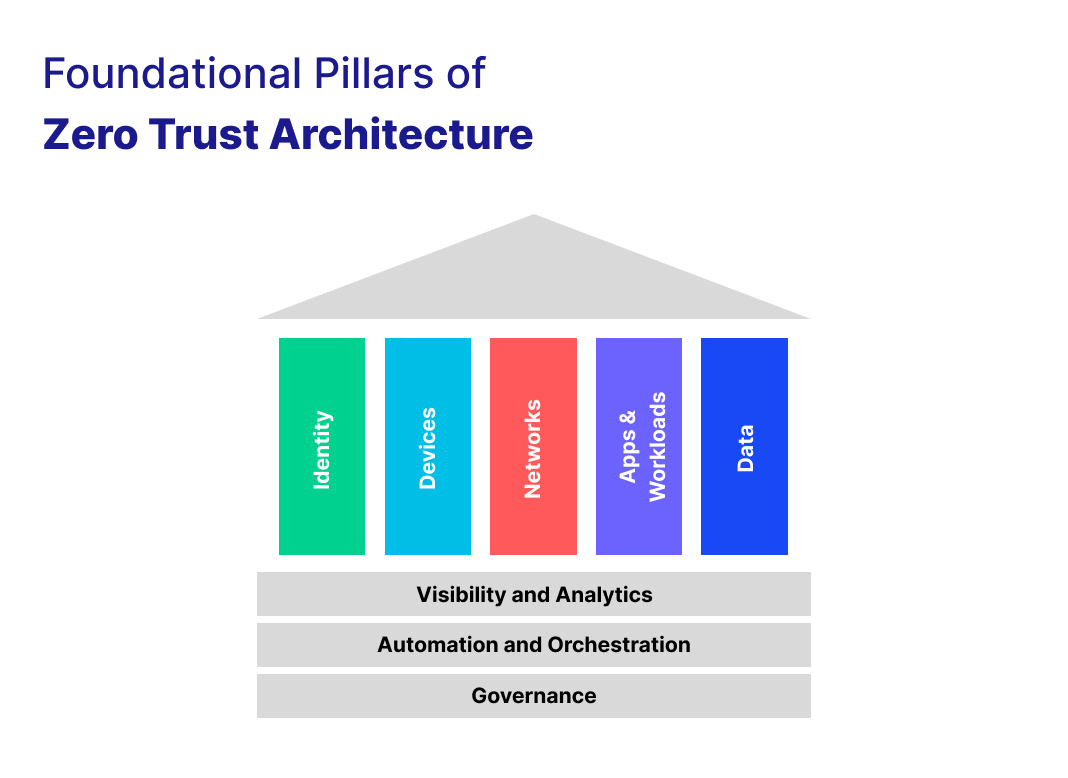
Implementing Zero Trust within a complex financial services environment is vastly different from deploying standard enterprise software. Wall Street institutions operate heterogeneous technology stacks that fuse decades-old COBOL-based mainframe systems with cutting-edge Kubernetes microservices running across hybrid cloud environments. According to industry architectural guidelines, transitioning to Adaptive Trust requires synchronized execution across several critical domains:
- Identity, Credential, and Access Management (ICAM): Moving beyond static passwords and basic multi-factor authentication (MFA) to phishing-resistant, cryptographic authentication tokens and context-aware adaptive access policies.
- Micro-Segmentation: Breaking down monolithic internal networks into isolated, highly secure zones. If a threat actor compromises a peripheral server, micro-segmentation prevents them from pivoting laterally to core financial ledgers or payment gateways like SWIFT networks.
- Continuous Behavioral Analytics: Utilizing machine learning models to establish baselines for user and entity behavior. If a trader's credentials suddenly access anomalous volumes of sensitive data at 3:00 AM from an unrecognized IP address, the system automatically revokes access or steps up authentication requirements in real-time.
- Infrastructure Automation and Telemetry: Ensuring that every endpoint—from high-frequency trading terminals to cloud-native serverless functions—continually reports its security posture and patch compliance back to a centralized orchestration engine.
- AI-Driven Automated Enforcement: The integration of artificial intelligence and machine learning into ZTA fabrics to enable instantaneous, autonomous threat response without requiring human intervention in the security operations center (SOC).
- Quantum-Resistant Cryptography: As the horizon for quantum computing approaches, financial institutions are beginning to bake post-quantum cryptographic standards into their Zero Trust identity and data encryption protocols.
- Regulatory Mandates: Transitioning from voluntary frameworks and supervisory guidance to explicit, codified regulatory mandates requiring documented Zero Trust maturity levels for all G-SIBs.
Verified Data & Metrics Breakdown Table
The transition from legacy perimeter security to Adaptive Trust involves substantial capital allocation, enterprise restructuring, and measurable operational shifts. The following comparative data highlights the structural evolution of financial sector cybersecurity architecture from the pre-ZTA era to current institutional deployments.
| Architectural Metric / Focus Area | Legacy Perimeter Model (Pre-2020) | Adaptive Trust ZTA Model (Current Standard) |
|---|---|---|
| Primary Security Perimeter | Network perimeter firewall and corporate VPN | Identity-centric micro-perimeter and device posture |
| Trust Verification Timing | Static verification at initial login/authentication boundary | Continuous, real-time risk evaluation and telemetry monitoring |
| Lateral Movement Risk | High (flat internal networks allow uninhibited movement) | Mitigated via strict micro-segmentation and least-privilege access |
| Regulatory Audit Focus | Compliance checklist, firewall rule reviews, perimeter audits | Data lineage tracking, identity governance, and resilience testing |
| Primary Industry Catalyst | Compliance adherence and basic perimeter defense | BPI Framework (2022), sophisticated supply-chain attacks, cloud scale |
Industry & Market Implications: Capital Allocation and Valuation Multiples
The operational pivot toward Adaptive Trust carries profound economic repercussions across the financial services ecosystem. Cybersecurity is no longer viewed merely as an operational expense (OpEx) item managed by a back-office IT department; it has evolved into a core determinant of enterprise valuation, risk mitigation, and capital allocation strategy.
Who Wins: Enterprise cybersecurity vendors specializing in identity governance, micro-segmentation, and cloud-native application protection platforms (CNAPPs) are experiencing unprecedented demand. Furthermore, Tier-1 financial institutions that successfully modernize their architectures gain a distinct competitive advantage. They experience lower cyber insurance premiums, reduced vulnerability to costly ransomware remediation, and enhanced trust from institutional clients and regulators alike.
Who Loses: Financial institutions that delay modernization face mounting systemic vulnerabilities, potential reputational damage, and severe regulatory penalties. Legacy hardware vendors relying on traditional perimeter appliance sales are being squeezed out as banks consolidate their tech stacks around software-defined, API-first security frameworks. Moreover, institutions burdened by monolithic, inflexible legacy architectures find themselves at a structural disadvantage, suffering from higher operational drag and sluggish time-to-market for digital products.
From a capital markets perspective, institutional investors and credit rating agencies (such as Moody’s and S&P Global) are increasingly factoring cyber resilience and ZTA maturity into their governance (G) and operational risk scoring. A robust Zero Trust posture acts as a defensive moat against catastrophic tail-risks that can instantly wipe out billions in market capitalization following a major data breach or system outage.
Frequently Asked Questions (People Also Ask)
What is the core difference between traditional perimeter security and Adaptive Zero Trust Architecture?
Traditional security relies on a "castle-and-moat" approach, assuming that anything inside the corporate network is safe once initial authentication is established. Adaptive Zero Trust Architecture assumes breach, enforcing continuous, real-time verification of every user, device, and application request regardless of their network location.
How did the Bank Policy Institute (BPI) influence financial cybersecurity standards in 2022?
The March 2022 BPI white paper authored by Andrew Kennedy provided a comprehensive roadmap tailored specifically to the unique regulatory, infrastructural, and operational complexities of financial institutions. It catalyzed industry-wide consensus on shifting toward identity-centric micro-segmentation and continuous adaptive risk scoring.
Does Zero Trust Architecture introduce latency that could impact high-frequency trading (HFT)?
Early implementations raised concerns regarding network latency; however, modern ZTA deployments utilize optimized software-defined networking, local policy enforcement points, and hardware-accelerated encryption to maintain ultra-low latency tolerances required for high-frequency trading and core transaction processing.
How do regulatory bodies view Zero Trust adoption in banking?
Regulatory agencies—including the SEC, Federal Reserve, and OCC—view ZTA as an essential component of operational resilience. Recent regulatory guidelines increasingly emphasize automated monitoring, data protection, and rapid incident containment, aligning directly with Zero Trust principles.
Future Outlook: The Next Milestones in Financial Cyber Resilience
As financial markets become increasingly digitized, interconnected, and reliant on artificial intelligence, the implementation of Adaptive Trust will enter its next evolutionary phase. Over the next 24 to 36 months, industry experts expect several key milestones to shape the landscape:
Ultimately, the transition catalyzed by the 2022 BPI blueprint is irreversible. In an era where digital trust is the ultimate currency, Adaptive Trust serves as the foundational infrastructure ensuring the stability, security, and integrity of the global financial system.