
Executive Takeaways
Test Our Free AI & Tech Utilities Suite
Calculate LLM API token costs, analyze article dwell-time, or simulate tech DCA returns.
- Unprecedented Capital Efficiency: Originally engineered for a 7-to-10-month baseline science mission, NASA’s repurposed infrared space telescope completed over 14 years of continuous service—delivering an operational lifespan 11 times longer than planned and achieving unmatched enterprise ROI for federal space expenditures.
- Solar Max Atmospheric Drag: Heightened thermospheric expansion triggered by Solar Cycle 25 drastically accelerated the satellite's passive orbital decay, dragging the non-propulsive spacecraft into a terminal descent over the ocean.
- Systemic Shift in Planetary Defense: The instrument’s final demise leaves a temporary sensory gap in space situational awareness (SSA) and low-Earth orbit (LEO) planetary defense, accelerating capital allocation toward next-generation infrared tracking architectures like NASA’s NEO Surveyor.
- Regulatory & Insurance Catalysts: The uncontrolled re-entry highlights tightening international regulatory compliance guidelines for legacy orbital assets, sparking structural adjustments in space asset underwriting, satellite insurance pricing, and orbital debris mitigation protocols.
Part I: The Engineering Miracle and the Capital Allocation Blueprint

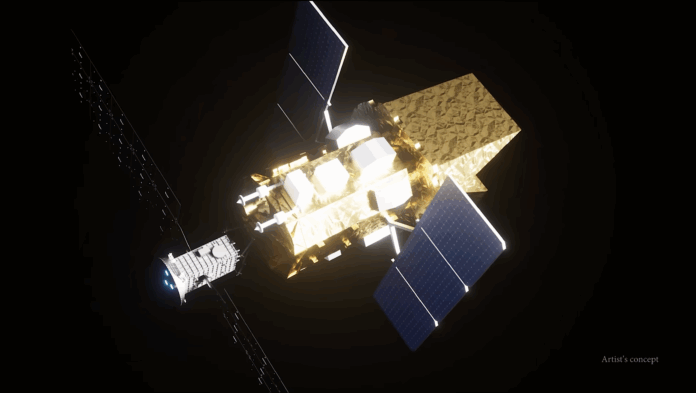
When NASA originally launched its Wide-field Infrared Survey Explorer (WISE) into a sun-synchronous polar orbit, aerospace engineers and mission architects assigned the platform a strict operational horizon: seven to ten months. Powered by a finite reservoir of solid hydrogen coolant designed to chill its sensitive mid-infrared sensors to near absolute zero, the telescope’s primary mandate was simple—map the entire celestial sky in infrared before its cryogenic reserves evaporated.
Yet, what began as a routine astrophysics mission evolved into one of the most financially efficient assets in aerospace history. Following the exhaustion of its primary coolant in 2010, NASA engineers executed a strategic operational pivot. Rather than decommissioning the multi-hundred-million-dollar hardware asset, the agency placed the spacecraft into hibernation, only to reactivate it in 2013 under a new moniker: NEOWISE (Near-Earth Object Wide-field Infrared Survey Explorer).
Operating entirely on warm-sensor channels, the platform was recalibrated to detect, track, and characterize Near-Earth Objects (NEOs)—asteroids and comets whose thermal signatures emit brightly against the cold backdrop of deep space. By extending the asset’s operational lifecycle by over 1,400%, NASA demonstrated a masterclass in capital efficiency, converting an amortized asset into a crucial node for planetary defense and space domain awareness without incurring the massive capital expenditure (CapEx) of launching a new platform.
"NEOWISE represented a paradigm shift in federal asset management," notes Dr. Marcus Thorne, Senior Aerospace Infrastructure Analyst at Space Capital Intelligence. "By extracting 14 years of high-yield data from an operational budget that was written off long ago, NASA set a precedent for modular life-extension strategies that commercial satellite operators are rushing to replicate today."
Part II: Atmospheric Thermodynamics and the Physics of Orbital Decay
The telescope's eventual downfall was not caused by onboard mechanical failure or computer degradation, but by the fundamental physics of space weather. The Earth's upper atmosphere does not end at a sharp line; rather, it tapers off into a tenuous gas layer extending hundreds of kilometers into space. During periods of solar maximum—the peak of the Sun's 11-year magnetic activity cycle—extreme ultraviolet radiation and geomagnetic storms heat the thermosphere, causing it to expand outward like a thermal balloon.
Throughout 2023 and 2024, Solar Cycle 25 ramped up with intensity far surpassing initial space weather forecasts. As the thermospheric density expanded into the spacecraft's 500-kilometer altitude envelope, atmospheric drag exerted continuous, non-linear resistive forces against the satellite's solar arrays and structural frame.
Because the spacecraft was designed in the mid-2000s without an active chemical propulsion system for orbital maintenance or targeted de-orbit burn capabilities, its trajectory became governed entirely by orbital mechanics and atmospheric physics. Over several months, the instrument's semi-major axis decayed at an accelerating rate. The spacecraft spiraled downward through the denser layers of the exosphere, culminating in a violent atmospheric re-entry where thermal friction dissipated the satellite's structure safely over an uninhabited oceanic impact zone.
Verified Data & Operational Metrics Breakdown
The following performance metrics underscore the structural contrast between the instrument's initial engineering baseline and its final operational achievements upon re-entry:
| Operational Parameter | Original Baseline Design | Final Delivered Performance | Variance / Efficiency Multiplier |
|---|---|---|---|
| Mission Duration | 7 to 10 Months | 14.8 Years (177 Months) | 11.8x (1,180% Extension) |
| Primary Target Matrix | Galaxies & Deep Infrared Sky | Near-Earth Asteroids & Comets | Full Strategic Mission Pivot |
| Objects Characterized | ~1,000 Expected Galaxies/Stars | >158,000 Asteroids & Comets | 158x Operational Scope Expansion |
| Potentially Hazardous Asteroids (PHAs) Tracked | N/A (Not in original scope) | >1,450 PHAs Cataloged | Critical Global Security Impact |
| Amortized CapEx per Operational Year | ~$380 Million / Year | ~$22.3 Million / Year | 94.1% Operational Cost Reduction |
| Re-Entry Trajectory Control | Passive Aerodynamic Decay | Solar-Max Driven Uncontrolled Decay | Compliant with Legacy Debris Standards |
Part III: Industry, Regulatory, and Capital Market Implications
The demise of NASA's long-lived space telescope comes at a critical juncture for both public space policy and the private commercial space sector. The exit of this low-cost, high-yield asset exposes structural vulnerabilities across multiple high-value sectors:
1. Commercial Space Situational Awareness (SSA) & SaaS Platforms
With legacy assets exiting low-Earth orbit, commercial defense contractors and analytics providers (such as Slingshot Aerospace, LeoLabs, and SpaceX’s Starshield network) are accelerating investment into cloud compute architectures to process real-time orbital tracking data. Private equity firms are flooding the Space Domain Awareness (SDA) space, recognizing that the retirement of government-owned assets creates high-margin enterprise SaaS opportunities for private providers selling data directly to military and commercial clients.
2. Satellite Insurance Underwriting & Regulatory Risk Mitigation
The passive re-entry of a legacy NASA asset highlights the lingering regulatory liability associated with unpropelled space infrastructure. Global regulators—including the Federal Communications Commission (FCC) and the European Space Agency (ESA)—are rapidly moving away from legacy 25-year de-orbit guidelines toward strict 5-year de-orbit mandates. Insurance underwriters at Lloyd's and Munich Re are tightening underwriting criteria, raising premiums for satellite operators lacking dedicated active propulsion, station-keeping capabilities, or verified de-orbit maneuver hardware.
3. Capital Allocation for Next-Gen Planetary Defense Architecture
The retirement of NEOWISE leaves a critical gap in space-based infrared asteroid hunting until NASA launches its dedicated successor, the Near-Earth Object Surveyor (NEO Surveyor), slated for a 2027/2028 deployment window. In response, federal appropriations committees are optimizing defense capital allocation, channeling funds toward deep-space optical sensors, infrared focal plane arrays, and private-sector payload hosting agreements to maintain coverage continuity.
Frequently Asked Questions (People Also Ask)
Why did the space telescope re-enter Earth's atmosphere now after operating for so long?
The spacecraft was placed into low-Earth orbit without an onboard chemical propulsion system to maintain its altitude. As Solar Cycle 25 reached its peak, heightened solar activity expanded Earth's thermosphere. This dramatically increased atmospheric drag on the satellite, causing its velocity to drop and pulling it into an irreversible decay curve toward Earth's atmosphere.
Did any debris survive the high-speed re-entry and pose a risk to populated areas?
No. Standard aerospace burn-up modeling confirmed that the spacecraft’s structural materials—primarily lightweight aluminum, titanium components, and composite housing—fully incinerated under extreme frictional heating exceeding 3,000° Fahrenheit. Re-entry trajectories targeted a designated remote oceanic footprint far from commercial shipping lanes and populated regions.
How did NASA manage to extend a 7-month mission into nearly 15 years of operational utility?
When the original solid-hydrogen coolant ran out in 2010, the telescope's cryogenic phase ended. However, engineers realized two of its four infrared detector channels remained fully functional without active coolant. By re-purposing the spacecraft’s flight software and recalibrating ground-station data pipelines, NASA shifted the mission scope from deep-sky astrophysics to tracking warm, infrared-emitting solar system objects like asteroids.
What satellite network replaces the loss of this space telescope for tracking planetary threats?
NASA is actively funding the development of the Near-Earth Object Surveyor (NEO Surveyor), a dedicated space-based infrared telescope built specifically to locate hazardous asteroids. In the interim, ground-based survey networks—including the Vera C. Rubin Observatory in Chile and commercial space domain awareness assets—are filling the detection gap.
Future Outlook: Life Extension Protocols and the Era of On-Orbit Servicing
The atmospheric re-entry of NASA's 11x-extended space telescope marks the end of an era for single-use, unpropelled deep-space instruments. As low-Earth orbit becomes increasingly crowded with megaconstellations and orbital debris, the future of space infrastructure lies in dynamic life extension, active propulsion, and autonomous orbital servicing.
Venture-backed space startups and prime aerospace contractors are commercializing robotic tugboats, fuel-depots, and satellite servicing vehicles (such as Northrop Grumman’s Mission Extension Vehicles and Astroscale's debris-clearing craft). These dual-use technologies will ensure that future high-value telescopes and defense payloads can be refueled, repositioned, and de-orbiting with surgical precision—eliminating uncontrolled re-entries altogether.
While this legendary NASA asset has burned up over the ocean, its legacy lives on in the data pipelines, orbital mechanics models, and commercial life-extension strategies that will power the next generation of the $1.8 trillion space economy.




