Executive Takeaways
- The Paradigm Shift: Published on March 21, 2022, the Bank Policy Institute’s (BPI) landmark paper "Adaptive Trust: Zero Trust Architecture in a Financial Services Environment," authored by Andrew Kennedy, catalyzed a fundamental reassessment of capital allocation for cyber defense across global systemically important banks (G-SIBs).
- Erosion of the Perimeter: Legacy "castle-and-moat" network perimeters have been rendered obsolete by rapid cloud compute architecture adoption, remote workforces, and multi-cloud infrastructure scalability.
- Capital Allocation & Valuation Multiples: Tier-1 financial institutions are aggressively redirecting enterprise ROI metrics toward Zero Trust Architecture (ZTA), treating continuous risk mitigation and regulatory compliance as direct drivers of protected valuation multiples and market liquidity.
- Operationalizing Identity: Moving beyond simple multi-factor authentication (MFA), modern ZTA implements dynamic, context-aware policy engines that evaluate behavioral telemetry in real-time, drastically reducing the blast radius of potential nation-state incursions.
For decades, the architectural blueprint of Wall Street’s digital fortress relied on a comforting, yet increasingly perilous, fiction: once a user, device, or application proved its identity at the network perimeter, it was granted implicit trust to roam freely across internal databases, payment rails, and customer ledgers. That perimeter-based security model—effectively a digital castle with a sturdy outer wall and an entirely unguarded courtyard—died a quiet death under the weight of cloud migration, API proliferation, and aggressive cyber espionage.
When the Bank Policy Institute (BPI) published Andrew Kennedy’s defining executive whitepaper, "Adaptive Trust: Zero Trust Architecture in a Financial Services Environment," on March 21, 2022, it served as a clarion call for the financial services sector. The thesis was both stark and unyielding: trust is a vulnerability. In an era where sophisticated threat actors routinely dwell inside enterprise networks for upwards of 200 days before detection, the financial industry could no longer rely on static credentials and perimeter defenses. It had to embrace a philosophy of "never trust, always verify."
The Catalytic Breaking Point: Why Legacy Security Failed Wall Street
Test Our Free AI & Tech Utilities Suite
Calculate LLM API token costs, analyze article dwell-time, or simulate tech DCA returns.
To understand the urgency behind the BPI’s 2022 framework, one must examine the tectonic shifts in how financial institutions consume technology. The traditional banking model was built on centralized, on-premises data centers connected via private, highly controlled Multiprotocol Label Switching (MPLS) circuits. Security teams could wrap their arms around these discrete physical boundaries.
However, the commoditization of cloud compute architecture, accelerated by post-pandemic remote work mandates, shattered these boundaries. Financial institutions rapidly migrated core processing, customer analytics, and client-facing applications to multi-cloud environments (AWS, Microsoft Azure, Google Cloud Platform). Simultaneously, open banking initiatives forced banks to expose proprietary APIs to fintech partners, third-party vendors, and aggregators.
This decentralized topology created a nightmare for Chief Information Security Officers (CISOs). Threat vectors evolved faster than legacy infrastructure scalability could manage. Ransomware gangs transformed from simple data encryptors into extortion syndicates capable of weaponizing stolen internal documentation against market stability. The financial sector—uniquely targeted due to its direct access to capital, sensitive Personally Identifiable Information (PII), and systemic role in global market liquidity—faced mounting pressure from regulators, including the Securities and Exchange Commission (SEC), the Office of the Comptroller of the Currency (OCC), and international bodies, to harden their operational resilience.
Deconstructing "Adaptive Trust": The Core Tenets of Financial ZTA
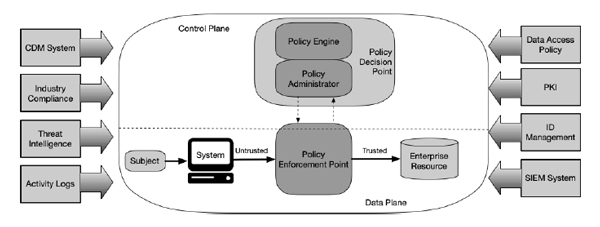
Unlike standard IT modernization initiatives, implementing Zero Trust Architecture in a financial services environment requires a profound cultural and structural overhaul. As outlined in the BPI framework, ZTA is not a single product or appliance that can be procured off-the-shelf; it is an overarching architectural strategy centered on continuous validation.
At its core, financial ZTA rests on three foundational pillars:
- Micro-Segmentation: Breaking down monolithic internal networks into isolated, highly restricted micro-zones. If a threat actor compromises a low-level marketing server, lateral movement to core ledger databases or SWIFT messaging gateways is blocked by internal software-defined perimeters.
- Continuous Contextual Verification: Moving beyond static passwords and basic MFA. Adaptive trust engines continuously analyze hundreds of telemetry signals—including user behavior analytics (UBA), device health status, geographical anomalies, time-of-day access requests, and application context—to dynamically adjust access permissions in real-time.
- Least-Privilege Access: Enforcing strict, role-based and attribute-based access controls (RBAC/ABAC) that ensure employees and automated workloads possess only the bare minimum permissions necessary to execute their immediate functions.
Furthermore, financial institutions must treat every data transaction as potentially hostile. Encryption must be ubiquitous—applied not only when data is in transit across public networks (data-in-transit) and at rest in enterprise databases (data-at-rest), but crucially, while data is actively being processed within memory (confidential computing).
Verified Data & Metrics Breakdown: Legacy vs. Zero Trust Financial Architecture
The transition from perimeter defense to adaptive trust is quantified by significant shifts in operational risk, compliance posture, and capital allocation efficiency across the banking sector.
| Architectural Metric | Legacy Perimeter Model (Pre-2020) | Adaptive Trust ZTA Model (Current Standard) |
|---|---|---|
| Primary Trust Assumption | Internal network users/devices are implicitly trusted. | Zero implicit trust; verify explicitly at every interaction. |
| Average Mean Time to Detect (MTTD) | 197 to 212 days (high dwell time). | Under 24 hours via automated telemetry and AI analytics. |
| Lateral Movement Risk | Extensive; once inside, attackers roam freely. | Near zero; constrained by strict micro-segmentation. |
| Regulatory Compliance Friction | High audit overhead; complex manual boundary mapping. | Automated audit trails, continuous compliance validation. |
| Capital Expenditure Focus | Hardware firewalls, VPN gateways, perimeter appliances. | Identity governance, policy orchestration, cloud security posture. |
Industry & Market Implications: Winners, Losers, and Economic Realities
The widespread adoption of Zero Trust Architecture across banking institutions is not merely a technical compliance checkbox; it is a profound economic restructuring that directly influences corporate valuation multiples and capital allocation strategies.
Who Wins: Resilient Institutions and Enterprise Security Innovators
Tier-1 and Tier-2 financial institutions that successfully operationalize adaptive trust frameworks position themselves favorably in the eyes of institutional investors, credit rating agencies, and regulatory supervisors. By demonstrating superior risk mitigation and operational resilience, these banks protect their brand equity and avoid catastrophic regulatory fines or operational downtime. On the supply side, enterprise cybersecurity vendors specializing in Identity and Access Management (IAM), cloud access security brokers (CASB), and micro-segmentation software enjoy robust revenue growth and expanding valuation multiples.
Who Loses: Legacy Vendors and Complacent Banks
Conversely, financial institutions slow to divest from legacy perimeter-security models find themselves facing disproportionate cyber insurance premiums, punitive regulatory scrutiny, and severe vulnerabilities to supply chain compromises. Furthermore, legacy hardware vendors that relied on selling static firewall appliances and outdated VPN infrastructure face declining revenues as budgets pivot toward software-defined, cloud-native security orchestration.
Frequently Asked Questions (People Also Ask)
1. What is the fundamental difference between legacy network security and Zero Trust Architecture in banking?
Legacy security operates on a "trust but verify" model, assuming that internal users, devices, and applications inside the corporate network perimeter are safe. Zero Trust Architecture (ZTA) operates on an "never trust, always verify" model. Every access request—regardless of whether it originates from inside or outside the physical bank building—is authenticated, authorized, and encrypted before access is granted.
2. How does Andrew Kennedy’s BPI paper impact regulatory compliance for financial institutions?
The Bank Policy Institute’s 2022 framework provides a strategic blueprint that aligns banking technology operations with stringent regulatory expectations from bodies like the SEC and OCC. By emphasizing continuous monitoring, micro-segmentation, and immutable audit trails, ZTA helps banks satisfy mandates regarding operational resilience, customer data protection, and systemic risk management.
3. Does Zero Trust Architecture eliminate the need for Multi-Factor Authentication (MFA)?
No. MFA is a foundational baseline component of Zero Trust, but ZTA goes significantly further. While MFA verifies identity at the initial login point, ZTA continuously evaluates context throughout the entire session—monitoring user behavior, device compliance, network anomalies, and data sensitivity to dynamically adapt access rights in real-time.
4. What are the primary capital expenditure challenges banks face when implementing ZTA?
The primary hurdles include rearchitecting legacy monolithic applications that were never designed for micro-segmentation, managing complex multi-cloud integration, overcoming cultural resistance to new authentication workflows, and reallocating substantial IT budgets away from traditional hardware toward advanced identity governance and behavioral analytics platforms.
Future Outlook: The Road Ahead for Financial Cyber Resilience
As financial ecosystems become increasingly interconnected through real-time payment rails, open banking APIs, and artificial intelligence-driven trading algorithms, the attack surface will continue to expand exponentially. The principles articulated in the Bank Policy Institute’s 2022 whitepaper mark only the beginning of a generational evolution in financial engineering.
Over the next three to five years, industry watchers should monitor several critical milestones:
- AI-Driven Policy Orchestration: The integration of advanced machine learning models capable of dynamically rewriting micro-segmentation and access policies in milliseconds based on emerging threat intelligence.
- Post-Quantum Cryptography Integration: As quantum computing threatens traditional RSA and ECC encryption standards, financial institutions will bake post-quantum cryptographic algorithms directly into their Zero Trust data pipelines.
- Standardized Interoperability: The development of universal industry standards for cross-institutional Zero Trust identity federation, allowing secure, frictionless collaboration between global banks, fintechs, and central bank digital currency (CBDC) networks.
Ultimately, adaptive trust is no longer a competitive differentiator; it is the fundamental cost of doing business in a hostile digital economy. Financial institutions that master this architecture will safeguard their liquidity, protect their customers, and secure their market valuation for decades to come.