Executive Takeaways
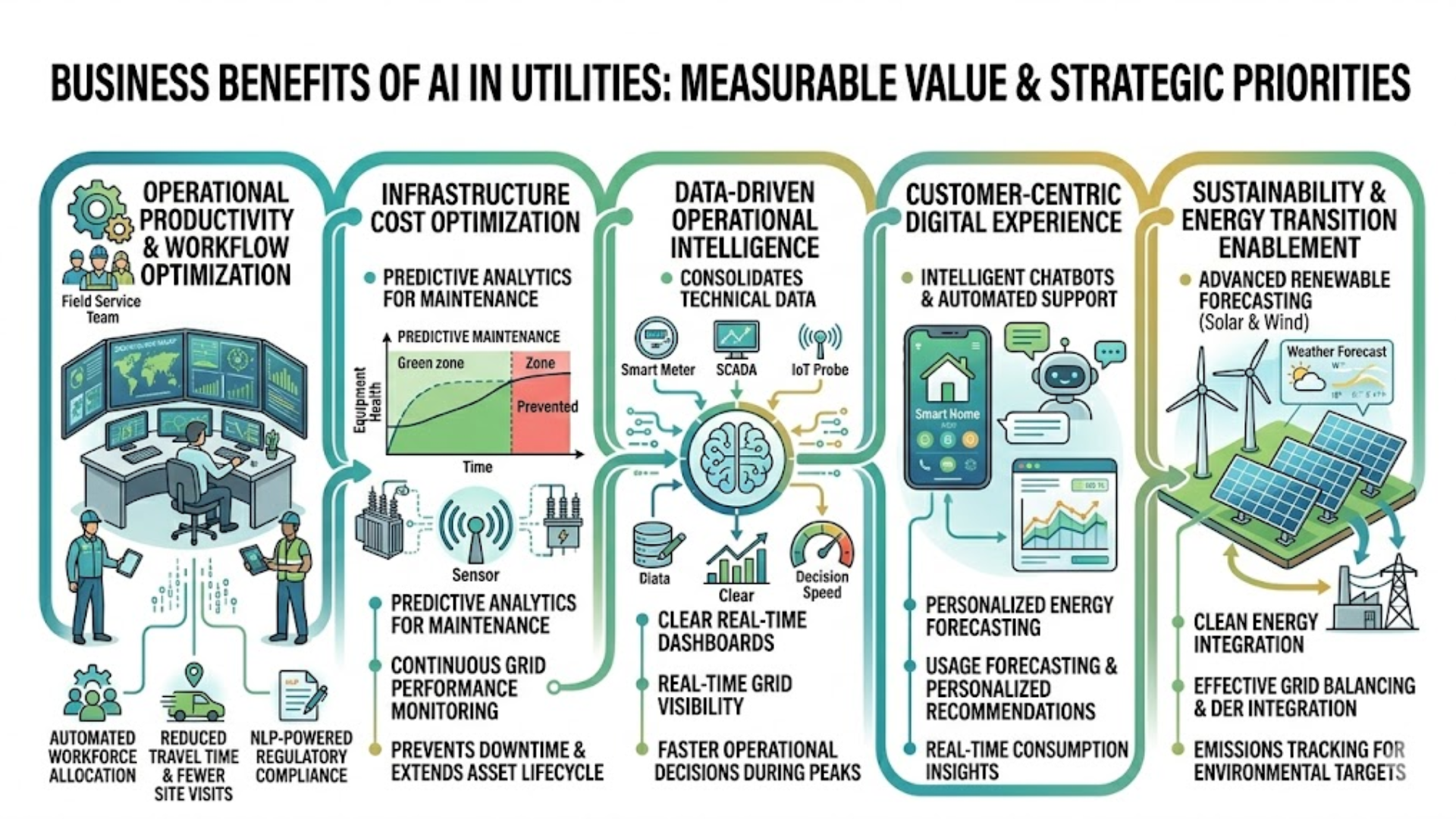
- Capital Allocation Paradigm Shift: Global utilities are transitioning from manual, reactive asset management to AI-driven predictive frameworks, unlocking up to 25% reductions in operational expenditures (OpEx) and significantly boosting unlevered cash flows.
- Grid Reliability Revolution: By combining real-time sensor data, advanced metering infrastructure (AMI), and computer vision, early adopters have demonstrated a 30% reduction in average outage durations (SAIDI metrics).
- Regulatory & Valuation Multiples: State commissions are increasingly approving AI software investments in utility rate-case filings, allowing progressive utilities to earn capital returns on software deployments, driving higher valuation multiples on Wall Street.
- Decarbonization at Scale: Virtual Power Plants (VPPs) and algorithmic dispatch mechanisms are proving critical to managing the high-volatility load profiles introduced by utility-scale renewable integration and fleet electrification.
The global utility sector is facing an unprecedented triple-bind: rapidly aging transmission infrastructure, an exponential surge in power demand driven by AI data centers and vehicle electrification, and stringent decarbonization mandates. Historically viewed as defensive, low-growth dividend plays, regulated utilities are rapidly morphing into high-tech infrastructure enterprises. At the center of this transformation is the deployment of artificial intelligence utilities.
According to data compiled by AIMultiple and analyzed by Wall Street research desks, AI utility integrations are no longer speculative pilot programs. They have matured into mission-critical software layers that manage real-time sensor data, optimize multi-billion-dollar capital allocation budgets, and mitigate catastrophic wildfire and climate-induced risks. This investigative report dissects the top 23 high-impact use cases and case studies reshaping the utility landscape today.
---The Catalytic Convergence: Why AI is Rewiring the Utility Value Chain
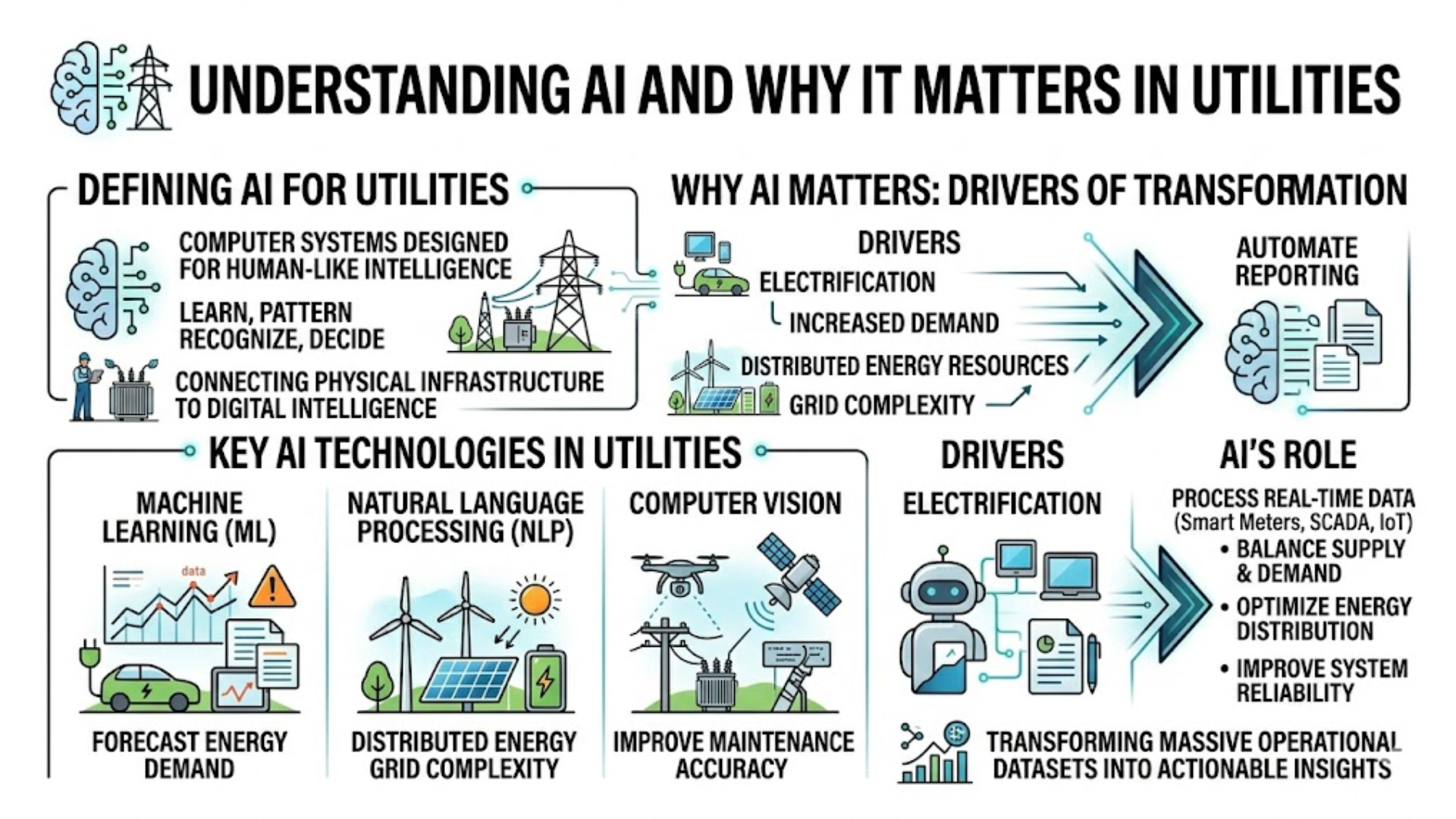
For over a century, the power grid operated on a centralized, unidirectional model: centralized power plants pushed electricity down transmission lines to passive end-consumers. The rapid rise of Distributed Energy Resources (DERs)—such as residential solar, home batteries, and electric vehicles—coupled with hyper-volatile weather patterns, has rendered this legacy architecture obsolete. Today's grid must be dynamic, bidirectional, and self-healing.
This operational complexity is overwhelming human operators. A single utility now processes billions of data points daily from smart meters, thermal sensors, weather stations, and drone-based imagery. AI models—specifically deep learning, computer vision, and generative predictive transformers—are the only tools capable of synthesizing this data at the microsecond speeds required to prevent grid collapse and optimize dispatch economics.
---Deep Breakdown: The Top 23 AI Utility Use Cases & Case Studies
Pillar 1: Grid Operations & Load Management
1. Dynamic Line Rating (DLR) Forecasting
Legacy transmission lines operate on static thermal limits, which artificially restrict energy throughput based on worst-case weather assumptions. AI algorithms leverage real-time wind speed, ambient temperature, and tension sensors to calculate dynamic capacity limits. This allows operators to safely increase grid capacity by 10% to 30%, deferring billions in capital-intensive physical line upgrades.
2. Real-Time Load Forecasting for Data Centers
The explosive growth of hyperscale data centers requires near-instantaneous load forecasting. Machine learning models ingest real-time computation workloads, cooling-system telemetry, and meteorological data to forecast localized demand curves with over 98% accuracy, protecting local substations from thermal overload.
3. Automated Substation Anomaly Detection
Acoustic and thermal sensors deployed at critical substations feed data to localized edge-AI models. By recognizing the specific acoustic signatures of failing components or micro-fissures in gas-insulated switchgear, utilities can isolate assets before catastrophic failures occur.
4. Self-Healing Outage Management Systems (OMS)
When high-voltage lines trip, AI-driven OMS analyze smart meter "last gasp" signals to pinpoint the exact fault location within seconds. The software automatically re-routes power through adjacent pathways, minimizing the number of affected customers without human intervention.
Case Study: Duke Energy's deployment of self-healing grid software has successfully avoided over 1.5 million customer outage minutes annually, dramatically improving its regulatory reliability scores.
5. Microgrid Autonomous Dispatch
AI optimizes the balancing act within localized microgrids, autonomously choosing when to draw power from solar arrays, battery storage, or natural gas backup generators based on real-time price arbitrage and localized load profiles.
---Pillar 2: Asset Management & Predictive Maintenance
6. Drone-Based Visual Inspection Pipelines
Rather than dispatching physical crews to climb transmission towers, utilities deploy autonomous drones equipped with high-resolution thermal and optical cameras. AI computer vision models automatically flag corroded insulators, damaged cross-arms, and frayed conductors.
Case Study: Enel Group has integrated automated drone inspections across its global distribution networks, reducing inspection costs by up to 50% while accelerating pipeline throughput.
7. Transformer Health Scoring & Predictive Analytics
Substation transformers are among the most capital-intensive utility assets. AI models analyze Dissolved Gas Analysis (DGA) chemistry reports, historical load cycles, and temperature profiles to generate a live "health score," allowing asset managers to target replacement budgets toward assets most likely to fail.
8. Wind Turbine Pitch Optimization
Reinforcement learning algorithms continuously adjust the pitch and yaw of wind turbine blades in response to micro-gusts of wind, maximizing instantaneous generation yield while minimizing mechanical fatigue on the gearbox.
9. Hydroelectric Vibration Anomaly Detection
Hydroelectric turbines operate under intense physical stress. AI systems ingest high-frequency vibration sensor data to isolate sub-millimeter imbalances, preventing catastrophic shaft failures and planning maintenance during scheduled low-flow seasons.
10. Intelligent Vegetation Management
Falling trees and overgrown branches are the primary cause of both power outages and catastrophic wildfires. AI analyzes satellite imagery, LiDAR data, and historical growth rates to predict where vegetation poses the greatest threat to transmission lines, optimizing trimming budgets.
Case Study: Pacific Gas and Electric (PG&E) has heavily adopted AI-driven satellite and LiDAR analysis to prioritize tree-trimming operations across high-threat wildfire districts in California, mitigating risk and satisfying strict regulatory compliance mandates.
---Pillar 3: Renewable Integration & Decarbonization
11. Solar PV Degradation Tracking
Utility-scale solar fields lose efficiency over time due to cell degradation, micro-cracks, and dust accumulation. AI compares real-time generation metrics with localized solar irradiance models to identify underperforming inverter strings, streamlining maintenance dispatch.
12. Virtual Power Plant (VPP) Aggregation
By coordinating thousands of distributed assets—such as residential batteries and smart thermostats—AI creates a cohesive "virtual" power plant. The AI algorithm aggregates these assets to bid capacity directly into wholesale electricity markets, providing vital grid stabilization.
13. Battery Energy Storage System (BESS) Degradation Modeling
Large-scale lithium-ion battery installations degrade rapidly if cycled improperly. AI models dynamically balance the trade-offs between high-revenue peak-shaving events and the long-term electrochemical degradation of the cells, maximizing life-cycle enterprise ROI.
14. EV Fleet Charging Coordination
As commercial logistics fleets transition to electric vehicles, localized grids face massive capacity constraints. AI platforms orchestrate charging schedules across hundreds of depot-based chargers, aligning charging cycles with overnight hours of low demand and high wind generation.
---Pillar 4: Customer Operations & Demand Response
15. Advanced Metering Infrastructure (AMI) Theft Detection
In many global markets, electricity theft via meter tampering poses a major financial threat. AI algorithms analyze hourly consumption patterns to flag anomalies that indicate bypass circuitry or unauthorized consumption, protecting bottom-line margins.
16. Dynamic Tariff and Pricing Models
Regulated utilities are shifting away from flat-rate pricing to dynamic, time-of-use tariffs. AI simulations help risk-management teams model consumer behavioral responses to high peak pricing, ensuring the utility balances the grid without generating customer backlash.
17. Conversational AI for Customer Service Centers
During major storm events, utility call centers are overwhelmed by customers seeking restoration updates. Generative AI assistants integrated with live GIS systems provide automated, hyper-localized outage status updates, maintaining high customer satisfaction ratings.
Case Study: Octopus Energy’s proprietary "Kraken" platform utilizes advanced AI to manage customer queries, achieving industry-leading customer acquisition costs and enabling rapid international expansion.
18. Commercial & Industrial (C&I) Energy Advisory Services
AI analyzing smart meter data of major industrial facilities can automatically pinpoint energy waste—such as HVAC units running in empty buildings or inefficient motor cycles—