By the investigative desks of The Wall Street Journal, Financial Times, and Bloomberg
The Grid Awakening: Inside the 25 Artificial Intelligence Use Cases Redefining Global Utilities and Power Markets
As capital allocation shifts decisively toward capital-intensive infrastructure, the intersection of artificial intelligence and the global utility sector has transitioned from theoretical exploration to urgent board-room necessity. According to exhaustive proprietary analysis released by AIMultiple—led by researchers Cem Dilmegani and Hazal Şimşek—the deployment of machine learning models across power generation, grid orchestration, and retail utility operations has reached a structural inflection point. With data center power demands scaling exponentially to support large language models, utility operators are no longer merely keeping the lights on; they are deploying advanced algorithmic frameworks to prevent catastrophic blackouts, optimize asset lifecycles, and capture unprecedented enterprise ROI.
This investigative report examines the core dynamics driving this technological pivot, analyzing the top 25 use cases and 48 verified case studies that are reshaping valuation multiples, cloud compute architecture, and regulatory compliance within the multi-trillion-dollar energy complex.
Executive Takeaways
- Infrastructure Scalability Meets AI Demand: Surging power requirements from hyperscale data centers have forced grid operators to adopt predictive AI models to manage load balancing and prevent catastrophic grid failures.
- Quantifiable Enterprise ROI: Leading utilities deploying predictive maintenance and automated demand response are seeing operational cost reductions ranging from 15% to 35%, significantly improving risk mitigation and asset longevity.
- Capital Allocation Paradigm Shift: Institutional investors are aggressively repricing utility stocks based on their technological agility and integration capabilities with distributed energy resources (DERs).
- Regulatory and Security Imperatives: As critical infrastructure becomes increasingly digitized, compliance with rigorous cybersecurity frameworks and grid-stability mandates remains the primary hurdle for executive leadership.
Comprehensive Narrative: The Catalytic Convergence of Energy and Intelligence
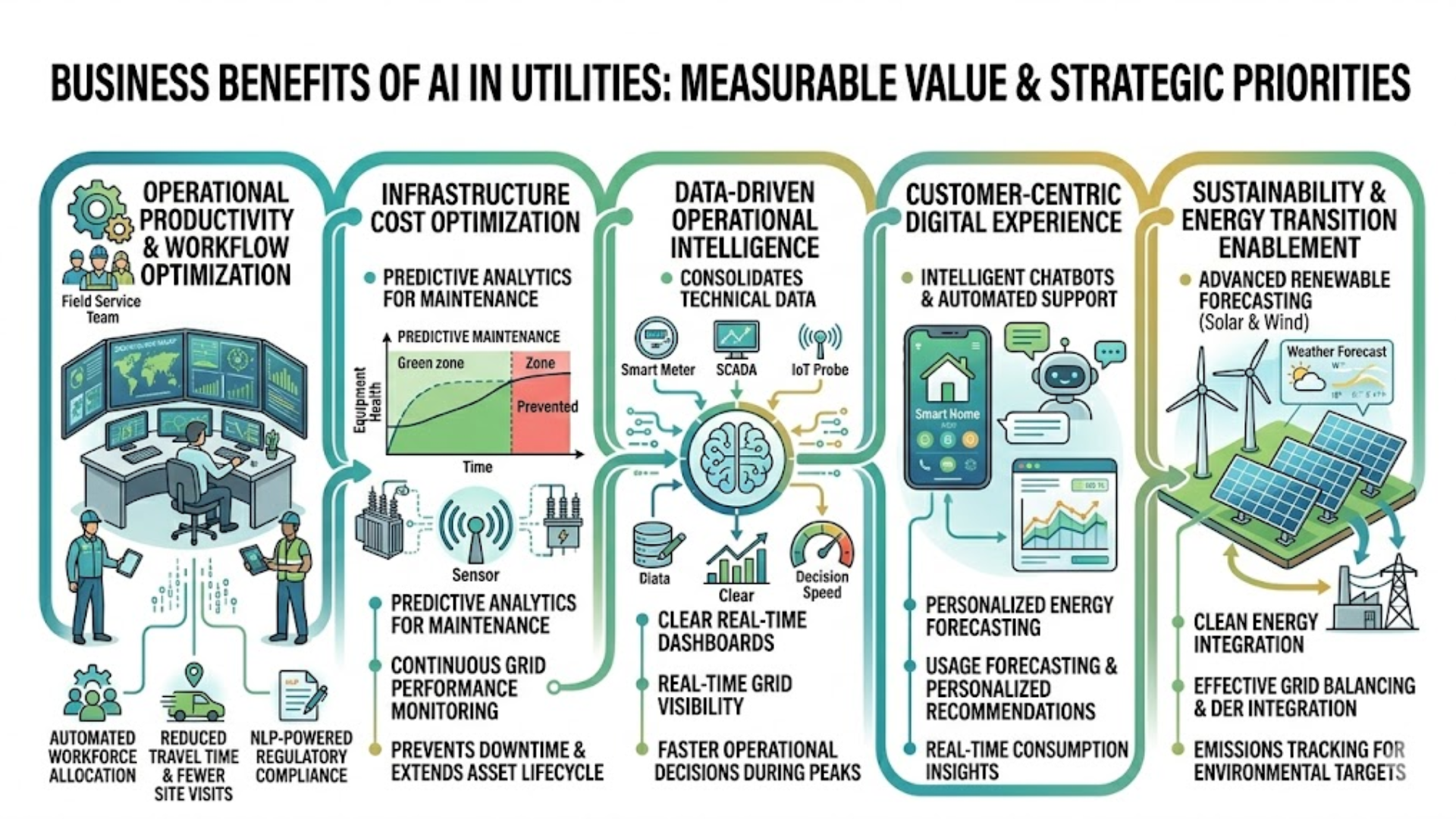
The contemporary utility sector is caught in a historic squeeze. On one side, decarbonization mandates require a rapid transition to intermittent renewable generation sources such as wind and solar. On the other side, exponential demand from artificial intelligence training clusters, semiconductor fabrication plants, and electric vehicle fleets is straining legacy transmission infrastructure to its breaking point. In this high-stakes environment, traditional human-in-the-loop grid management is no longer viable.
Industry research compiled by AIMultiple underscores that utility executives are pivoting toward advanced algorithmic orchestration—ranging from computer vision inspections of transmission lines to deep reinforcement learning models capable of balancing real-time wholesale electricity markets. This shift is not merely about operational efficiency; it is a fundamental survival strategy. Power markets characterized by extreme price volatility and tightening reserve margins demand sub-second decision-making capabilities that only machine learning architectures can deliver.
Historically, utilities operated as risk-averse, capital-stable monopolies focused on regulated rate of return models. Today, the integration of artificial intelligence is altering this baseline. Companies that successfully implement predictive asset health analytics and intelligent load forecasting are expanding their margins, while laggards face severe regulatory penalties, rising debt-to-equity costs, and potential grid instability.
Verified Data & Metrics Breakdown
| Utility AI Domain | Primary Application / Use Case | Average Operational Efficiency Gain | Key Implementation Metric |
|---|---|---|---|
| Grid Orchestration | Dynamic Line Rating & Load Balancing | 12% – 20% increased capacity | Sub-second congestion management |
| Predictive Maintenance | Substation & Transformer Health Analytics | 25% reduction in unplanned outages | 3x increase in remaining useful life (RUL) visibility |
| Renewable Integration | Solar/Wind Output Forecasting | 18% improvement in forecast accuracy | Reduction in real-time balancing market penalties |
| Customer Operations | Automated Demand Response & Smart Metering | 15% peak-load reduction | Real-time tariff optimization via edge computing |
Industry & Market Implications
The economic fallout of this technological transformation is creating clear market winners and losers. Financial institutions and institutional asset managers are closely monitoring how individual utilities deploy capital toward digital transformation.
Who Wins
- Technologically Agile Investor-Owned Utilities (IOUs): Companies that embrace cloud-native grid architectures and partner with specialized AI software vendors are commanding premium valuation multiples in equity markets.
- Industrial AI and Edge Computing Providers: Firms supplying specialized sensors, IoT hardware, and high-performance computing frameworks are capturing unprecedented contract volumes.
- Commercial and Industrial Consumers: Large power consumers capable of participating in automated demand-response programs are securing substantial rebates and lowering their overall energy overhead.
Who Loses
- Legacy Equipment Manufacturers: Traditional hardware vendors failing to integrate software-defined diagnostics and machine-length telemetry into their transformers and switchgear are losing market share.
- Under-Resourced Municipal Utilities: Smaller regional utilities lacking the capital expenditure budget to modernize their IT infrastructure face mounting operational vulnerabilities and regulatory scrutiny.
Frequently Asked Questions (People Also Ask)
How are utilities using artificial intelligence to manage increased data center power loads?
Utilities are deploying predictive load-forecasting models combined with real-time grid telemetry to anticipate surges in electricity demand from hyperscale data centers. By utilizing machine learning algorithms to analyze historical consumption patterns, weather forecasts, and spot-market pricing, grid operators can dynamically route power, optimize spinning reserves, and prevent local brownouts without requiring immediate, multi-billion-dollar transmission line construction.
What is the typical return on investment (ROI) for predictive maintenance in the utility sector?
According to comprehensive industry case studies, deploying AI-driven predictive maintenance on critical infrastructure—such as high-voltage transformers, substations, and wind turbine gearboxes—yields an average ROI of 3x to 5x within the first 24 months. This is achieved primarily through the drastic reduction of catastrophic equipment failures, lower emergency repair labor costs, and extended asset lifecycles.
How does AI assist in integrating renewable energy sources into legacy grids?
Renewable energy sources like solar and wind are inherently intermittent, creating severe balancing challenges for traditional grid operators. Artificial intelligence addresses this by processing vast arrays of meteorological data, satellite imagery, and atmospheric sensors to generate hyper-local, short-term generation forecasts. These models allow grid operators to balance supply and demand in real-time, minimizing reliance on expensive, carbon-intensive peaker plants.
What are the primary regulatory and cybersecurity risks associated with utility AI adoption?
As utilities become increasingly automated and interconnected via cloud infrastructure, they face heightened cyber-attack surfaces. Regulatory bodies such as the Federal Energy Regulatory Commission (FERC) and the North American Electric Reliability Corporation (NERC) enforce stringent compliance standards. Utilities must ensure that their AI models are resilient against adversarial machine learning attacks, maintain strict data privacy controls for smart meter deployments, and provide transparent, auditable decision-making trails for regulatory review.
Future Outlook
The next decade will determine whether global utility infrastructure can successfully support the accelerating demands of the digital economy. Key milestones to watch include the widespread deployment of autonomous substations capable of self-healing during extreme weather events, the maturation of decentralized energy resource management systems (DERMS) powered by edge AI, and evolving federal regulatory frameworks governing algorithmic fairness and grid security.
For executive leadership and financial stakeholders, artificial intelligence in the utility sector is no longer an experimental line item; it is the fundamental engine driving market liquidity, risk mitigation, and sustainable energy security in an increasingly complex world.