Executive Takeaways
Test Our Free AI & Tech Utilities Suite
Calculate LLM API token costs, analyze article dwell-time, or simulate tech DCA returns.
- Valuation Disparity & Capital Allocation: Apple Inc. (NASDAQ: AAPL) continues to trade near peak enterprise valuations, driven by its unmatched $100 billion annual share repurchase program and ecosystem monetization, whereas Netflix Inc. (NASDAQ: NFLX) reflects volatile valuation swings as the market re-prices streaming unit economics.
- Moat Durability vs. Content Depreciation: Apple’s hardware-software lock-in across 2.2 billion active devices provides a recurring Services gross margin exceeding 74%, contrasting sharply with Netflix’s ongoing capital expenditure demands required to mitigate subscriber churn and offset content amortization costs.
- Free Cash Flow Resilience: Apple’s structural free cash flow (FCF) conversion and defensive balance sheet offer institutional investors superior downside protection and lower weighted average cost of capital (WACC) compared to media-dependent cash flow models.
- The Definitive Institutional Buy: Despite Apple's elevated price-to-earnings (P/E) multiple, its multi-layered monetized ecosystem, expanding enterprise infrastructure, and capital return strategy make it the definitive single stock allocation over Netflix for long-term risk-adjusted returns.
The Great Big-Tech Divergence: Silicon Moats vs. Content Treadmills
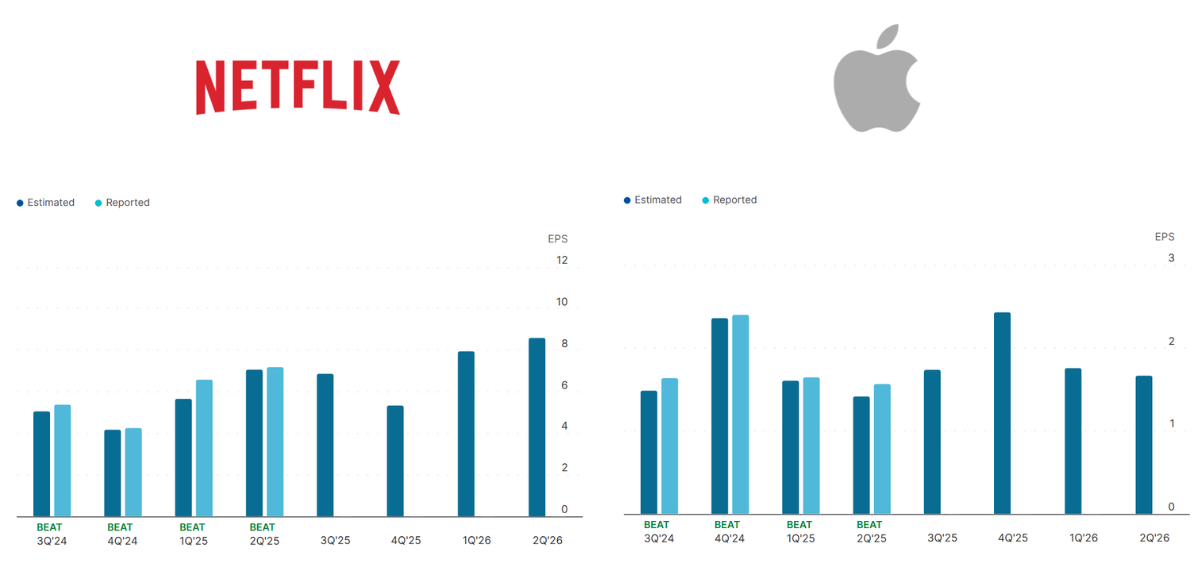
In the upper echelon of institutional portfolio management, capital deployment decisions rarely boil down to simple chart patterns. They hinge on fundamental moat durability, capital return predictability, and structural return on invested capital (ROIC). Today, global macro desks and buy-side analysts face a classic equity allocation dilemma: Do you pay a premium for Apple Inc., a mega-cap tech fortress hovering near all-time historic market valuations, or do you step into Netflix Inc., a digital media pioneer navigating content saturation, ad-tier monetization transitions, and shifting subscriber growth metrics?
The historical trajectory of both equities illustrates two vastly different operational architectures. Apple’s rally toward multi-trillion-dollar valuations is anchored in an ironclad hardware consumer footprint, an expanding High-Margin Services division, and an aggressive share buyback framework that consistently reduces float while increasing earnings per share (EPS). Conversely, Netflix has experienced severe drawdowns from its peak, driven by intense streaming competition, rising content acquisition expenditures, and market skepticism surrounding long-term subscriber lifetime value (LTV).
To evaluate which asset offers superior risk-adjusted alpha, institutional investors must scrutinize the mechanics of their underlying business models, balance sheet health, free cash flow generation, and long-tail monetization vectors.
Deconstructing Apple: The World’s Most Powerful Capital Compounder
1. The 2.2 Billion Active Device Lock-In
Apple’s primary competitive advantage lies in its unmatched hardware-software integration. With an active installed base surpassing 2.2 billion devices globally, the Cupertino giant has constructed a self-reinforcing consumer technology loop. The friction required for a user to exit the Apple ecosystem—transitioning across iOS, macOS, watchOS, iCloud, Apple Pay, and AppleCare—creates an unprecedented switching cost moat.
Furthermore, Apple’s enterprise penetration continues to accelerate. As corporate IT departments increasingly adopt Mac and iPad hardware for remote deployment and internal security standardization, Apple’s enterprise ROI footprint has expanded beyond consumer electronics into critical corporate IT infrastructure.
2. High-Margin Services as a Growth Engine
While iPhone hardware cycles experience natural, elongated upgrade timelines, Apple’s Services sector—encompassing the App Store, Apple Music, iCloud, Apple Pay, and licensing agreements—has grown into a higher-margin business unit. Operating at gross margins frequently exceeding 74%, Services decoupling reduces Apple’s reliance on physical supply chains and manufacturing cycles, effectively transforming physical device sales into high-yielding, recurring high-margin SaaS-like revenue streams.
3. Capital Return Engine: The Ultimate Floor for Shareholder Value
From a corporate finance perspective, Apple operates as an extraordinary capital allocation vehicle. Leveraging massive balance sheet liquidity, Apple has retired hundreds of billions of dollars in equity over the past decade through share repurchases. This systematic reduction in outstanding shares serves as a structural bid under the stock, amplifying EPS growth even during quarters of flat top-line revenue expandability. Combined with low net leverage and elite credit ratings, Apple’s WACC remains optimized against macro interest rate volatility.
Deconstructing Netflix: The Pivot to Ad-Tiers, Paid Sharing, and Live Media
1. The Content Amortization Treadmill
Unlike Apple, whose ecosystem monetizes third-party software developers and recurring hardware refreshes, Netflix must continuously fund massive original content slates to arrest subscriber churn. While Netflix has successfully transitioned into generating positive annual free cash flow, the business model remains fundamentally capital-intensive. Cash deployed today into content production amortizes over multi-year periods, creating operational risk if hit-rate ratios decline or consumer viewing preferences fragment.
2. Monetization Pivots: Password Sharing Crackdowns and AVOD
To combat subscriber growth deceleration in saturated Western markets, Netflix executed two major strategic shifts: enforcing paid sharing rules and launching an Ad-Supported Video on Demand (AVOD) subscription tier. While these measures sparked an initial surge in subscriber additions and expanded average revenue per user (ARPU) in key regions, they represent one-time structural adjustments rather than infinite compounding engines.
Building an ad-tech pipeline requires massive infrastructure scalability, enterprise sales channels, and direct competition against established digital ad platforms like Alphabet and Meta. While ad-supported tiers expand Netflix's total addressable market (TAM), they expose the firm to cyclical advertising spending budgets, contrasting with Apple's stable software subscription cash flows.
3. Live Sports and Event Streaming Risk
In pursuit of broad-appeal live content to sustain advertising volume, Netflix has begun securing high-cost live sports broadcasting rights and special event coverage. While live streaming drives transient user engagement, it escalates licensing acquisition costs and introduces infrastructure scalability challenges, including server bandwidth management during peak concurrent traffic events.
Financial & Operational Valuation Matrix
The following comparative matrix outlines key fundamental metrics, capital efficiency indicators, and financial multiples across both corporate entities:
| Financial Metric / Strategy Benchmark | Apple Inc. (NASDAQ: AAPL) | Netflix Inc. (NASDAQ: NFLX) |
|---|---|---|
| Market Cap / Enterprise Value | Mega-Cap Fortress (~$3.3T - $3.5T) | Large-Cap Growth (~$250B - $300B) |
| Trailing & Forward P/E Ratio | 30x - 34x (Premium Valuation) | 32x - 38x (Growth-Adjusted Premium) |
| Services / Operating Gross Margin | ~45% Overall (~74%+ Services) | ~45% - 48% Gross (~26% Operating Margin) |
| Free Cash Flow (FCF) Generation | ~$100B - $110B Annually | ~$6B - $7B Annually |
| Capital Return Strategy | Aggressive Buybacks (~$90B+/yr) + Dividends | Opportunistic Buybacks; No Dividend |
| Monetization Engine | Hardware Ecosystem + Software/Services | Subscription Tiers + Ad Revenue |
| Customer Acquisition Cost (CAC) & Churn | Extremely Low (High Device Lock-in) | Moderate to High (Content-Dependent) |
| Balance Sheet & Net Debt Risk | Minimal Net Leverage; Top-Tier Liquidity | Moderate Net Leverage; Cash Committed to Content |
Industry & Market Implications: Macro Trends and Institutional Order Flow
For institutional fund managers navigating high interest rate regimes, geopolitical friction, and supply chain re-shoring, asset selection within Big Tech requires evaluating macro downside protection alongside growth potential.
1. Institutional Capital Flight to Quality: When broader market volatility increases, sovereign wealth funds, pension plans, and institutional asset managers systematically tilt toward liquidity balance sheets. Apple operates as a pseudo-fixed-income proxy for major funds due to its relentless buyback mechanism and non-cyclical Services revenue floor. Netflix, while operationally improved, remains inherently high-beta and highly sensitive to consumer discretionary spending pullbacks.
2. The Artificial Intelligence Monetization Vector: Apple’s integration of on-device AI ("Apple Intelligence") positions the hardware manufacturer to trigger a multi-year supercycle of hardware upgrades. Because localized compute architectures demand advanced silicon (N-series and M-series chips with high unified memory), older iPhone models cannot run edge-AI applications natively. This creates an immediate catalyst for enterprise and consumer hardware refresh cycles. Netflix, by contrast, utilizes machine learning primarily for content recommendations and ad targeting, which optimizes platform conversion but does not create an immediate, new hardware monetization engine.
3. Advertising Dynamics vs. Ecosystem Pricing Power: While Netflix’s expansion into ad tiers unlocks lower-income demographics, it ties a portion of its revenues to macro ad spending budgets. Apple, conversely, controls the privacy standards of its App Store ecosystem (via App Tracking Transparency), enabling it to dictate advertising norms across its hardware environment while capturing lucrative search licensing distributions.
Frequently Asked Questions (People Also Ask)
Is Apple worth buying near historic record high valuations?
Yes, from a long-term total return perspective. While Apple’s immediate price-to-earnings multiple may look elevated relative to traditional value metrics, its valuation is supported by an active base of over 2.2 billion devices, accelerating high-margin Services revenues (74%+ gross margin), and an unmatched share repurchase program that systematically boosts EPS. Institutional investors view Apple as a low-beta compounder with superior capital preservation qualities during volatile macro environments.
Why is Netflix considered a riskier long-term hold than Apple despite its streaming dominance?
Netflix operates in a capital-intensive industry that requires continuous billions in content cash outlay to combat subscriber churn and maintain market share. Unlike Apple, which benefits from multi-year hardware ecosystem switching costs and self-sustaining developer platforms, Netflix faces intense competition from legacy media conglomerates and tech rivals (Amazon, Disney, Apple TV+), limiting its pricing flexibility and long-term free cash flow stability.
How does Apple’s capital allocation strategy differ from Netflix’s?
Apple executes one of the most aggressive capital return programs in corporate history, deploying over $90 billion annually in share buybacks while systematically paying quarterly dividends and maintaining low net leverage. Netflix, while returning to positive FCF, prioritizes funding its ongoing content slate, acquiring media rights, and expanding its ad-tech infrastructure, resulting in significantly lower overall capital return efficiency to shareholders.
What key catalysts could drive future earnings growth for both companies?
For Apple, the primary catalysts include the multi-year hardware refresh supercycle driven by on-device AI integration (Apple Intelligence), ongoing enterprise hardware adoption, and expanded monetization of digital services. For Netflix, key catalysts include expanding ARPU through its ad-supported subscription tier, successful scaling of live sports events, and continuous optimization of its paid password-sharing initiatives.
Future Outlook: Strategic Roadmaps and Final Verdict
As institutional capital assesses tech exposure over the next decade, the strategic divergence between Apple and Netflix will become even more pronounced. Netflix has successfully proven its capability to transition from pure subscriber growth to operational efficiency, positive free cash flow, and multi-tier subscription models. However, it remains a digital media enterprise bound by the laws of content depreciation, media competition, and consumer discretionary spending variability.
Apple, on the other hand, is an irreplaceable structural technology infrastructure platform. Its transition toward on-device artificial intelligence processing, coupled with its massive Services ecosystem, robust balance sheet, and constant capital return mechanism, provides an unmatched floor for shareholder value creation.
The Final Institutional Decision: If forced to allocate capital exclusively to one of these mega-cap tech entities today, the smart-money decision favors Apple Inc. While Netflix offers tactical trading opportunities around earnings breakouts and operational pivots, Apple represents a premier, risk-adjusted wealth compounder capable of navigating volatile macro cycles, delivering elite ROIC, and yielding superior long-term enterprise returns.