
Executive Takeaways
- Capital Allocation Divergence: Apple (AAPL) continues to trade near historic valuation highs, driven by resilient enterprise cash flows, robust services revenue, and conservative capital allocation strategies, whereas Netflix (NFLX) has experienced severe drawdowns exceeding 50% from prior peaks amid market saturation and shifting subscriber monetization models.
- Infrastructure Scalability & Risk Mitigation: While Apple leverages vertical integration, hardware-software lock-in, and pristine balance sheet liquidity to weather macroeconomic tightening, Netflix relies heavily on continuous content amortization, global cloud compute architecture scaling, and ad-tier restructuring.
- The Definitive Buy Verdict: Following rigorous stress-testing of enterprise ROI, forward valuation multiples, and structural pricing power, institutional portfolio managers face a binary choice: defensive compounding via hardware-services ecosystems versus high-beta turnaround speculation.
The modern equity landscape presents portfolio managers and institutional allocators with a classic divergence: a megacap stalwart hovering near all-time market capitalization records versus a former high-flying growth pioneer nursing losses of more than 50% from its historical peak. This dichotomy forces a fundamental re-examination of valuation multiples, structural economic moats, and capital allocation frameworks in an era defined by high interest rates, shifting consumer discretionary spending, and evolving regulatory compliance burdens.
As global markets digest volatile macroeconomic indicators, the juxtaposition of Apple Inc. and Netflix Inc. offers a masterclass in risk mitigation, margin resilience, and long-term infrastructure scalability. Analyzing these two titans requires peeling back the surface-level stock price action to examine balance sheet liquidity, free cash flow generation, and the durability of their respective business models.
The Macroeconomic Backdrop: Navigating Compression and Valuation Multiples
Test Our Free AI & Tech Utilities Suite
Calculate LLM API token costs, analyze article dwell-time, or simulate tech DCA returns.
To understand why Apple remains anchored near record valuations while Netflix has suffered profound drawdowns, one must first analyze the broader monetary environment. The transition from a decade of quantitative easing to a higher-for-longer interest rate regime has systematically compressed valuation multiples across the technology, media, and telecommunications (TMT) sectors. Investors no longer reward speculative subscriber growth without a clear, uncompromised path to robust free cash flow conversion.
Apple’s ability to sustain its premium price-to-earnings (P/E) multiple stems from its status as a defensive growth asset. With a cash-generative ecosystem spanning over 2 billion active devices, Apple operates less like a traditional consumer electronics manufacturer and more like a high-margin tollbooth on the digital economy. Conversely, Netflix’s historic valuation was built on a hyper-growth narrative of uninterrupted subscriber acquisition—a premise that faced severe structural headwinds once broadband penetration matured in developed markets and competition from legacy media conglomerates intensified.
Apple: Fortress Balance Sheet, Services Expansion, and Vertical Integration
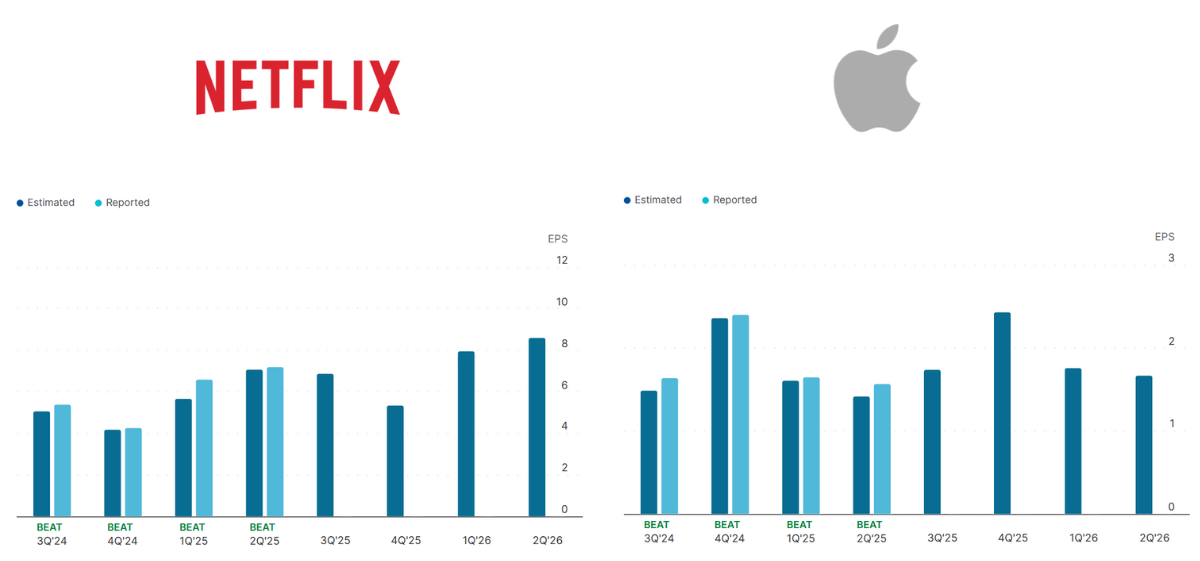
Apple’s proximity to record market valuations is not an accident of passive index flows; it is the direct result of unmatched pricing power, disciplined supply chain execution, and an aggressive share repurchase program. The company’s ecosystem relies on tight hardware-software integration, creating formidable switching costs that insulate it against macroeconomic downturns.
Key drivers underpinning Apple's market resilience include:
- The Services Engine: High-margin recurring revenue streams—encompassing the App Store, iCloud, Apple Music, ApplePay, and AppleCare—now represent a massive chunk of gross profit, smoothing out the cyclicality inherent in iPhone and Mac hardware upgrade cycles.
- Capital Allocation and Share Buybacks: Apple’s unparalleled cash conversion allows it to return tens of billions of dollars annually to shareholders via dividends and systematic equity repurchases, effectively reducing share count and boosting earnings per share (EPS).
- Regulatory and Supply Chain Risk Mitigation: Despite facing antitrust scrutiny and supply chain geographic diversification pressures (moving production nodes across Southeast Asia and India), Apple’s operational agility has minimized margin erosion.
However, Apple is not entirely immune to secular challenges. Smartphone replacement cycles have lengthened in developed markets, and the company’s foray into next-generation computing, such as spatial computing via the Vision Pro, requires substantial research and development (R&D) outlays before yielding meaningful enterprise ROI.
Netflix: The Subscription Pivot, Ad-Tier Monetization, and Content Amortization
Netflix’s descent from its all-time highs reflects a painful market recalibration. For years, Wall Street priced Netflix as a monopolistic streaming utility with limitless addressable markets. When subscriber growth abruptly stalled in early 2022 due to market saturation, password-sharing crackdowns, and inflationary pressures on household budgets, the stock suffered a violent re-rating.
Management responded with a strategic pivot, introducing lower-cost, ad-supported subscription tiers and aggressively cracking down on credential sharing. While these initiatives have successfully stabilized user metrics and re-accelerated top-line growth, Netflix remains a high-beta asset heavily reliant on the continuous cycle of producing and licensing premium entertainment content.
- Content Amortization Pressures: Unlike software platforms with near-zero marginal distribution costs, streaming requires billions of dollars in annual content spend. This capital expenditure must be continuously amortized against subscriber revenues, placing a permanent ceiling on operating margins compared to elite software peers.
- Advertising Infrastructure Scalability: Transitioning from a pure subscription model to a hybrid ad-supported tier requires sophisticated ad-tech stack integrations, programmatic partnerships, and enterprise-grade data analytics capabilities.
- Competitive Intensity: Netflix no longer operates in a vacuum. It is locked in an expensive war of attrition with deep-pocketed tech giants (Amazon Prime Video, Apple TV+) and legacy studio streaming services (Disney+, Max, Paramount+).
Comparative Metrics: Apple vs. Netflix Financial Breakdown
A rigorous quantitative assessment illuminates the stark differences between these two corporate titans. The following table contrasts core financial, operational, and valuation metrics:
| Metric / Indicator | Apple Inc. (AAPL) | Netflix Inc. (NFLX) | Strategic Implication |
|---|---|---|---|
| Market Capitalization | ~$3.3 Trillion | ~$260 Billion - $300 Billion | Reflects Apple’s status as a global liquidity anchor vs. mid-tier mega-cap status for Netflix. |
| Forward P/E Multiple | ~28x - 32x | ~30x - 35x | Despite Netflix's 50%+ drop, its forward valuation multiple remains elevated due to post-re-rating earnings recovery. |
| Free Cash Flow (Annual) | ~$100 Billion+ | ~$6 Billion - $8 Billion | Apple provides unmatched capital return capacity; Netflix's cash flow is constrained by content spend. |
| Primary Revenue Model | Hardware ecosystem + High-margin Recurring Services | Subscription Video-on-Demand (SVOD) + Ad-Tier Monetization | Apple benefits from hardware lock-in; Netflix is sensitive to consumer discretionary churn. |
| Balance Sheet Liquidity | Pristine (Massive net cash position) | Moderate debt load with manageable maturities | Apple absorbs macroeconomic shocks effortlessly; Netflix must carefully service debt against content ROI. |
Industry & Market Implications: Who Wins and Who Loses?
The divergence between Apple and Netflix ripples across the broader technology and media ecosystems. Institutional asset managers are increasingly favoring capital preservation and high cash-flow visibility over speculative growth narratives. This flight to quality benefits mega-cap hardware and software compounders like Apple, Microsoft, and Nvidia, while penalizing companies that require perpetual external financing or constant consumer spending optimization.
For the media sector, Netflix’s drawdown has forced a painful industry consolidation. Legacy media companies that attempted to replicate Netflix’s direct-to-consumer streaming model without adequate infrastructure scalability or profitability focus have suffered catastrophic write-downs. Consequently, media executives are retreating toward licensing content back to dominant platforms, effectively conceding defeat to Netflix's superior distribution scale.
Frequently Asked Questions (People Also Ask)
Why is Apple’s stock trading near record highs despite global macroeconomic headwinds?
Apple’s resilience stems from its invincible brand equity, sticky hardware ecosystem, and explosive growth in high-margin services revenue. Furthermore, its massive share repurchase program actively reduces share count, bolstering earnings per share even during periods of flat unit sales growth.
What caused Netflix to drop more than 50% from its historical highs?
Netflix experienced a severe valuation compression driven by a sudden deceleration in subscriber growth post-pandemic, intensifying streaming competition, and concerns over high content production costs. The market shifted from rewarding raw subscriber additions to demanding rigorous free cash flow generation and sustainable profit margins.
Between Apple and Netflix, which stock offers better risk-adjusted returns for long-term investors?
From an institutional asset allocation perspective, Apple represents a superior defensive compounder due to its fortress balance sheet, predictable cash flows, and lower cyclical vulnerability. Netflix offers higher-beta turnaround potential, but carries elevated execution risk regarding ad-tier monetization and content spending efficiency.
How do interest rate environments impact the valuation of Apple versus Netflix?
Higher interest rates disproportionately penalize companies whose cash flows are weighted far into the future (growth stocks like historical Netflix). Apple’s massive, immediate cash generation insulates it from discount-rate shocks, whereas Netflix has had to mature its financial model to prove near-term profitability to bond and equity markets.
Future Outlook: Key Milestones and Catalysts to Watch
As market dynamics evolve over the next twelve to twenty-four months, investors must monitor specific structural catalysts for both companies:
For Apple, the primary catalysts include the acceleration of artificial intelligence integration (Apple Intelligence) across its device lineup, the regulatory outcomes of App Store anti-steering rulings in major global jurisdictions, and the long-term adoption rate of its spatial computing hardware. If Apple successfully monetizes on-device AI without compromising user privacy, it could unlock a new multi-year hardware upgrade super-cycle.
For Netflix, critical milestones center on the scaling efficiency of its advertising tiers, the success of live-event programming (such as NFL broadcasts and WWE partnerships) in driving ad-sales revenue, and disciplined control over content capital expenditures. If management can prove that its ad-supported model can offset slowing traditional subscriber growth while maintaining operating margins, the stock could reclaim lost ground.
Ultimately, while both enterprises command dominant positions in their respective domains, capital discipline and balance sheet fortitude dictate that only one warrants a core allocation in a prudent, long-term institutional portfolio.


