
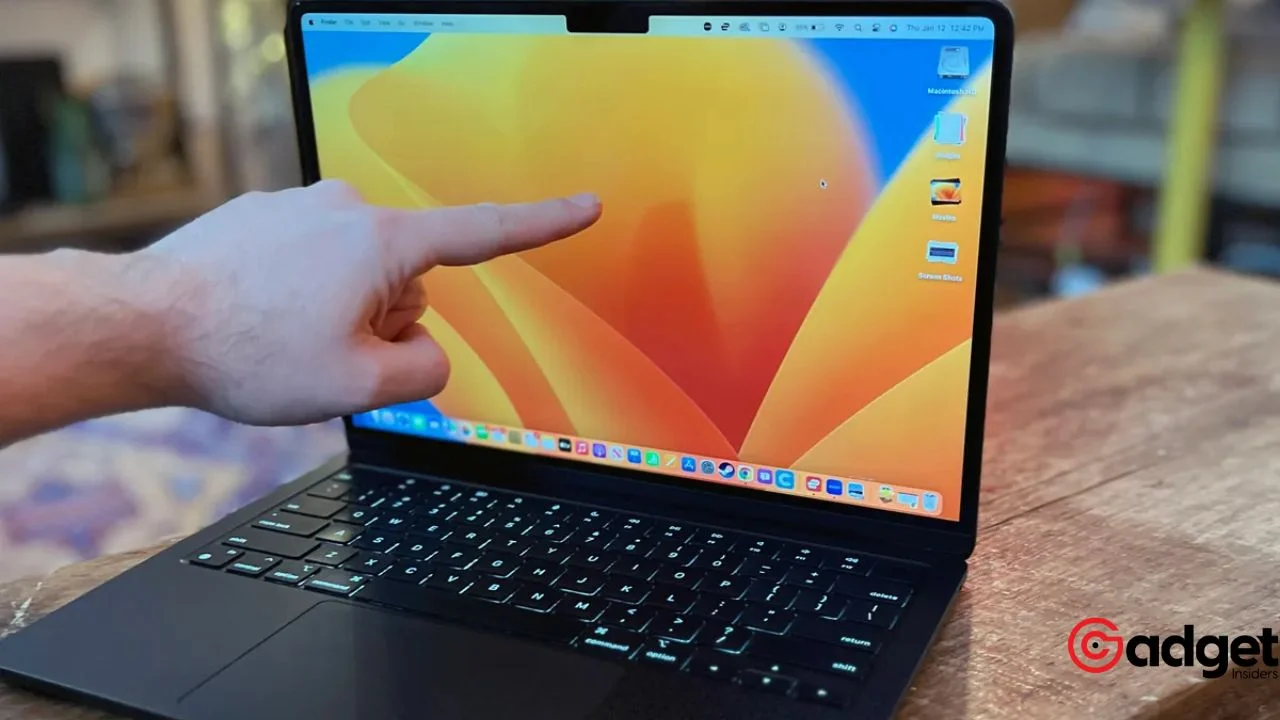
Executive Takeaways
- Paradigm Shift: Apple has officially abandoned its decade-long resistance to touchscreen laptops, setting the stage for a redesigned MacBook lineup featuring advanced OLED panel integration.
- Financial Impact: The move is expected to catalyze hardware replacement cycles across enterprise accounts, directly challenging Microsoft’s Surface ecosystem and stabilizing high-margin Mac revenue.
- Supply Chain Realignment: Global semiconductor and display manufacturing partners are scaling capital expenditure to meet rigid multitouch durability and low-latency haptic specifications.
- Valuation & Market Liquidity: Wall Street analysts project that form-factor innovation will reinforce Apple’s hardware pricing power, mitigating softening upgrade trends in mature smartphone markets.
Cupertino is preparing to execute what insiders are calling the most significant ergonomic pivot in modern computing history. Apple Inc. is advancing development on its first-ever touchscreen MacBook, a strategic about-face that shatters a long-standing ideological boundary established by late co-founder Steve Jobs. For over a decade, executive leadership maintained that vertical touchscreens on laptop form factors were ergonomically flawed and redundant. However, accelerating convergence between iPadOS and macOS, combined with intense competitive pressure from Windows OEMs and shifting enterprise user expectations, has forced a monumental reevaluation of capital allocation and product architecture.
This investigative report breaks down the catalytic events driving Apple’s hardware roadmap shift, analyzes the supply chain dependencies, assesses enterprise ROI and valuation multiples, and projects the broader market liquidity implications for the global consumer electronics sector.
The Anatomy of a U-Turn: Catalysts and Corporate Strategy
Test Our Free AI & Tech Utilities Suite
Calculate LLM API token costs, analyze article dwell-time, or simulate tech DCA returns.
The decision to integrate touch input into the flagship portable Mac lineup is not merely an aesthetic update; it is a calculated response to structural changes in enterprise software consumption and consumer behavior. Over the past five years, the boundaries between desktop computing and mobile operating systems have dissolved. The proliferation of Apple Silicon—specifically the M-series system-on-chip (SoC) architecture—has enabled seamless execution of iOS and iPadOS applications natively on macOS.
Despite this technical unification, users navigating iPad apps on a traditional MacBook trackpad experienced persistent friction. Competitors such as Microsoft with the Surface Pro, Dell, and Lenovo capitalized on this gap, capturing market share among creative professionals and mobile executives who demanded tactile interactivity. Institutional investors tracking Apple’s quarterly earnings reports have long debated whether the absence of a touchscreen was a structural vulnerability. By addressing this feature gap, Apple aims to protect its premium average selling prices (ASPs) and reinforce customer lifetime value within its hardware ecosystem.
Furthermore, internal risk mitigation strategies dictated that Apple could no longer ignore the generational shift in user expectations. Digital natives entering the workforce view multitouch interfaces as a baseline utility rather than an optional luxury. The forthcoming touchscreen MacBook is engineered to bridge this divide without compromising the precision and efficiency of the traditional keyboard-and-trackpad workflow.
Engineering Challenges and Display Technology Integration
Implementing a touchscreen on a MacBook requires solving complex thermal, structural, and optical engineering hurdles. Unlike the iPad, which is held in the hand or docked at variable angles, a laptop screen must withstand constant physical pressure from typing adjustments, screen tilting, and touch input without inducing structural flex in the chassis.
Industry supply chain intelligence indicates that Apple will bypass traditional LCD technology in favor of advanced tandem OLED panels. These displays offer superior brightness, enhanced energy efficiency, and deep black levels critical for professional color grading. Crucially, the touch sensor layer will be embedded directly into the cell structure—a technique known as "on-cell touch"—to eliminate internal air gaps, reduce parallax distortion, and maintain the razor-thin profile associated with the MacBook Air and MacBook Pro lines.
From an infrastructure scalability perspective, display partners including Samsung Display, LG Display, and BOE are retooling fabrication lines to meet Apple’s stringent quality control metrics. The manufacturing yields for large-form-factor OLED touch panels remain a critical variable, directly influencing initial inventory availability and supply chain velocity upon commercial launch.
| Metric / Specification | Legacy MacBook Pro (M3/M4) | Projected Touchscreen MacBook | Strategic Impact |
|---|---|---|---|
| Display Technology | Mini-LED (Liquid Retina XDR) | Advanced Tandem OLED with Touch | Improves contrast, reduces weight, enables touch input. |
| Input Modality | Keyboard, Force Touch Trackpad | Keyboard, Trackpad, Multitouch Display | Unifies iOS/macOS interaction paradigms. |
| Target Enterprise ROI | Standard 3-4 Year Upgrade Cycle | Accelerated Refresh via Form-Factor Novelty | Drives enterprise hardware revenue stability. |
| Projected Price Point | Baseline Premium Tier | Premium Plus (Estimated +$150-$300) | Enhances hardware gross margin percentages. |
Industry & Market Implications: Who Wins, Who Loses
The introduction of a touchscreen MacBook is poised to trigger immediate ripples across the global technology ecosystem. Financial markets are already pricing in the competitive threat this poses to enterprise-focused PC vendors.
Winners
- Apple Shareholders: Form-factor innovation provides a reliable catalyst for hardware upgrades, supporting valuation multiples and stabilizing cash flow generation.
- OLED Panel Manufacturers: Major display suppliers securing Apple contracts will experience substantial revenue growth and improved fab utilization rates.
- Enterprise Software Developers: Studios building cross-platform applications (productivity suites, design software, and financial modeling tools) gain a unified canvas for user interaction.
Losers
- Windows OEM Competitors: Brands like Dell, HP, and Lenovo lose their primary hardware differentiator—touch capability—against the Mac lineup.
- Mid-Tier Tablet Makers: Devices occupying the ambiguous space between standalone tablets and traditional laptops may face accelerated obsolescence as the MacBook absorbs their utility.
Frequently Asked Questions (People Also Answered)
Why did Apple change its mind about touchscreen MacBooks?
For years, Steve Jobs and subsequent engineering leads argued that vertical touchscreens caused arm fatigue and ergonomic inefficiency. However, the commercial success of Apple Silicon, the complete convergence of iOS and macOS application ecosystems, and shifting expectations among enterprise and Gen-Z users made touch input an operational necessity to maintain market leadership.
Will macOS require a complete redesign to support touch?
Apple is expected to retain the precision-focused macOS desktop interface while introducing subtle, intelligent touch-target scaling. Rather than transforming macOS into a mobile operating system, Apple will likely implement adaptive UI elements that respond dynamically when a user interacts directly with the glass panel.
How will this impact enterprise IT deployment and procurement?
Enterprise Chief Information Officers (CIOs) will likely view the touchscreen MacBook as a versatile device that bridges the gap between field-use tablets and desk-bound workstations. This consolidation can simplify IT infrastructure management, reduce device sprawl, and improve total enterprise ROI on hardware expenditures.
When is the official release date expected?
While Apple has not issued official scheduling guidance, supply chain indicators and component procurement schedules point toward an initial commercial rollout within the next 12 to 24 months, with initial announcements likely accompanying upcoming M-series chip generation updates.
Future Outlook and Strategic Milestones
As Apple navigates the final phases of prototyping and supply chain integration, financial analysts and institutional investors will monitor several key milestones. The primary indicator of commercial success will be display fabrication yields, which dictate initial unit volume and distribution reach. Furthermore, developer adoption rates of touch-optimized APIs during Worldwide Developers Conference (WWDC) sessions will signal how rapidly the software ecosystem adapts to the new hardware paradigm.
Ultimately, the transition to a touchscreen MacBook represents a pragmatic maturation of Apple’s product philosophy. By balancing its legendary commitment to design elegance with the functional demands of modern enterprise and consumer markets, Apple is positioning its Mac division for sustained, high-margin growth through the remainder of the decade.


