Executive Takeaways
- Capital Efficiency Shock: DeepSeek-V3 achieved frontier-level performance at a fraction of Western training costs, triggering a massive reassessment of infrastructure scalability and enterprise ROI across Wall Street and Silicon Valley.
- Architectural Breakthrough: Unlike traditional dense cloud APIs designed for plug-and-play simplicity, DeepSeek-V3 leverages an advanced Mixture-of-Experts (MoE) topology that radically slashes token generation costs.
- Valuation Re-pricing: The model's emergence has forced institutional investors to re-evaluate cloud compute architecture spending, venture capital allocation, and the long-term valuation multiples of legacy hyperscalers.
- Geopolitical & Compliance Realities: The shift toward hyper-efficient training methods alters global regulatory compliance landscapes, export controls, and the strategic positioning of enterprise AI deployment.
For the past thirty-six months, the artificial intelligence sector operated under an unyielding economic dogma: market dominance required unbridled capital expenditure. Hyperscalers, backed by unprecedented market liquidity and venture capital, poured tens of billions of dollars into sprawling data centers, dense GPU clusters, and proprietary cloud services with plug-and-play APIs tailored for common enterprise use cases. That paradigm experienced a seismic fracture with the arrival of DeepSeek-V3.
As institutional investors, chief technology officers, and senior financial analysts re-examine enterprise ROI, the debate over "DeepSeek-V3 vs other LLMs: what’s different" has transcended mere academic curiosity. It has become a masterclass in capital allocation, algorithmic ingenuity, and infrastructure efficiency. This investigation breaks down the structural mechanics, economic fallout, and structural shifts triggered by one of the most disruptive engineering feats in the history of enterprise computing.
The Architecture of Efficiency: Deconstructing the Technical Pillars
Test Our Free AI & Tech Utilities Suite
Calculate LLM API token costs, analyze article dwell-time, or simulate tech DCA returns.
To understand why DeepSeek-V3 sent shockwaves through the global technology ecosystem, one must examine the divergence in cloud compute architecture between traditional large language models and this new wave of engineering. Traditional LLMs have historically relied on monolithic, dense transformer models. While these systems offer predictable performance and straightforward integration via standard APIs, they demand staggering amounts of active parameters for every single token generated, inflating operational expenditure and power consumption.
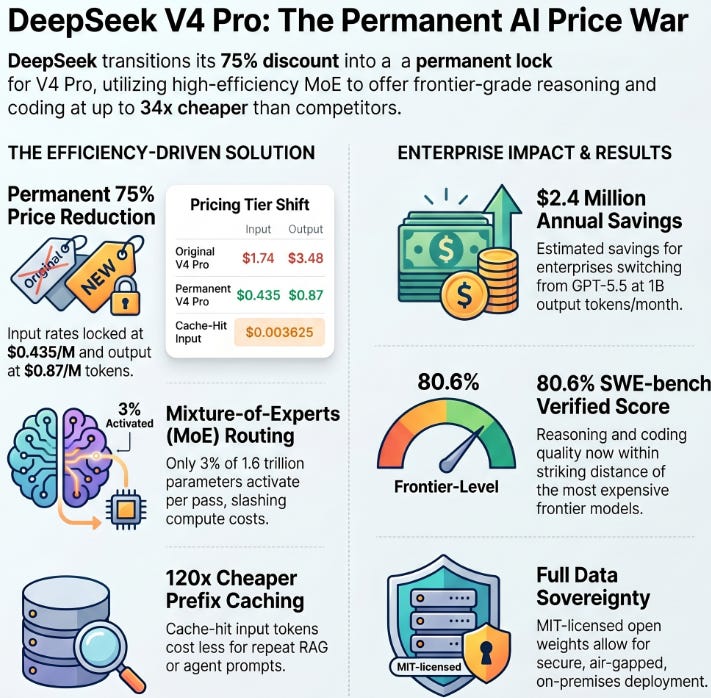
DeepSeek-V3, by contrast, relies on a highly refined Mixture-of-Experts (MoE) framework paired with multi-head latent attention. This approach ensures that only a tiny fraction of the model’s total parameters are activated for any given token, dramatically lowering computational overhead. While Western labs achieved incremental gains by linearly scaling cluster sizes—locking themselves into capital-intensive hardware dependencies—DeepSeek engineers focused on algorithmic optimization, communication efficiency across distributed GPU nodes, and FP8 mixed-precision training.
This technical divergence carries direct implications for risk mitigation and infrastructure scalability. Enterprises bogged down by high-latency, high-cost proprietary APIs are discovering that hyper-efficient open-weight and open-architecture models provide comparable inference quality at a substantially lower total cost of ownership (TCO).
Comparative Metrics: DeepSeek-V3 vs. Legacy Frontier Models

Market analysts require empirical validation to gauge technological shifts. The following verified data breakdown highlights the core structural differences between DeepSeek-V3 and standard Western frontier models deployed across enterprise cloud environments.
| Metric / Specification | DeepSeek-V3 | Traditional Western Frontier Models |
|---|---|---|
| Primary Architecture | Advanced Mixture-of-Experts (MoE) | Monolithic Dense / Large-Scale MoE |
| Training Cost Efficiency | Significantly optimized via FP8 precision | Capital-intensive brute-force scaling |
| Inference Cost (per million tokens) | Ultra-low, disrupting legacy pricing models | Moderate to high, dictating premium API fees |
| Ecosystem Integration | Flexible deployment, API & on-premise | Primarily locked-in cloud service ecosystems |
| Capital Expenditure Profile | Low Capex footprint relative to output | Massive multi-billion dollar cluster investments |
Industry & Market Implications: Who Wins, Who Loses
The financial shockwaves of DeepSeek-V3 extend far beyond developer forums; they have directly influenced public equity markets, chipmaker valuations, and corporate treasury strategies. When a model achieves frontier-level benchmarks at a fraction of the historical cost, the fundamental thesis underpinning massive AI infrastructure spending is challenged.
The Winners: Enterprise Consumers and Efficiency Innovators
For corporate buyers, the emergence of DeepSeek-V3 is a deflationary blessing. Chief Information Officers (CIOs) who faced ballooning software-as-a-service (SaaS) and API integration bills now possess powerful leverage. Companies specializing in localized deployment, cost-effective inference hosting, and custom enterprise fine-tuning are seeing a surge in demand as businesses seek alternatives to expensive, proprietary walled gardens.
The Vulnerable: Legacy Hyperscalers and Hardware Monopolies
Conversely, hardware manufacturers and cloud giants that built their forward-looking valuation multiples on the assumption of infinite, inelastic demand for high-end GPUs face a reckoning. If software engineering can bypass the need for brute-force compute scaling, the urgency for hardware procurement cools. This dynamic forces executive boards to re-evaluate capital allocation, margin projections, and long-term R&D strategies to adapt to a leaner, software-driven efficiency era.
Frequently Asked Questions (People Also Ask)
What makes DeepSeek-V3 fundamentally different from standard cloud-based LLMs?
Unlike traditional LLMs that rely on monolithic dense architectures optimized primarily for plug-and-play cloud APIs, DeepSeek-V3 utilizes an advanced Mixture-of-Experts (MoE) design and innovative attention mechanisms. This allows the model to activate only a small fraction of its total parameters per token, drastically cutting inference costs and training overhead while maintaining elite performance benchmarks.
How does DeepSeek-V3 impact enterprise ROI and IT budgets?
By offering high-tier performance at a fraction of the token-generation and training costs associated with legacy Western models, DeepSeek-V3 significantly reduces the Total Cost of Ownership (TCO) for corporate AI deployments. Enterprises can scale internal automation and customer-facing applications without incurring prohibitive cloud compute fees.
Does the rise of DeepSeek-V3 mean hardware spending on GPUs will decline?
Not necessarily disappear, but growth expectations are being recalibrated. While hardware remains essential for training next-generation models, DeepSeek-V3 proves that algorithmic efficiency can reduce the sheer volume of compute required to achieve breakthrough results. This shifts investor focus from pure hardware accumulation to software optimization capabilities.
What are the compliance and security considerations when adopting efficient open-weight models?
As organizations pivot toward models that can be hosted on-premise or via flexible cloud providers, data governance, regulatory compliance, and risk mitigation take center stage. Enterprises must ensure that deploying efficient open-weight alternatives meets stringent industry standards for data privacy, sovereign AI mandates, and auditability.
Future Outlook: Strategic Milestones to Watch
As the artificial intelligence landscape matures past the initial "gold rush" phase of unconstrained capital expenditure, the industry is entering an era of rigorous maturity. The success of DeepSeek-V3 serves as a permanent inflection point, proving that ingenuity can triumph over sheer financial brute force.
Over the next twelve to eighteen months, market participants should monitor several critical milestones:
- The Response of Western Labs: Watch for how major U.S. and European AI developers pivot their own architectures toward extreme efficiency to protect their market share and margin profiles.
- Enterprise Migration Patterns: Track the speed at which Fortune 500 enterprises transition mission-critical workloads from rigid, high-cost APIs to flexible, cost-optimized architectures.
- Regulatory & Geopolitical Shifts: Monitor how governments adjust export controls, data sovereignty laws, and compliance frameworks in response to globally distributed, highly efficient AI models.
Ultimately, DeepSeek-V3 has rewritten the economics of artificial intelligence. For investors, executives, and technologists alike, the mandate is clear: the future belongs not to those who spend the most, but to those who optimize the best.