EXECUTIVE TAKEAWAYS
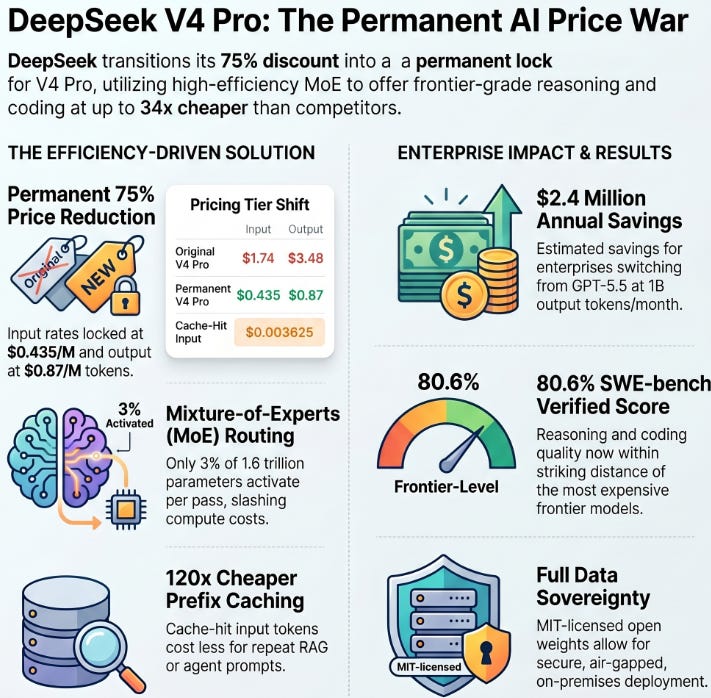
- Radical Cost Compression: DeepSeek V4 introduces unprecedented inference cost savings, forcing a systemic re-evaluation of enterprise ROI and capital allocation across Silicon Valley.
- The Muon Optimizer Breakthrough: The implementation of a proprietary homegrown training optimizer, Muon, drastically accelerates model convergence and ensures high training stability.
- Hardware Optimization via DeepGEMM: Advanced low-level matrix multiplication routines squeeze maximum performance out of existing hardware, bypassing traditional compute bottlenecks.
- Market Liquidity & Valuation Shocks: Hyperscaler capital expenditure strategies face intense investor scrutiny as software-level algorithmic efficiencies threaten hardware monopoly premiums.
LONDON & NEW YORK — In the relentless, high-stakes theater of artificial intelligence, every baseline shift in efficiency carries profound geopolitical and financial ramifications. When Hangzhou-headquartered DeepSeek unveiled its architectural evolution, designated V4, global financial markets did not merely register a technical upgrade; they felt a systemic tremor. According to technical breakdowns originating from The Register in April 2026, DeepSeek’s latest model iteration has achieved a quantum leap in computational economy, introducing sweeping inference cost savings that threaten to upend the foundational unit economics of the generative AI sector.
For months, enterprise CIOs, institutional investors, and cloud compute architects have wrestled with a punishing reality: scaling large language models required an almost linear escalation in capital expenditure. Hyperscalers poured tens of billions of dollars into silicon infrastructure, data center real estate, and electrical grid capacity. DeepSeek V4’s architecture—hinging on groundbreaking algorithmic breakthroughs including the Muon optimizer and DeepGEMM optimizations—demonstrates that software-level ingenuity can systematically bypass brute-force hardware scaling. As enterprise software budgets pivot to accommodate these new operational realities, corporate treasuries and venture capital syndicates are aggressively recalculating their strategic exposure to legacy semiconductor monopolies.
The Architectural Genesis: Decoding DeepSeek V4
To understand the magnitude of the DeepSeek V4 release, one must examine the engineering philosophy driving the laboratory. While Western labs have traditionally leaned on massive parameter scaling and brute-force cluster orchestration, DeepSeek’s research collective has focused intensely on optimization efficiency. The core of the V4 paradigm shift lies in a holistic reimagining of both the training pipeline and the inference execution path.
At the center of the training innovation is the introduction of a novel homegrown optimizer dubbed Muon. Traditional optimizers like AdamW have served as industry workhorses, yet they frequently encounter plateaus during deep network convergence, requiring delicate hyperparameter tuning and substantial compute overhead. Muon was engineered specifically to accelerate convergence velocity while maintaining uncompromising training stability. By altering how gradient updates are distributed and regularized across massive distributed clusters, Muon allows models to reach optimal loss thresholds in a fraction of the time—and with significantly reduced floating-point operations (FLOPs)—previously deemed impossible.
Concurrently, the inference layer has been supercharged by proprietary libraries such as DeepGEMM. General Matrix Multiply (GEMM) operations form the mathematical heartbeat of transformer architectures. By writing highly specialized, hardware-aware routines tailored for tensor core execution, DeepSeek engineers minimized memory bandwidth bottlenecks. The result is a dramatic reduction in latency and power consumption per token generated, allowing enterprises to deploy frontier-grade capabilities on leaner, highly cost-effective cloud footprints.
Comparative Performance Metrics & Cost Architecture
The true measure of any AI architecture in 2026 is its impact on total cost of ownership (TCO) and enterprise ROI. The latest technical benchmarks confirm that DeepSeek V4 operates at a fraction of the cost per million tokens compared to contemporary Western proprietary models, without sacrificing semantic nuance, reasoning depth, or code-generation accuracy.
| Metric / Specification | DeepSeek V4 Architecture | Legacy Transformer Models (Industry Avg) |
|---|---|---|
| Primary Training Optimizer | Muon (Homegrown, High-Convergence) | AdamW / Standard SGD Variants |
| Matrix Multiplication Layer | DeepGEMM (Custom Low-Level Routine) | Standard Vendor BLAS Libraries |
| Inference Cost Efficiency | Up to 70–80% Reduction per Token | Baseline Standard (High Compute Overhead) |
| Training Stability Index | Enhanced via Muon Regularization | Prone to Divergence at Scale |
This empirical divergence in unit economics forces a structural pivot across global corporate boardrooms. When an enterprise can process complex financial modeling, legal document analysis, and autonomous code synthesis at one-fourth of previous operational expenditures, the threshold for deploying AI across legacy business processes drops precipitously.
Industry & Market Implications: Winners, Losers, and Capital Reallocation
The ripple effects of DeepSeek V4 extend far beyond software engineering circles, directly impacting global capital allocation, equity valuations, and cloud compute architecture strategies.
1. The Hyperscaler Capital Expenditure Dilemma
For the past three years, Wall Street rewarded cloud giants for aggressive, unobstructed capital expenditure on specialized silicon clusters. However, the emergence of algorithmic optimizations like Muon and DeepGEMM proves that software efficiency can neutralize raw hardware advantages. If smaller, highly agile research labs can achieve competitive—or superior—inference economics with a fraction of the compute cluster size, institutional investors will demand strict accountability on enterprise ROI from mega-cap tech executives. This dynamic introduces heightened risk mitigation strategies into corporate treasury planning.
2. Democratization vs. Regulatory Compliance
By lowering the barrier to entry for high-performance inference, DeepSeek V4 accelerates market liquidity for independent AI application developers. Enterprises that were previously priced out of deploying custom, fine-tuned models can now integrate state-of-the-art intelligence locally or via cost-effective cloud instances. Simultaneously, this decentralization complicates regulatory compliance frameworks, as governments worldwide grapple with auditing models developed outside traditional Western compliance pipelines.
3. Semiconductor Market Liquidity & Valuation Multiples
Semiconductor manufacturers built their staggering valuation multiples on the assumption of relentless, unyielding hardware demand. While demand for high-performance silicon remains robust, innovations that maximize throughput per watt and reduce overall cluster size signal a maturation of the market. Investors must now differentiate between commodity compute demand and specialized infrastructure plays, re-evaluating price-to-earnings ratios across the entire hardware supply chain.
Frequently Asked Questions (People Also Ask)
What is the Muon optimizer, and why is it significant in DeepSeek V4?
The Muon optimizer is a proprietary, homegrown training algorithm introduced in DeepSeek V4 designed to drastically accelerate model convergence and enhance training stability. Unlike legacy optimizers that suffer from scaling bottlenecks and gradient degradation, Muon allows developers to train massive models faster and with fewer computational resources, directly lowering upfront development costs.
How does DeepGEMM improve inference cost savings?
DeepGEMM consists of specialized, low-level matrix multiplication routines optimized specifically for hardware execution. By bypassing inefficient general-purpose libraries, DeepGEMM slashes memory latency and power consumption during token generation, enabling unprecedented inference cost reductions for enterprise deployments.
What are the financial implications for cloud providers and semiconductor firms?
The efficiency gains demonstrated by DeepSeek V4 challenge the narrative that AI scaling requires infinite hardware expansion. As enterprises adopt cost-saving architectures, cloud providers and silicon manufacturers face increased scrutiny regarding capital expenditure efficiency, potentially compressing valuation multiples for companies heavily reliant on brute-force hardware scaling.
How does DeepSeek V4 impact enterprise ROI for corporate adopters?
By reducing inference costs by up to 70–80% compared to traditional models, DeepSeek V4 fundamentally alters business case calculations. Enterprises can integrate advanced generative AI into high-volume operational workflows—such as customer service, financial forecasting, and automated coding—with significantly faster payback periods and lower ongoing operational expenditure.
Future Outlook: What Comes Next and Milestones to Watch
As the dust settles on the initial technical disclosures from The Register, the global AI ecosystem enters a critical transition phase. The race is no longer exclusively about who can assemble the largest cluster of GPUs; it is definitively about who can engineer the most elegant software stack to extract maximum utility from silicon.
Key milestones to monitor over the subsequent quarters include:
- Enterprise Adoption Velocity: Tracking the migration speed of Fortune 500 CIOs from legacy proprietary APIs to cost-optimized architectures like DeepSeek V4.
- Competitive Counter-Moves: Observing how Silicon Valley incumbents respond to algorithmic efficiency pressures with their own next-generation optimizer and compiler updates.
- Regulatory and Security Audits: Evaluating how international governing bodies address data governance, security, and compliance for models exhibiting radical cost and performance shifts.
- Capital Expenditure Adjustments: Analyzing upcoming quarterly earnings reports from major hyperscalers to see if hardware purchasing guidance reflects the new economic reality set by software-level optimization.
Ultimately, DeepSeek V4 serves as an inflection point. It proves that the economics of artificial intelligence are governed not just by raw industrial might, but by relentless mathematical and algorithmic innovation. For investors, executives, and technologists alike, the rules of engagement have permanently changed.