Executive Takeaways
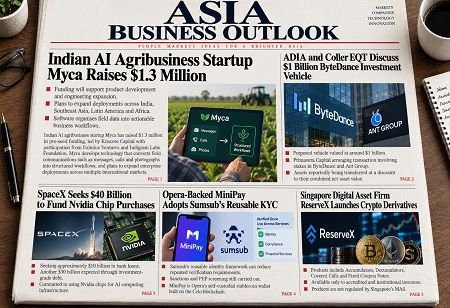
- Sovereign Liquidity Injection: The Abu Dhabi Investment Authority (ADIA) and Coller EQT are spearheading discussions for a landmark $1 billion investment vehicle targeting ByteDance, signaling a structural shift in secondary liquidity management.
- Agritech Convergence: Indian AI agribusiness startup Myca has successfully secured $1.3 million in seed funding, validating the rapid digitization and supply-chain optimization of South Asia’s agricultural sector.
- Global Capital Arbitrage: SpaceX’s pursuit of a $30 billion secondary liquidity and primary equity valuation highlights the aggressive cross-border capital allocation trends bleeding from Western aerospace into Asian venture ecosystems.
- Macroeconomic Resilience: Despite global interest rate headwinds and tightening venture capital deployment, Asia’s tech stack—spanning fintech, crypto, AI, and agritech—demonstrates robust capital liquidity and structural valuation recalibration.
The Asian technology and investment landscape is undergoing a profound structural metamorphosis. Driven by an intricate matrix of sovereign wealth repositioning, aggressive venture capital deployment, and the rapid vertical integration of artificial intelligence into traditional industries like agriculture, the region is cementing its status as the epicenter of global economic dynamism. While Western markets grapple with protracted valuation corrections and stringent regulatory scrutiny, Asian capital markets—from Mumbai to Singapore and Tokyo—are rewriting the playbook for enterprise ROI, infrastructure scalability, and cross-border risk mitigation.
Recent developments captured across primary wire services outline a market in overdrive. From sovereign goliaths orchestrating billion-dollar private equity maneuvers to early-stage agritech disruptors leveraging machine learning to optimize South Asian crop yields, the current capital allocation cycle is defined by high-conviction bets. This investigative report dissects the macro and microeconomic forces powering Asia's latest funding wave, analyzing the strategic implications for institutional investors, enterprise technologists, and global market liquidity.
The Sovereign Playbook: ADIA, Coller EQT, and the ByteDance Secondary Market
At the upper echelon of institutional finance, the narrative is dominated by monumental liquidity events. Reports indicating that the Abu Dhabi Investment Authority (ADIA) and private equity major Coller EQT are in advanced discussions to establish a dedicated $1 billion investment vehicle targeting ByteDance represent a watershed moment for private market architecture.
This prospective transaction is not merely a vote of confidence in the world’s most valuable privately held technology conglomerate; it is a masterclass in secondary market liquidity engineering. For years, massive late-stage tech giants like ByteDance have remained private, depriving institutional investors of traditional public market exits. By constructing a targeted $1 billion secondary vehicle, sovereign capital allocators and global private equity heavyweights are institutionalizing private market liquidity.
From a risk mitigation and valuation multiple perspective, this vehicle allows early-stage venture funds and weary limited partners (LPs) to achieve capital realization without forcing a turbulent, regulation-laden public listing. Simultaneously, it grants Gulf-based sovereign capital direct exposure to consumer AI algorithms, recommendation engines, and global digital advertising cash flows. The implications for market liquidity are staggering: if successful, this vehicle will serve as a structural template for future mega-rounds, effectively decoupling private tech valuations from public market volatility.
Agritech Meets Artificial Intelligence: Inside Myca’s $1.3 Million Funding Milestone
While sovereign wealth funds maneuver at the top of the financial pyramid, the base of the Asian innovation economy is experiencing an equally vital transformation. Indian AI agribusiness startup Myca’s recent securing of a $1.3 million funding injection underscores the burgeoning investor appetite for verticalized SaaS and artificial intelligence applications tailored to emerging market inefficiencies.
Agriculture remains the backbone of South Asia’s employment ecosystem, yet it has historically suffered from acute supply chain fragmentation, post-harvest loss, and opaque pricing mechanisms. Myca’s platform leverages advanced predictive analytics, computer vision, and machine learning models to streamline agricultural supply chains—from farm-gate procurement to end-consumer delivery.
Enterprise ROI in the agritech sector is exceptionally high when solutions effectively eliminate intermediaries and optimize logistics. By utilizing cloud compute architecture and IoT-enabled cold-chain monitoring, Myca is demonstrating how AI can be deployed to solve foundational economic challenges. This $1.3 million seed round, while modest compared to sovereign-backed vehicles, signals a critical maturation of India’s agritech venture ecosystem, attracting institutional seed capital looking for defensive, high-impact asset classes insulated from broader macroeconomic downturns.
Global Spillover: SpaceX’s $30 Billion Capital Pursuit and Asian Tech Corridors
The fluidity of modern venture capital is further exemplified by aerospace titan SpaceX seeking a staggering $30 billion valuation framework. While headquartered in the United States, SpaceX’s capital-raising endeavors deeply intersect with Asian sovereign funds, family offices, and ultra-high-net-worth syndicates seeking exposure to deep-tech infrastructure and satellite broadband communications (such as Starlink).
The expansion of Starlink across Southeast Asia and South Asia creates profound ripple effects for regional fintech, crypto adoption, and remote digital infrastructure. As high-speed satellite internet penetrates rural and semi-urban corridors across the Asian archipelago, the total addressable market (TAM) for digital banking, decentralized finance, and cloud-native startups expands exponentially. Consequently, capital allocators in Singapore and Hong Kong view deep-tech infrastructure not as a speculative peripheral play, but as a foundational prerequisite for the next wave of regional fintech and AI adoption.
| Venture / Transaction | Capital Involved | Sector / Asset Class | Strategic Objective |
|---|---|---|---|
| ADIA & Coller EQT / ByteDance | $1 Billion (Proposed) | Consumer AI / Private Equity Secondary | Institutionalizing private market liquidity and securing exposure to AI algorithms. |
| Myca (Agribusiness) | $1.3 Million | Agritech / Artificial Intelligence | Supply-chain optimization, predictive crop analytics, and market verticalization. |
| SpaceX Global Offering | $30 Billion Valuation Target | Aerospace / Satellite Infrastructure | Expanding global broadband connectivity to fuel emerging market digital economies. |
Industry & Market Implications: Winners, Losers, and Economic Realities
The ongoing bifurcation of Asia’s technology funding landscape produces distinct winners and losers across the economic spectrum.
The Winners
- Sovereign Wealth Funds & Institutional LPs: Entities like ADIA and Temasek are leveraging their balance sheet scale to dictate valuation multiples, securing preferential access to tier-1 assets at defensive entry points.
- Deep-Tech & AI Infrastructure Providers: Startups integrating machine learning with tangible operational assets (such as Myca in agritech or logistics-focused AI plays) are capturing disproportionate venture funding.
- Secondary Market Intermediaries: Investment banks and private equity firms specializing in liquidity solutions are experiencing an unprecedented boom as mature tech companies delay traditional IPOs.
The Losers
- Traditional Venture Capitalists Lacking Differentiation: Generalist seed funds that rely purely on capital deployment without offering technical or regulatory value-add are being squeezed out by disciplined syndicates.
- Legacy Agritech and Retail Models: Manual supply chains and non-digitized agricultural traders face terminal margin compression as AI-driven competitors optimize pricing and eliminate wastage.
Frequently Asked Questions (People Also Ask)
What is the significance of the ADIA and Coller EQT proposed $1 billion ByteDance vehicle?
The proposed $1 billion secondary vehicle represents a major evolution in private market liquidity management. By allowing early investors to exit while keeping the company private, sovereign wealth funds and private equity majors are creating structured pathways to trade mega-cap tech equity without relying on traditional, volatile public market IPOs.
How are AI startups transforming the South Asian agribusiness sector?
Startups like Myca are utilizing machine learning, predictive analytics, and IoT supply chain monitoring to eliminate inefficiencies in crop distribution, reduce post-harvest waste, and provide transparent pricing. This integration drives massive enterprise ROI by streamlining fragmented agricultural networks.
How does SpaceX’s capital strategy impact the broader Asian technology ecosystem?
SpaceX’s equity and secondary funding rounds draw capital from global syndicates, while its Starlink infrastructure directly enhances digital connectivity across emerging Asian markets. Improved rural broadband lays the foundational infrastructure required for regional fintech, decentralized finance, and cloud-native software adoption.
What trends are currently dominating Asian fintech and startup funding?
The current funding climate prioritizes disciplined capital allocation, regulatory compliance, and proven enterprise profitability over hyper-growth-at-all-costs models. Fintech and crypto sectors are focusing heavily on cross-border payment rails, institutional custody solutions, and AI-driven risk mitigation.
Future Outlook: What Comes Next for Asian Capital Markets
As we look toward the remainder of the fiscal year, Asia’s technology and investment corridors are poised for calculated expansion. The convergence of sovereign-backed secondary liquidity vehicles and hyper-focused vertical AI applications indicates a maturation of the region's venture ecosystem. Market participants must monitor regulatory shifts in cross-border data governance, the stabilization of interest rate environments, and the speed at which enterprise AI proofs-of-concept transition into cash-flow-positive balance sheets.
Ultimately, Asia is proving that macroeconomic headwinds can be successfully navigated through strategic capital re-allocation, technological verticalization, and institutional-grade financial engineering. For investors and technologists alike, the message is unequivocal: disciplined execution and foundational infrastructure investments are the undisputed currencies of the new economic era.