
By our Asia Bureau & Special Investigations Desk
Published 16 hours ago
Executive Takeaways
- Capital Resurgence: Pan-Asian venture capital and private equity deployment are pivoting aggressively toward enterprise infrastructure, moving past consumer-facing app economies.
- The DeepTech Shift: Artificial intelligence, precision agritech, and compliant fintech are commanding outsized valuation multiples despite global macroeconomic tightening.
- Regulatory Convergence: Singapore, Tokyo, and Hong Kong are establishing rigorous regulatory compliance frameworks that simultaneously attract institutional capital and filter out speculative froth.
- Infrastructure Bottlenecks: Cloud compute architecture and sovereign data localization mandates remain the primary growth variables governing enterprise ROI across developing Asian markets.
SINGAPORE, TOKYO, AND HONG KONG — Across the dynamic corridors of the Asia-Pacific region, a profound structural realignment is underway. No longer viewed merely as a vast testing ground for consumer internet applications, Asian economies are rapidly consolidating their positions as global innovation hubs. Driven by accelerated capital allocation, localized deep-tech breakthroughs, and maturing regulatory frameworks, the continent's technology ecosystem is experiencing a high-stakes renaissance. From the server farms of Seoul powering next-generation generative models to precision-agriculture networks optimizing yields across the Mekong Delta, capital is finding new routes to high-yield enterprise ROI.
Yet, this multi-trillion-dollar pivot is not without systemic friction. As venture capitalists recalibrate their risk mitigation strategies, founders face rigorous scrutiny over infrastructure scalability, unit economics, and sustainable business models. This investigative report examines how artificial intelligence, agritech, fintech, and digital asset markets are reshaping Asia's economic topography—and what these developments signal for institutional investors navigating the region's capital markets.
The Macroeconomic Catalyst: Navigating Liquidity and Valuation Shifts
To understand Asia's contemporary tech boom, one must first examine the shifting currents of global liquidity. Following a prolonged contraction in late 2022 and 2023, institutional investors have returned to Asian markets with renewed tactical discipline. However, the era of unbridled, growth-at-all-costs venture funding has been permanently replaced by a relentless focus on cash-flow visibility and operational efficiency.
Venture capital firms operating in Singapore and Greater China report that valuation multiples have compressed to historical medians, forcing early-stage and growth-stage enterprises to optimize their burn rates. Concurrently, sovereign wealth funds—such as Singapore’s Temasek and GIC, alongside Middle Eastern capital allocators looking east—are directing billions into structured private equity vehicles designed to shore up critical technological infrastructure.
This capital influx targets specific structural gaps: supply chain resilience, semiconductor sovereignty, and cross-border payment interoperability. As trade realignments reshape manufacturing corridors from Vietnam to India, technology is no longer an isolated vertical; it is the fundamental operating system underpinning Asian commerce.
Artificial Intelligence: Beyond the Hype to Enterprise Compute and Sovereignty
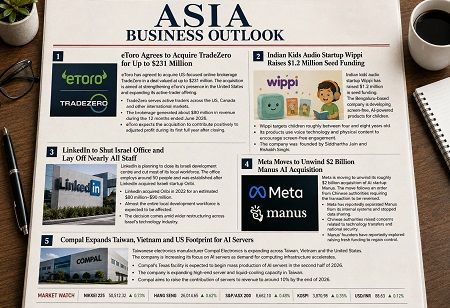
Artificial intelligence in Asia has evolved past consumer-facing chatbots into a fierce geopolitical and commercial race for infrastructure dominance. Unlike Western markets, where foundational model development is concentrated among a handful of US tech giants, Asia’s AI landscape is defined by national sovereignty, linguistic diversity, and heavy industrial integration.
In Singapore, government-backed initiatives are financing sovereign large language models (LLMs) tailored to Southeast Asia's multilingual linguistic mosaic. Meanwhile, Japan and South Korea are leveraging their advanced manufacturing base to integrate AI directly into robotics, automotive supply chains, and semiconductor fabrication.
Cloud Compute Architecture and Power Constraints
The primary bottleneck restricting Asia's AI expansion is not capital availability, but cloud compute architecture and power grid capacity. Hyperscale data center operators are encountering severe friction in securing reliable, low-carbon energy sources across densely populated urban centers like Tokyo, Mumbai, and Jakarta.
Consequently, enterprise software startups specializing in model compression, edge computing, and energy-efficient neural networks are commanding premium valuations. By enabling corporations to run sophisticated AI workloads locally—thereby satisfying stringent data localization laws—these startups are unlocking massive enterprise contracts across banking, healthcare, and telecommunications.
Agritech and Fintech: Digitizing the Unbanked and Feeding the Future
While artificial intelligence grabs headline valuations, agritech and fintech represent the high-impact engines driving inclusive growth across developing Asia. These sectors directly address fundamental structural challenges: food security, supply chain inefficiencies, and financial exclusion.
The Precision Agritech Revolution
With arable land under increasing environmental stress, agritech enterprises in India, Thailand, and Indonesia are deploying Internet of Things (IoT) sensors, drone-based crop monitoring, and blockchain-enabled traceability networks. These technologies are no longer boutique pilot projects; they are scaling across millions of smallholder farms.
- Supply Chain Transparency: Institutional buyers can now track agricultural commodities from farm gate to export terminal, mitigating fraud and reducing post-harvest loss.
- Micro-Lending Integration: Agritech platforms are leveraging real-time crop health data to underwrite micro-loans for farmers, bypassing traditional, predatory informal credit markets.
Fintech Maturation and Regulatory Compliance
Asia's fintech sector has transitioned from disruptive consumer wallets to deeply entrenched institutional infrastructure. Cross-border QR code payment linkages—such as those connecting Singapore, Thailand, Malaysia, and Indonesia—are standardizing real-time retail settlements and reducing foreign exchange friction for millions of travelers and merchants.
Simultaneously, the digital asset and cryptocurrency landscape in Asia is undergoing a structural bifurcation. While speculative retail trading faces strict oversight, institutional-grade crypto infrastructure, tokenized real-world assets (RWAs), and central bank digital currencies (CBDCs) are gaining regulatory sanction. Hong Kong and Singapore have positioned themselves as premier digital asset jurisdictions by enforcing rigorous anti-money laundering (AML) protocols while encouraging institutional blockchain innovation.
| Sector | Primary Capital Focus | Key Regulatory Hubs | Primary Growth Driver |
|---|---|---|---|
| Artificial Intelligence | Sovereign LLMs & Data Centers | Singapore, Seoul, Tokyo | Cloud compute architecture & enterprise automation |
| Agritech | IoT Sensors & Supply Chain Traceability | New Delhi, Bangkok, Jakarta | Food security & climate risk mitigation |
| Fintech & Digital Assets | Cross-Border Rails & Tokenized RWAs | Hong Kong, Singapore, Tokyo | Regulatory compliance & institutional liquidity |
| Venture Funding | DeepTech & B2B Infrastructure | Singapore, Bengaluru, Shanghai | Focus on unit economics & cash-flow visibility |
Industry & Market Implications: Winners, Losers, and Economic Realities
The maturation of Asia's technology sectors is creating distinct economic beneficiaries and casualties. Understanding these dynamics is essential for corporate strategists and institutional investors.
The Winners: Enterprise software providers, regulated digital exchanges, and deep-tech startups possessing proprietary intellectual property stand to capture the lion's share of institutional capital. Furthermore, traditional conglomerates that successfully partner with agile agritech and fintech platforms are rapidly expanding their market share and improving operational margins.
The Losers: Unfunded consumer startups relying on perpetual cash-burn models are facing terminal valuation haircuts. Additionally, traditional financial institutions that fail to modernize their legacy core banking systems risk rapid disintermediation by nimble, API-driven fintech competitors.
On a macro level, this capital redeployment is cementing Asia's economic resilience. By insulating regional supply chains against external geopolitical shocks and modernizing traditional sectors like agriculture and banking, the continent is building a robust foundation for sustainable, long-term GDP expansion.
Frequently Asked Questions (People Also Ask)
How is venture capital funding in Asia shifting compared to previous years?
Venture capital deployment in Asia has shifted decisively away from speculative consumer internet applications toward deep-tech infrastructure, enterprise AI, agritech, and regulatory-compliant fintech. Investors are prioritizing sustainable unit economics, clear paths to profitability, and robust infrastructure scalability over rapid, burn-rate-driven user acquisition.
What role do regulatory frameworks play in Asia's fintech and crypto sectors?
Regulatory frameworks in major hubs like Singapore, Hong Kong, and Tokyo act as critical filters and catalysts. Rather than stifling innovation, stringent compliance mandates regarding anti-money laundering (AML), data localization, and consumer protection have successfully attracted institutional capital while weeding out fraudulent or unsustainable operators.
Why is agritech attracting significant investment in developing Asian economies?
Agritech is attracting massive capital allocation because it directly addresses critical vulnerabilities in food security, supply chain inefficiency, and climate change adaptation. By integrating IoT sensors, drone analytics, and blockchain traceability, agritech platforms improve crop yields, reduce post-harvest losses, and unlock micro-financing for unbanked smallholder farmers.
What are the primary infrastructure bottlenecks facing AI development in Asia?
The primary bottlenecks are cloud compute architecture limitations, reliable energy access for hyperscale data centers, and the availability of specialized semiconductor hardware. Additionally, navigating diverse cross-border data privacy laws and national data sovereignty mandates requires sophisticated engineering and compliance architectures.
Future Outlook: Milestones and Strategic Watchpoints
As we look toward the remainder of the decade, Asia's technological trajectory will be defined by execution, convergence, and regulatory harmonization. Key milestones for institutional investors and industry executives to monitor include:
- Cross-Border CBDC Interoperability: Watch for the expansion of multi-lateral Central Bank Digital Currency pilots (such as Project mBridge), which threaten to fundamentally disrupt traditional correspondent banking rails.
- Green Energy Integration for Data Centers: The ability of Asian hyperscale operators to secure dedicated renewable energy power purchase agreements (PPAs) will dictate the ceiling for regional AI infrastructure expansion.
- Consolidation Waves in Fintech and Agritech: Anticipate a wave of M&A activity as well-capitalized conglomerates acquire early-stage innovators to consolidate market share across Southeast Asia and India.
Ultimately, Asia's capital supercycle is maturing from speculative exuberance into disciplined, high-value industrial execution. For stakeholders who navigate the intersection of technological innovation and regulatory compliance with precision, the region offers unparalleled long-term growth potential.