India’s ₹20,804-Crore Railway Gambit: Cabinet Approves 8 Mega-Projects to Unclog Vital Industrial Corridors
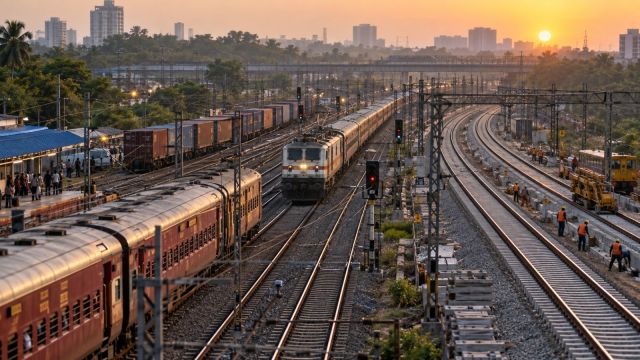
NEW DELHI — In a decisive bid to dismantle chronic logistical bottlenecks and supercharge India’s supply-chain efficiency, the Cabinet Committee on Economic Affairs (CCEA), chaired by Prime Minister Narendra Modi, has greenlit eight high-impact multitracking railway projects. Valued at an estimated ₹20,804 crore (approximately $2.5 billion), this sweeping infrastructural intervention target-fixes some of the nation's most congested railway corridors, spanning seven states and adding 1,163 kilometers of track to the national network.
The development marks a major milestone under the PM Gati Shakti National Master Plan for multimodal connectivity. By tripling and quadrupling key saturated routes, the Indian government seeks to lower the country's overall logistics cost—currently hovering around 13-14% of GDP—closer to the global benchmark of 8-9%. Economists view the move as a highly calculated structural play to fortify domestic manufacturing, ease passenger transit, and expedite the movement of essential industrial inputs.
The Strategic Blueprint: Unpacking the ₹20,804-Crore Infrastructure Blitz
At its core, this capital-intensive expansion is designed to resolve structural gridlocks in India's industrial and agricultural heartlands. The eight newly sanctioned routes traverse 26 districts across seven states: Odisha, Maharashtra, Andhra Pradesh, Jharkhand, Bihar, Telangana, and West Bengal. Rather than laying speculative new lines, the Ministry of Railways is doubling down on "multitracking"—a process of adding multiple parallel tracks to pre-existing, over-utilized corridors.
According to official statements, these routes are the lifeblood of India’s heavy industry, carrying critical raw materials and agricultural yield. By expanding capacity, the government expects to accommodate an incremental freight volume of 143 Million Tonnes Per Annum (MTPA). This additional capacity is vital for sustaining the rapid growth of domestic steel, cement, and power sectors, all of which rely heavily on bulk rail transport.
Key Infrastructure Deliverables:
- System Capacity Expansion: Addition of 1,163 km of new track lines across high-density corridors, eliminating systemic train delays.
- Socio-Economic Inclusivity: Improved rail access to aspirational districts and previously underserved industrial clusters.
- Direct Employment Generation: The construction phase is projected to generate approximately 30 million man-days of direct and indirect employment, fueling rural economies.
The Economic Underpinnings: Cutting Logistics Costs & Boosting Freight

The primary economic driver behind this ₹20,804-crore outlay is the optimization of India’s freight-to-passenger ratio. Currently, Indian Railways' passenger services heavily cross-subsidize freight operations. Delays caused by saturated lines further penalize freight transport, driving businesses to use road networks, which are significantly more expensive and carbon-intensive.
Under the PM Gati Shakti framework, these eight corridors have been chosen using advanced geospatial mapping to ensure seamless coordination with ports, coal mines, steel plants, and agricultural hubs. The targeted commodities for these routes include coal, iron ore, finished steel, cement, food grains, fertilizers, and petroleum products. Providing these commodities with dedicated, multi-tracked pathways ensures reliable delivery schedules for heavy industries, reducing the need for costly stockpiling.
A Detailed Breakdown of the Cabinet's Approved Railway Corridors
The following table outlines the strategic distribution, financial outlays, and target cargo profiles for the approved railway expansion projects:
| Project Scope / Region | Primary States Involved | Network Additions (Km) | Key Commodities Handled | Strategic Objective |
|---|---|---|---|---|
| Eastern Coal & Steel Corridor | Odisha, Jharkhand, West Bengal | Approx. 450 km | Coal, Iron Ore, Finished Steel | To feed thermal power plants and major metallurgical clusters. |
| Deccan-South Industrial Link | Maharashtra, Andhra Pradesh, Telangana | Approx. 380 km | Cement, Fertilizers, Food Grains | Unclogging the north-south transit spine for faster distribution. |
| Ganges Plains Agro-Corridor | Bihar, Jharkhand | Approx. 333 km | Agricultural Produce, Petroleum (POL) | Connecting rural food hubs to urban consumption centers efficiently. |
Market & Environmental Implications: The Ripple Effect
The capital expenditure of ₹20,804 crore is set to trigger a significant multiplier effect across several sectors. On Dalal Street, railway infrastructure and engineering procurement contract (EPC) stocks—including Rail Vikas Nigam Limited (RVNL), IRCON International, Jupiter Wagons, and Titagarh Rail Systems—are expected to see heightened investor interest as tenders are rolled out over the coming quarters.
From an environmental perspective, the modal shift from road to rail is a cornerstone of India's commitment to achieving net-zero emissions by 2070. Railways are inherently more energy-efficient than road transport, consuming roughly 75-90% less energy per ton-kilometer. The Ministry of Railways estimates that these eight projects will collectively result in a reduction of 10 billion liters of diesel fuel imports and mitigate millions of tonnes of carbon dioxide emissions annually, aligning industrial scaling with aggressive climate goals.
Looking Ahead: Execution Timelines and Challenges
While the financial approvals are secure, the true test lies in the execution. Indian infrastructure projects have historically faced headwinds from bureaucratic land acquisitions, forest clearances, and inter-state regulatory hurdles. However, the government has emphasized that the PM Gati Shakti platform—utilizing digital twin technology and integrated ministry portals—will significantly compress the pre-construction planning phase.
These eight projects are slated for completion within the next four to five years. If executed on schedule, they will not only change the face of Indian logistics but will also establish the foundational infrastructure required to support India's aspirations of becoming a $5-trillion economy in the near-term future.
Frequently Asked Questions (FAQ)
1. Why is the government prioritizing "multitracking" over building entirely new rail lines?
Multitracking (adding third, fourth, or even fifth lines to existing routes) is highly cost-effective and structurally impactful. Existing corridors are already connected to major industrial and urban centers but suffer from extreme congestion, where passenger and freight trains fight for the same slots. Adding tracks immediately increases throughput capacity, eliminates delays, and utilizes existing railway land, making it much faster to execute than acquiring new land for entirely greenfield lines.
2. How do these projects benefit the average Indian consumer?
While these projects are heavily focused on freight, they directly benefit passenger transport by freeing up capacity on highly congested tracks. This will result in fewer delays for passenger trains and allow Indian Railways to introduce new passenger services on these routes. Additionally, by lowering the logistics cost of transporting bulk commodities like cement, steel, and food grains, the overall retail cost of construction materials and essential goods for consumers is kept in check.