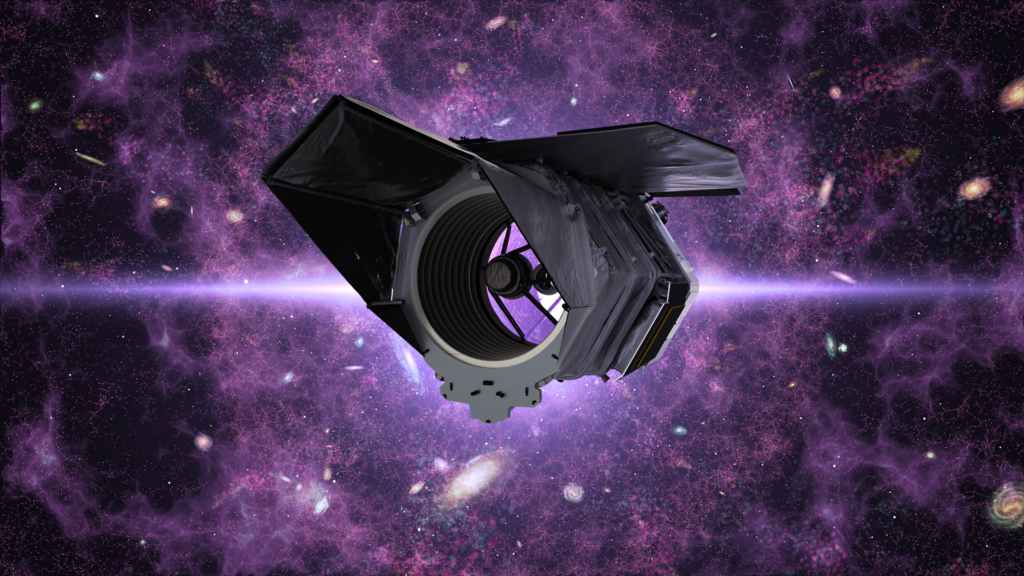
For decades, humanity’s quest to understand the cosmos has been governed by a frustrating limitation: we can either look incredibly deep into a microscopic sliver of space, or scan wide swathes of the sky with very little detail. Now, NASA is preparing to launch a new class of space observatory that promises to shatter this compromise. This upcoming flagship instrument—the Nancy Grace Roman Space Telescope—is poised to revolutionize astrophysics by combining unprecedented panoramic vision with the deep-space clarity of the legendary Hubble Space Telescope.
While the James Webb Space Telescope (JWST) continues to capture global headlines with its ultra-deep infrared focus, Roman represents a paradigm shift in how astrophysicists map the universe. Backed by aerospace conglomerates and international coalitions, this multi-billion-dollar mission is designed to solve the two greatest mysteries of modern physics: dark energy and dark matter.
The Great Cosmic Panoramic: Why Roman is a Game-Changer
To understand the sheer scale of the Roman Space Telescope, one must look at its field of view. While Roman’s primary mirror is 2.4 meters in diameter—the same size as Hubble’s—its state-of-the-art 300-megapixel Wide Field Instrument will capture an area of the sky 100 times larger than Hubble in a single exposure.
"If Hubble is like looking at the night sky through a needle's eye, Roman is like looking through a wide-angle camera lens on a premium DSLR," explains a senior NASA astrophysicist associated with the project. "We aren't just looking at individual galaxies anymore; we are mapping entire cosmic webs."
This massive field of view will allow scientists to conduct sweeping cosmic surveys that would take Hubble or Webb hundreds of years to complete. By rapidly photographing billions of stars and galaxies, Roman will create a high-definition 3D map of our universe, allowing researchers to track how cosmic structures have evolved over 13 billion years.
The Key Strategic Objectives of NASA's Next-Gen Mission
- Unmasking Dark Energy and Dark Matter: Roman will measure the distribution of hundreds of millions of galaxies to determine whether the expansion of the universe is accelerating due to Einstein's cosmological constant or an exotic new force.
- The Ultimate Exoplanet Census: Using a technique called gravitational microlensing, the telescope will detect thousands of planets orbiting distant stars, including rocky worlds in the habitable zones of their suns.
- Direct Exoplanet Imaging: Equipped with a revolutionary Coronagraph Instrument, Roman will block out starlight to directly image giant exoplanets, paving the way for future missions to hunt for biosignatures.
The Economics of the New Space Race

For institutional investors and aerospace contractors, the development of the Roman Space Telescope represents a major industrial milestone. Prime contractors, including L3Harris Technologies and Ball Aerospace, have pushed the boundaries of optical engineering to deliver instruments capable of cryogenic stability and extreme precision.
Unlike Webb, which faced decades of delays and ballooning budgets that topped $10 billion, Roman is operating under a highly disciplined, cost-capped budget of approximately $3.9 billion. NASA’s strict project management on Roman is seen by industry analysts as a vital test case to prove that next-generation scientific flagships can be delivered on schedule and within budget parameters.
| Specification / Feature | Hubble (HST) | James Webb (JWST) | Nancy Grace Roman (RST) |
|---|---|---|---|
| Primary Mirror Diameter | 2.4 meters | 6.5 meters | 2.4 meters |
| Primary Light Spectrum | Visible, UV, Near-IR | Infrared (Mid and Near) | Near-Infrared, Visible |
| Field of View (Relative) | 1x Baseline | ~1.2x (High Sensitivity) | 100x Hubble Baseline |
| Target Launch / Orbit | Low Earth Orbit (1990) | Lagrange Point 2 (2021) | Lagrange Point 2 (Target: May 2027) |
| Core Scientific Focus | General Astronomy | First Galaxies & Deep Universe | Dark Energy, Exoplanet Census |
Timeline and Next Steps: The Road to Lagrange Point 2
The Roman Space Telescope is currently undergoing rigorous environmental testing, designed to simulate the violent vibrations of a rocket launch and the extreme thermal cycles of deep space. NASA plans to launch the observatory onboard a commercial heavy-lift rocket—likely a SpaceX Falcon Heavy—from Kennedy Space Center.
Once launched, Roman will travel 1 million miles away from Earth to the second Lagrange Point (L2), a gravitationally stable position in space. There, shielded from the heat of the Sun, Earth, and Moon, it will begin its five-year primary mission, working in tandem with the James Webb Telescope and ground-based observatories to unlock a new golden age of astronomy.
Frequently Asked Questions
Is the Roman Space Telescope replacing the James Webb Space Telescope?
No. The Roman Space Telescope is designed to be highly complementary to the James Webb Space Telescope. While Webb excels at zooming in to capture highly detailed, deep-field spectroscopic data of specific cosmic targets, Roman’s strength is its massive field of view. Roman will find the rare, exotic cosmic anomalies across large swaths of the sky, which Webb can then zoom in on for ultra-deep analysis.
How will Roman find exoplanets that other telescopes have missed?
Roman will use a phenomenon called gravitational microlensing. When a foreground star (with a planet) passes directly in front of a background star, the foreground gravity acts like a magnifying glass, brightening the background star. By monitoring tens of millions of stars simultaneously in the crowded center of our galaxy, Roman will detect these brief brightening events, allowing it to catalog planets that are far colder and more distant from their parent stars than those found by previous transit-based telescopes like Kepler.