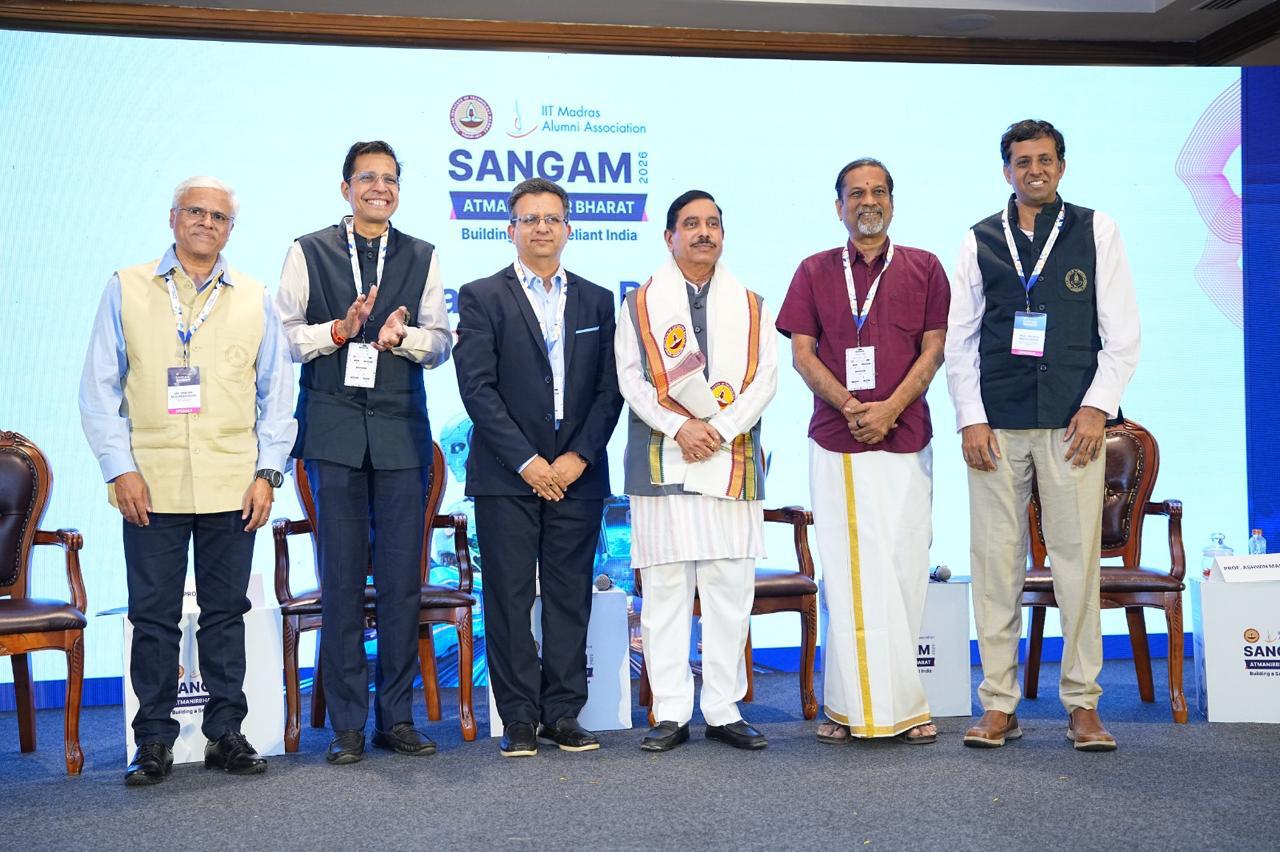
CHENNAI — As global technology supply chains realign around geopolitical fault lines, India’s quest for technology sovereignty has shifted from a policy aspiration to an aggressive, high-stakes industrial campaign. At the center of this transition is the Indian Institute of Technology Madras Alumni Association (IITMAA), which recently convened its flagship forum, Sangam 2026. Under the rallying cry of "Advancing India’s Self-Reliance Through AI, Semiconductors and Deep Tech," the confluence of global industry captains, academic pioneers, and policymakers laid out an actionable roadmap for India's technological independence.
Led by Mr. Sridhar Boovaraghavan, President of IITMAA, the summit served as a critical crucible for matching domestic engineering talent with strategic venture capital and state-backed manufacturing initiatives. The consensus among delegates was clear: India must transition from being the world’s back-office capability center to becoming a primary IP-creator in the foundational technologies of the 21st century.
Why the IIT Madras Ecosystem Holds the Key to India’s Silicon Ambitions
The choice of IIT Madras as the epicenter for this discourse is far from accidental. IIT Madras has long carved out a reputation as India’s premier deep-tech hub, famously housing the country's first university-driven Research Park. It is the birthplace of Shakti, India’s first indigenous RISC-V microprocessor, and has incubated over 350 deep-tech startups collectively valued at over $4 billion.
Speaking at the inaugural address, Mr. Sridhar Boovaraghavan highlighted the vital role that the global alumni network plays in bridging the gap between cutting-edge research and industrial scale. He stated:
"India is at a generational inflection point. The convergence of sovereign AI, domestic chip design, and deep tech is no longer just a business opportunity; it is a national security imperative. Through Sangam 2026, IITMAA is mobilizing global expertise to build robust, localized supply chains that ensure India remains resilient against global macroeconomic shocks."
This sentiment aligns closely with the Indian government's massive push under the India Semiconductor Mission (ISM), a $10 billion incentive program aimed at establishing commercial silicon fabrication units, packaging facilities, and design centers within the country.
The Triad of Sovereignty: AI, Semiconductors, and Deep Tech

The discussions at Sangam 2026 were structured around three core pillars, each representing a critical bottleneck and opportunity for Indian industry:
1. Semiconductor Independence: Beyond Assembly to Intellectual Property
While India excels in chip design—housing nearly 20% of the world’s semiconductor design engineers—the physical manufacturing (fabrication) has historically been concentrated in East Asia. Panellists at Sangam 2026 emphasized the need to foster "fabless" startup ecosystems within India. By utilizing the RISC-V open-source architecture, Indian startups can bypass expensive proprietary licensing fees to design custom chips tailored for IoT, automotive, and defense sectors.
2. Sovereign AI: Guarding Data and Developing Indigenous LLMs
With AI poised to add $500 billion to India’s GDP by 2025, the summit addressed the urgent need for "Sovereign AI." Panellists warned against relying solely on Western Large Language Models (LLMs) that lack contextual, linguistic, and cultural alignment with India's diverse population. The forum advocated for locally hosted compute infrastructure, built using energy-efficient domestic chips, to process public data securely within national borders.
3. Democratizing Deep Tech and Attracting Patient Capital
Deep tech—ranging from quantum computing to space-tech and advanced materials—requires high upfront capital expenditure and long gestation periods. Unlike traditional SaaS or consumer internet startups, deep-tech ventures need "patient capital." Sangam 2026 served as a matchmaking platform to connect early-stage deep-tech founders with institutional investors willing to commit to 7-to-10-year development cycles.
Strategic Milestones: The India Tech Landscape
To contextualize the scale of this technological shift, the following table outlines the key metrics and projected targets discussed during the summit's policy panels:
| Technology Sector | Current Landscape (2025-26) | Projected Target (2030) | Key Catalysts Needed |
|---|---|---|---|
| Semiconductors | Import reliant; strong design talent base | $110 Billion domestic market; functional local fabs | ISM Subsidies, Fabless venture funds, Talent upskilling |
| Sovereign AI | Localized pilot models; dependency on foreign cloud infrastructure | Unified Indic-language LLMs; national AI computing grids | GPU infrastructure expansion, Public-Private data partnerships |
| Deep Tech Startups | 10,000+ active startups; limited growth-stage funding | Global market leadership in Space-tech, Robotics, & Quantum | Long-term institutional capital, academic incubation pipelines |
Key Takeaways: The Path Forward from Sangam 2026
To translate discussions into tangible economic outcomes, the IITMAA steering committee outlined several key actionable mandates:
- Alumni-led Mentorship and Venture Co-investment: Establishing a dedicated micro-VC syndicate aimed specifically at commercializing pre-revenue deep-tech research from IIT Madras labs.
- The RISC-V Standardization Program: Driving the adoption of open-source RISC-V instruction set architectures across Indian public sector undertakings (PSUs) and defense systems to ensure hardware security.
- Bridging the Academia-Industry Divide: Creating rolling corporate fellowships where mid-career semiconductor and software engineers can spend quarters working alongside academic researchers to build commercial prototypes.
- Policy Advocacy for Patient Capital: Collaborating with regulatory bodies to incentivize domestic pension funds and insurance firms to allocate a percentage of their assets under management (AUM) to high-priority deep-tech sectors.
Ultimately, Sangam 2026 made it abundantly clear that India’s path to self-reliance does not lie in isolation, but in strategic global integration. By leveraging its vast, highly influential alumni network across Silicon Valley, Europe, and Asia, IIT Madras is positioning itself as the critical conduit through which global technological expertise flows back to ignite India's domestic manufacturing engine.
Frequently Asked Questions (FAQ)
What is the primary objective of the IITMAA Sangam 2026 initiative?
IITMAA Sangam 2026 is a strategic platform organized by the IIT Madras Alumni Association designed to accelerate India’s self-reliance (Atmanirbhar Bharat). It focuses specifically on mobilizing industry leaders, researchers, and policymakers to build self-sustaining ecosystems in Semiconductor fabrication, Sovereign AI, and high-value Deep Tech research and development.
Why is "Sovereign AI" considered critical for India's economic security?
Sovereign AI ensures that India develops its own foundational artificial intelligence models using localized data that respects the country's linguistic diversity and regulatory standards. It prevents critical national data from being stored on foreign servers, reduces dependency on overseas tech monopolies, and ensures that the economic gains generated by AI automation remain within the domestic economy.