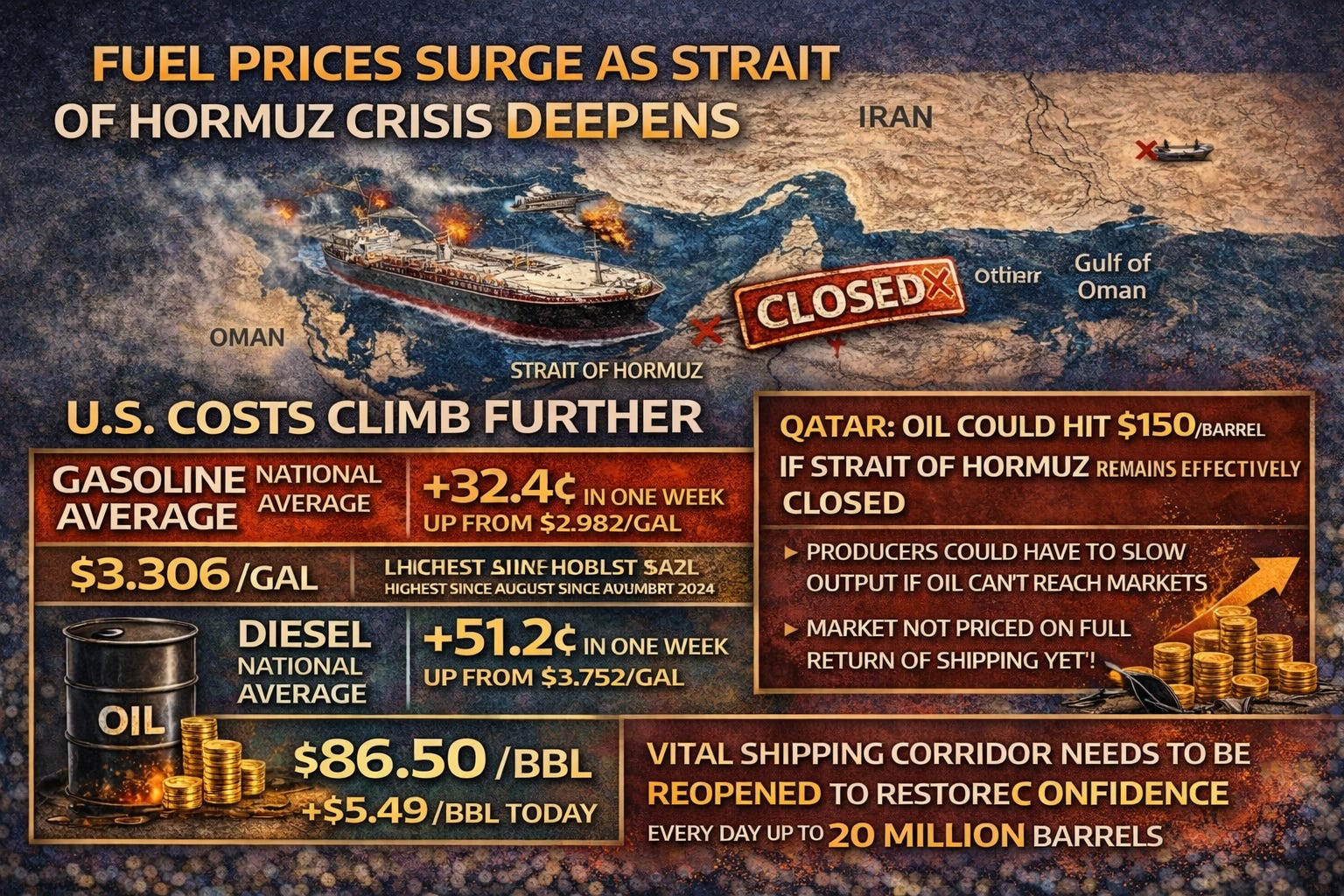
DUBAI / LONDON / SINGAPORE — Global energy markets are confronting their most systemic geopolitical stress test in decades as intensifying friction along the Strait of Hormuz cascades through maritime logistics, downstream refining margins, and retail fuel benchmarks. Long categorized by energy economists as the planet's single most critical hydrocarbon artery, the narrow maritime passage—separating the Arabian Peninsula from Iran—is once again dictating the velocity of international trade. What began as localized defensive posturing has rapidly transformed into a financial and logistical shock, sending seismic ripples across international crude benchmarks, ultra-low sulfur diesel, bunker fuel complexes, and broader enterprise balance sheets.
With an estimated 20.5 million barrels per day (bpd) of crude and petroleum liquids transiting the passage—accounting for roughly 21% of total global petroleum consumption and nearly a third of all seaborne crude trade—even the statistical probability of transit friction commands an immediate risk premium. Unlike regional pipeline infrastructure, which offers fractional redundant capacity, the physical reality of the Strait admits no immediate substitute. Energy trading desks from London to Tokyo are scrambling to reprice risk mitigation frameworks, corporate capital allocation plans are being aggressively overhauled, and maritime transport corridors are pricing in war-risk insurance premiums unseen since early 2022.
Executive Takeaways
- Systemic Chokepoint Vulnerability: The Strait of Hormuz carries roughly 20 to 21 million barrels per day of petroleum liquids alongside approximately 20% of global liquefied natural gas (LNG) supply, creating an irreplaceable artery where localized friction drives immediate global price discovery.
- Downstream Refined Product Spikes: While headline Brent and West Texas Intermediate (WTI) futures capture public attention, the acute crisis lies in middle distillates and maritime bunker fuels. Very Low Sulfur Fuel Oil (VLSFO) and Marine Gasoil (MGO) at bunkering hubs like Fujairah and Singapore have experienced explosive basis widening.
- Underwriting and Freight Compounding: War-risk insurance premiums for Very Large Crude Carriers (VLCCs) have escalated to between 0.65% and 1.0% of ship hull value per transit, pushing spot freight voyage costs to levels that enforce downstream cost-push inflation on importing economies.
- Enterprise Hedging Dislocation: Corporate treasuries and logistics enterprises face unprecedented liquidity demands, as soaring margin calls on crude derivatives and crack-spread hedges force immediate reevaluations of enterprise ROI, capital expenditure (CapEx), and inventory holding models.
The Mechanics of Transit: Why Hormuz Cannot Be Replaced

To understand the severity of the current price escalation, institutional investors must analyze the immutable geography of Persian Gulf hydrocarbons. The Strait of Hormuz is merely 21 nautical miles wide at its narrowest point, with the inbound and outbound commercial shipping lanes each measuring just two miles wide, separated by a two-mile buffer zone. This geographic bottleneck sits directly under the sovereign radar coverage and anti-ship missile envelopes of littoral powers.
A common market misconception is that cross-continental pipeline architecture provides adequate bypass protection. In reality, alternative transport routes offer negligible relief. Saudi Arabia’s East-West Crude Oil Pipeline (Petroline), running from the Eastern Province to the Red Sea terminal of Yanbu, boasts an operational nameplate capacity of roughly 5 to 7 million bpd, but historical utilization and downstream processing constraints prevent it from sustaining maximum throughput indefinitely. Similarly, the Abu Dhabi Crude Oil Pipeline (ADCOP), which funnels onshore Murban crude directly to the port of Fujairah on the Gulf of Oman, handles approximately 1.5 million bpd. Together, these systems provide less than 8 million bpd of effective divertible capacity, leaving at least 12 to 13 million bpd of crude and condensate entirely trapped within Persian Gulf waters should transit be impeded.
Compounding the liquid market dislocation is the natural gas dimension. The state of Qatar exports nearly all its LNG via the Strait, primarily targeting Asian utilities in Japan, South Korea, India, and China, alongside supplemental European cargoes. Because LNG cannot be redirected via overland pipes, any logistical disruption creates an instantaneous supply deficit in the spot gas complex, accelerating fuel-switching dynamics and driving heavy industrial enterprises to consume more diesel and fuel oil, further tightening middle distillate availability.
The Refined Products Shock: Bunker Fuel, Diesel, and the Fujairah Nexus
While mainstream coverage focuses heavily on the prompt-month price of ICE Brent crude breaching technical resistance bands, corporate treasurers, supply chain directors, and downstream distributors are reeling from movements in refined products. The shipping industry is absorbing the direct impact through marine bunker fuel—specifically Very Low Sulfur Fuel Oil (0.5% sulfur) and Marine Gasoil.
Fujairah, strategically positioned just outside the Strait of Hormuz, functions as the primary bunkering and storage hub for vessels entering and exiting the Gulf. Heightened risk surrounding the approach corridors has sparked severe logistical friction. Tanker operators face mounting demurrage costs, extended waiting times, and localized inventory hoarding. As a result, the "Fujairah bunker premium" relative to Singapore and Rotterdam has surged dramatically. Container liners, bulk carriers, and product tankers operating across the Asia-Europe and trans-Indian Ocean routes are facing bunker surcharge escalations that must be passed directly into container freight rates, driving up input costs for everything from industrial component manufacturing to consumer electronics.
Simultaneously, the global refining complex is experiencing extreme volatility in middle distillate crack spreads—the differential between crude feedstock costs and the wholesale price of refined diesel and jet fuel. Diesel is the fundamental fuel of industrial production, freight rail, long-haul trucking, and agriculture. Global inventories of middle distillates were already constrained across OECD storage facilities prior to recent geopolitical shocks. The prospect of losing Asian and Middle Eastern export volumes has driven crack spreads upward, reigniting industrial cost-push inflation and complicating the monetary easing trajectories of western central banks.
Verified Market Metrics: Operational & Price Breakdown
The operational and financial parameters across global energy, maritime shipping, and downstream derivative markets illustrate the structural shift resulting from heightened Strait of Hormuz risk:
| Market Metric / Instrument | Historical Baseline (Pre-Tension) | Current Stressed Level | Variance (%) | Enterprise & Economic Impact |
|---|---|---|---|---|
| ICE Brent Crude ($/bbl) | $73.50 – $78.00 | $89.50 – $94.00 | +21.2% | Upstream E&P revenue expansion; broad-based cost escalation across transport. |
| VLCC Spot Rates (TD3C Gulf-China, $/day) | $32,000 / day | $82,500 / day | +157.8% | Massive freight cost inflation; margin compression for Asian refiners. |
| War Risk Insurance (% of Hull Value) | 0.05% – 0.10% | 0.65% – 1.00% | +700% to +900% | Adds $600,000–$1,000,000+ per voyage in non-recoverable operational overhead. |
| Fujairah VLSFO 0.5% ($/MT) | $590.00 / MT | $745.00 / MT | +26.3% | Immediate escalation in ocean freight bunker adjustment factors (BAFs). |
| Global Gasoil/Diesel Crack Spread ($/bbl) | $18.50 / bbl | $31.20 / bbl | +68.6% | Elevates industrial logistics costs; reignites CPI transport inflation metrics. |
| Middle East Bypass Pipeline Utilization | 52% capacity | 88% capacity | +69.2% | Terminal congestion at Yanbu; acute technical limits on redundant volume. |
Maritime Underwriting, War Risk, and Freight Contagion
The escalation in fuel prices is exacerbated by structural developments in the maritime insurance and underwriting sectors. The Joint War Committee (JWC) of Lloyd's and the International Underwriting Association regularly updates listed areas of perceived enhanced security risk. When maritime insurers elevate the risk assessment of the Persian Gulf and Gulf of Oman, vessel owners are subjected to mandatory Additional Premium (AP) quotes for Breach of Institute Warranties.
Historically, war-risk insurance premiums hover around a modest 0.05% to 0.1% of an asset's insured hull and machinery value. In peak escalation cycles, these underwriting rates can spike tenfold, landing between 0.65% and 1.0%. For a newly constructed or high-spec VLCC valued at $120 million, a 1% additional premium imposes an extra $1.2 million in capital expenditure for a single seven-to-ten-day transit into Persian Gulf loading terminals. This single surcharge often exceeds the vessel's standard operational charter cost for the voyage.
This dynamic triggers an immediate supply contraction in available tonnage. Risk-averse shipowners elect to anchor vessels outside the risk zone or refuse Gulf fixtures entirely, shrinking the pool of available commercial vessels. In response, charterers are forced to bid up spot tanker day-rates (such as the standard TD3C benchmark from the Persian Gulf to Ningbo) to incentivize shipowners to assume transit hazards. This dual burden—skyrocketing fuel consumption costs coupled with historic freight rates—directly inflates the landed cost per barrel of imported crude.
Corporate Balance Sheets and Capital Allocation: The Liquidity Squeeze
Beyond the physical movement of hydrocarbons, the financial transmission mechanism of the Strait of Hormuz crisis is impacting institutional balance sheets, enterprise ROI calculations, and market liquidity. Corporate risk managers rely heavily on derivative instruments—such as forward freight agreements (FFAs), Brent/Dubai Exchange of Futures for Swaps (EFS), and crack-spread swaps—to insulate operational budgets from commodity volatility.
However, when energy volatility indices surge, clearinghouses and central counterparty clearing facilities (CCPs) immediately enact elevated initial and variation margin requirements. Trading houses, multi-national logistics providers, and independent refiners must rapidly allocate liquid working capital to satisfy exchange margin calls, pulling billions in cash away from core operational CapEx and short-term debt paydowns.
This capital allocation bind is forcing an operational restructuring across three distinct corporate cohorts:
- Downstream Refiners: Independent refiners lacking sovereign upstream balance sheets face deteriorating net operating cash flows. The cost of financing crude feedstock inventories via letters of credit has climbed alongside commercial interest rates, turning inventory maintenance into an expensive balance sheet item.
- Commercial Airlines and Air Freight: Jet fuel parity margins are decoupling from crude due to middle distillate scarcity. Enterprise treasuries that failed to lock in jet-A1 hedges are finding their operating margins instantly compromised, forcing swift downward revisions to forward EBITDA guidance.
- Multinational Heavy Industry: Organizations reliant on petrochemical feedstocks (such as naphtha and ethane sourced via Middle Eastern terminals) are experiencing cost inflation that cannot easily be passed down to consumer markets experiencing slowing real demand.
Industry Winners, Losers, and Macroeconomic Divergence
The geopolitical repricing of the world's most critical fuel corridor exposes a clean line of demarcation across corporate and sovereign balance sheets:
The Structural Winners
Primary beneficiaries include upstream exploration and production (E&P) enterprises with low-cost asset bases situated far from Middle Eastern transit risk, such as operators in the Permian Basin, the North Sea, offshore Guyana, and Brazilian pre-salt basins. Because these producers market their crude into Western hubs without paying Middle East war-risk insurance or elevated Suez/Hormuz freight rates, their net realized margins per barrel surge directly to bottom-line enterprise free cash flow.
Simultaneously, alternative infrastructure pipeline operators possessing available pipeline transport quotas—specifically those controlling capacity through Saudi Arabia's Petroline or pipelines linking Caspian oil to Mediterranean ports—command significant tariff premiums. Large integrated oil majors with massive, diversified tanker fleets and captive internal trading arms also benefit substantially, utilizing physical arbitrage to supply constrained markets while capturing historic crack spreads within their own refining divisions.
The Structural Losers
On the losing side stand export-dependent Asian refining hubs that are structurally dependent on Persian Gulf medium-sour crude slates. Countries like Japan and South Korea, which import upwards of 75% to 85% of their total crude slate through the Strait of Hormuz, face deteriorating trade balances, foreign exchange downward pressure, and domestic energy subsidy pressures. Refiners unable to process heavy Western sweet crudes cannot simply substitute Persian Gulf sour crude with American WTI or West African grades due to technical refinery unit configurations.
Global transport, shipping, and intermodal logistics groups represent another deeply impacted segment. With operating margins already pinched by softening post-pandemic retail volume, unexpected surges in bunker fuel surcharges deplete cash flows. At a sovereign level, non-oil producing emerging economies face an acute balance-of-payments crisis, as rising dollar-denominated fuel import bills exhaust foreign exchange reserves, elevating sovereign default risks and requiring renewed intervention from international monetary institutions.
Frequently Asked Questions (People Also Ask)
How directly does a disruption in the Strait of Hormuz impact retail gasoline and diesel prices?
The transmission mechanism from the Strait of Hormuz to local retail pump stations operates with remarkable speed, typically manifesting within 7 to 21 business days. Because crude oil represents roughly 50% to 60% of the retail price of gasoline and diesel (with the remainder consisting of refining costs, transportation, marketing, and excise taxes), any immediate upward revaluation in global benchmarks like Brent or WTI directly increases refinery acquisition costs. Furthermore, since diesel and middle distillates are heavily exported from Asian and Middle Eastern refiners that rely on Hormuz transit, global inventories contract immediately, prompting regional fuel wholesalers to rapidly mark up fuel racks to reflect theoretical replacement costs.
What alternative pipeline routes exist to bypass the Strait of Hormuz, and can they handle current volumes?
There are only two major operational pipeline networks designed to bypass the Strait: Saudi Arabia's East-West Pipeline (Petroline) to Yanbu on the Red Sea, and the Abu Dhabi Crude Oil Pipeline (ADCOP) running to the Port of Fujairah. Combined, these networks possess a maximum technical diversion capacity of roughly 7 to 8 million barrels per day under optimal operating conditions. Given that daily transit volumes through the Strait exceed 20 million barrels per day, these pipelines can reroute less than 40% of standard traffic, leaving a permanent operational deficit of over 12 million barrels per day that cannot be bypassed by land.
Why do maritime war-risk insurance premiums surge before any physical barrels are stopped?
Maritime insurance works on probabilistic threat assessments rather than actual physical destruction. The Joint War Committee (JWC), which comprises underwriting representatives from the Lloyd's and International Underwriting Association markets, designates regions exhibiting military posturing, drone activity, or maritime interdictions as listed areas. Under standard charterparty agreements, entering a listed area triggers a breach of warranty, empowering underwriters to issue separate War Risk Additional Premiums (AP). Because underwriters must maintain catastrophic reserves against modern, high-value commercial vessels—which can carry cargo worth over $150 million each—insurers instantly raise rates to insulate capital reserves against potential fleet-wide losses.
How are global logistics and supply chain enterprises hedging against sustained bunker fuel volatility?
Enterprises utilize a combination of financial hedging, contract adjustments, and operational realignments. Financially, corporate risk managers execute Over-the-Counter (OTC) swaps and collar structures linked to standard bunker benchmarks like Singapore VLSFO or Rotterdam 0.5% fuel oil, capping their maximum per-ton exposure. Operationally, ocean carriers update Bunker Adjustment Factor (BAF) clauses in long-term freight service agreements to automatically pass fuel increases directly to downstream cargo shippers. Furthermore, shipping lines frequently enforce "slow steaming" protocols—reducing ship speeds by 2 to 4 knots—which exponentially decreases marine fuel consumption per nautical mile at the expense of longer supply chain delivery schedules.
Future Outlook & Strategic Watchpoints
As markets navigate prolonged tension in the Strait of Hormuz, institutional allocators, commodity desks, and industrial operators must monitor several pivotal triggers over the coming quarters:
- OPEC+ Spare Capacity Accessibility: While the OPEC+ alliance theoretically holds between 4.5 and 5.5 million bpd of shut-in spare production capacity, the vast majority of this cushion is geographically concentrated inside the Persian Gulf—principally in Saudi Arabia, the UAE, Kuwait, and Iraq. If transit out of the Gulf is structurally compromised, this offline spare capacity is rendered operationally useless to world markets, preventing OPEC+ from acting as an effective swing producer.
- Strategic Petroleum Reserve (SPR) Intervention Thresholds: The political tolerance for sustained fuel inflation in the United States and OECD nations is remarkably low. Prolonged crude pricing above $90 to $95 per barrel will inevitably spark co-ordinated releases from the International Energy Agency (IEA) and the U.S. SPR. However, with OECD strategic inventories already substantially depleted from historical interventions, the psychological and physical efficacy of future emergency stock releases is fundamentally diminished.
- Naval Convoy Escorts and Sovereign Reinsurance Backstops: If commercial war-risk underwriters withdraw hull cover or raise premiums past commercially viable thresholds, sovereign intervention becomes unavoidable. Markets must monitor the formation of international naval coalition task forces to escort commercial tanker traffic, alongside the potential implementation of sovereign state-backed reinsurance pools—a measure historically enacted during the "Tanker War" of the 1980s to prevent a total collapse of commercial merchant shipping.
The geopolitical reality of the Strait of Hormuz remains unambiguous: it is an indispensable structural artery of the modern industrial economy. So long as capital flows, refined products, and crude volumes remain exposed to the physical vulnerability of this 21-mile chokepoint, corporate balance sheets will continue to pay an ongoing, structural risk premium across the entire global energy landscape.



:max_bytes(150000):strip_icc():focal(772x203:774x205)/caitlin-clark-1-4d4c4a7ee3b64aa684aacbc098e2c55e.jpg)