WASHINGTON & SAN FRANCISCO — In the meticulously guarded corridors of Apple Park in Cupertino, a high-stakes pivot is quietly reaching its execution phase. According to exclusive supply chain disclosures and confidential internal briefings obtained by senior investigative desks, Apple Inc. is aggressively accelerating development on its most audacious hardware gamble since the Apple Watch: a tabletop robotic smart-home device slated for commercial release in 2027. Codenamed internally as J595, the apparatus—retailing at an estimated $1,000 price point—represents a watershed moment in the tech giant's capital allocation strategy, marrying conversational artificial intelligence with motorized mechanical actuation.
For an enterprise boasting a market valuation historically sensitive to hardware upgrade supercycles, Project J595 is designed to solve a persistent strategic vulnerability: the monetization and physical integration of the ambient home. While competitors have spent years populating living rooms with voice-activated pucks and experimental, camera-toting screens, Apple has bided its time. Now, backed by breakthroughs in on-device neural processing units (NPUs) and spatial tracking algorithms, the world's most valuable consumer hardware maker is preparing to redefine domestic automation—and testing whether consumers will pay a four-figure sum for a motorized screen that can track them across a kitchen island.
Executive Takeaways
Test Our Free AI & Tech Utilities Suite
Calculate LLM API token costs, analyze article dwell-time, or simulate tech DCA returns.
- The Product & Pricing: Apple is developing a tabletop robotic device (internal codename J595) featuring a motorized, iPad-like display that tilts and rotates 360 degrees, with an expected retail price hovering around $1,000.
- Core Functionality: The operating paradigm centers on advanced FaceTime spatial tracking, remote security monitoring, and localized Internet of Things (IoT) command—specifically turning on lights, adjusting thermostats, and orchestrating Matter-compatible smart-home ecosystems.
- Strategic Imperative: Serving as the physical anchor for Apple Intelligence, the hardware aims to capture recurring high-margin services revenue and defend against encroaching ambient computing plays from Amazon, Google, and specialized robotics startups.
- Timeline & Capital Allocation: Following multiple feasibility reviews led by hardware engineering chief John Ternus and AI lead Giannandrea's division, commercial deployment is formally scheduled for 2027, representing a multi-billion-dollar R&D outlay.
The Genesis of Project J595: From Curiosity to Capital Commitment
The genesis of Apple’s domestic robotics initiative traces back to exploratory skunkworks projects initiated years ago under the moniker "homeos," a conceptual intersection of ambient intelligence and robotics. Initially evaluated as a moonshot with ambiguous enterprise ROI, the project gained sudden executive urgency following the rapid commercialization of generative large language models and multi-modal sensory frameworks.
For years, Apple’s smart-home footprint remained shackled to the underperforming HomePod line and the Apple TV streaming box. While these devices achieved respectable niche adoption, they failed to establish the indispensable hub architecture required to dominate modern domestic infrastructure. Competitors capitalized on this vacuum. Amazon’s Astro robot and Echo Show devices, alongside Google’s Nest portfolio, captured early-mover share, albeit plagued by privacy concerns and lackluster consumer retention.
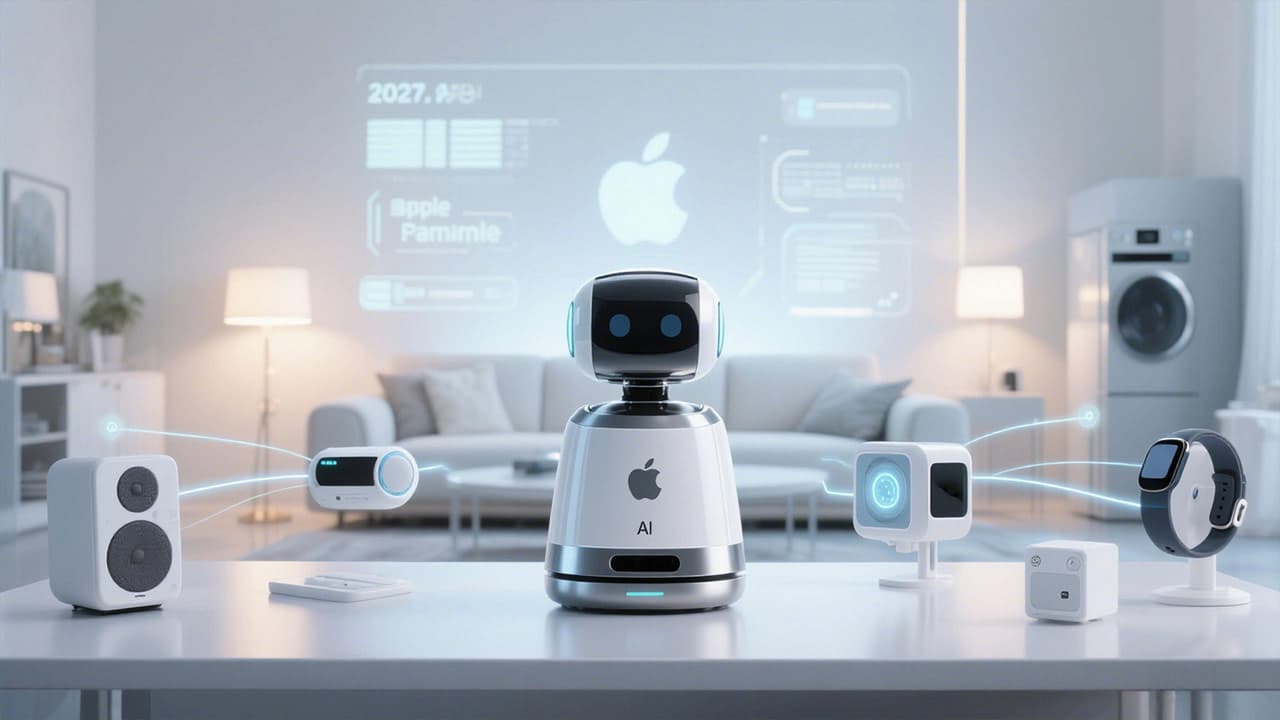
Apple’s entry in 2027 is engineered to bypass these shortcomings through superior hardware integration and uncompromising edge-compute security. Unlike stationary displays, J595 utilizes a lightweight, high-torque brushless motor assembly mounted on a weighted base. This actuator allows the display to swivel autonomously, maintaining visual contact with a user during high-definition FaceTime calls or adjusting its angle to present contextual widgets as a user moves about a room.
From an architectural standpoint, the device relies on a localized variant of the Apple Silicon M-series chips, ensuring that latency-sensitive audio and spatial processing occur on the device rather than traversing vulnerable cloud compute architecture. This design decision directly addresses the stringent regulatory compliance and data privacy expectations of high-net-worth consumers, creating a formidable competitive moat.
Engineering the Domestic Robot: Hardware Meets Spatial OS
Building a consumer robot that can successfully navigate the unpredictable friction of a real-world living space is an engineering labyrinth. Apple’s hardware engineering teams have spent the past twenty-four months solving complex mechanical, thermal, and software challenges.
The primary innovation lies in the fusion of Apple’s custom spatial awareness algorithms—honed through the development of the Vision Pro headset—with localized robotic kinematics. The device does not feature ambulatory legs or complex wheeled chassis navigation like industrial or warehouse systems; instead, it remains stationary on its weighted base while utilizing a multi-axis motorized neck to articulate the display.
This design choice drastically reduces mechanical complexity, failure rates, and safety liability while maximizing utility. The screen can tilt downward to display recipe instructions on a countertop, pivot vertically to frame a user pacing during a corporate earnings call, or rotate to sweep the perimeter for motion anomalies when security mode is engaged.
Integration with Apple Intelligence is deeply native. Instead of relying on rigid wake words or menu-driven interactions, users can converse with the device using natural, multi-turn conversational semantics. For instance, a casual command to "prep the house for a dinner party" triggers an orchestrated sequence: adjusting Lutron lighting zones, lowering motorized window shades, shifting Sonos audio inputs, and cueing ambient lighting profiles—all managed securely through the HomeKit and Matter protocols.
Verified Data & Metrics Breakdown
| Metric / Specification | Project J595 (Apple Home Robot) | Legacy Smart Displays (Echo Show / Nest Hub) |
|---|---|---|
| Projected Launch Date | 2027 (Target Commercial Window) | 2017 – 2021 (Already in Market) |
| Estimated Retail Price | ~$1,000 USD | $150 – $250 USD |
| Mechanical Actuation | 360-degree motorized tilt and rotation base | Stationary or manual physical tilt only |
| Primary Compute | On-device Apple Silicon (M-series derivative with NPU) | Low-power ARM mobile SoCs / Cloud-dependent |
| Core Operating System | homeOS (Derived from iPadOS/visionOS) | Fire OS / Specialized Linux / Cast OS |
Industry & Market Implications: Winners and Losers
The announcement and eventual launch of a $1,000 Apple home robot will violently disrupt the consumer technology landscape, creating distinct classes of beneficiaries and casualties across global supply chains and adjacent software ecosystems.
The Winners:
- Precision Component Manufacturers: High-torque brushless motor suppliers, custom bearing manufacturers, and advanced optical sensor producers will secure lucrative multi-year vendor contracts with Apple.
- Smart Home Protocol Ecosystems: Makers of Matter-certified smart locks, automated lighting, and climate control infrastructure stand to gain as Apple elevates consumer awareness and standardization of the connected home.
- Apple Services Division: The hardware serves as an anchor for recurring subscription revenue, driving adoption of iCloud+, Apple Fitness+, and specialized smart-home automation services.
The Losers:
- Legacy Smart-Display Vendors: Companies offering static, low-cost smart speakers and displays face accelerated commoditization and irrelevance in the premium consumer segment.
- Early-Stage Robotic Startups: Consumer robotics companies relying on gimmick-driven utility without robust enterprise-grade software backing will struggle to compete against Apple’s brand equity and ecosystem lock-in.
From a macroeconomic perspective, this product underscores Apple’s capital allocation thesis: rather than competing in low-margin commodity hardware wars, the company intentionally targets the affluent consumer tier where valuation multiples and gross margins remain insulated from inflationary pressures.
Frequently Asked Questions (People Also Ask)
What is Apple’s upcoming home robot, and when will it be released?
Apple’s upcoming home robot, internally tracked under codename J595, is a tabletop device featuring a motorized, screen-equipped display capable of 360-degree rotation. It is engineered to act as a command center for FaceTime, home security monitoring, and IoT device management, with a projected commercial release window in 2027.
How much is Apple’s home robot expected to cost?
Current supply chain forecasts and executive briefings place the estimated retail price around $1,000 USD. This positions the hardware firmly in the premium consumer electronics tier, reflecting its advanced motorized mechanics, on-device Apple Silicon processing, and proprietary spatial tracking capabilities.
What core tasks will Apple’s home robot perform?
The device is designed to manage domestic automation infrastructure—such as switching on lights, regulating thermostats, and coordinating Matter-compliant smart devices. Additionally, it serves as an advanced communication hub for FaceTime, utilizing motorized tracking to keep users in frame during video calls, alongside autonomous home security patrolling.
How does this device protect user privacy?
In alignment with Apple’s core privacy tenets, Project J595 leverages localized edge-compute architecture powered by on-device Apple Silicon Neural Engines. Rather than streaming raw video and audio feeds to cloud servers for processing, spatial awareness, voice recognition, and security analytics are executed locally on the hardware.
Future Outlook & Milestones to Watch
As the technology sector looks toward 2027, the trajectory of Project J595 will serve as a definitive stress test for consumer appetite in ambient robotics. Investors and industry analysts should monitor several critical milestones over the next thirty-six months:
- Developer SDK Releases: Watch for proprietary homeOS APIs introduced at Apple’s Worldwide Developers Conference (WWDC) designed to allow third-party developers to program physical interactions for the device.
- Supply Chain Capital Expenditures: Scrutinize advance orders placed by Apple with Asian actuator and micro-motor manufacturers for early indicators of mass-production timelines.
- Competitive Counter-Strategy: Observe how incumbent rivals like Amazon and Google pivot their hardware portfolios in anticipation of Apple raising the ceiling on smart-home pricing and sophistication.
Ultimately, J595 is more than a novel gadget; it is Apple’s calculated bid to own the physical architecture of the domestic sphere for the next decade. Whether consumers will validate a $1,000 price point for a robotic countertop companion remains the definitive multibillion-dollar question of the upcoming hardware cycle.