AI at Machine Velocity: Microsoft’s Multi-Model Agentic Security System Shatters Benchmarks and Reshapes Enterprise Risk
Test Our Free AI & Tech Utilities Suite
Calculate LLM API token costs, analyze article dwell-time, or simulate tech DCA returns.
As nation-state actors and cybercrime syndicates weaponize autonomous generative models, Microsoft deploys a groundbreaking multi-model agentic defense architecture designed to counter threats in real time—upending valuation models across the cybersecurity sector.
Executive Takeaways
- Paradigmatic Shift: Microsoft’s newly unveiled multi-model agentic security system transitions corporate defense from human-in-the-loop triage to autonomous, machine-speed mitigation, setting a new gold standard on leading industry benchmarks.
- Architectural Breakthrough: Spearheaded by Taesoo Kim, VP of Agentic Security, the platform orchestrates diverse specialized models to neutralize complex, multi-stage cyber attacks before human analysts can even verify telemetry alerts.
- Market Repercussions: The launch comes amid intense sector-wide consolidation and infrastructural realignment—coinciding with major market pivots such as the scheduled May 15, 2026 retirement of competing models like Grok—forcing enterprise buyers to re-evaluate capital allocation and cloud security spend.
- Monetization & ROI: Enterprise CFOs and CISOs are recalibrating valuation multiples for pure-play security vendors as integrated hyperscaler platforms demonstrate superior threat intelligence ingestion and cloud compute architecture efficiency.
The Anatomy of an Asymmetric Cyber War
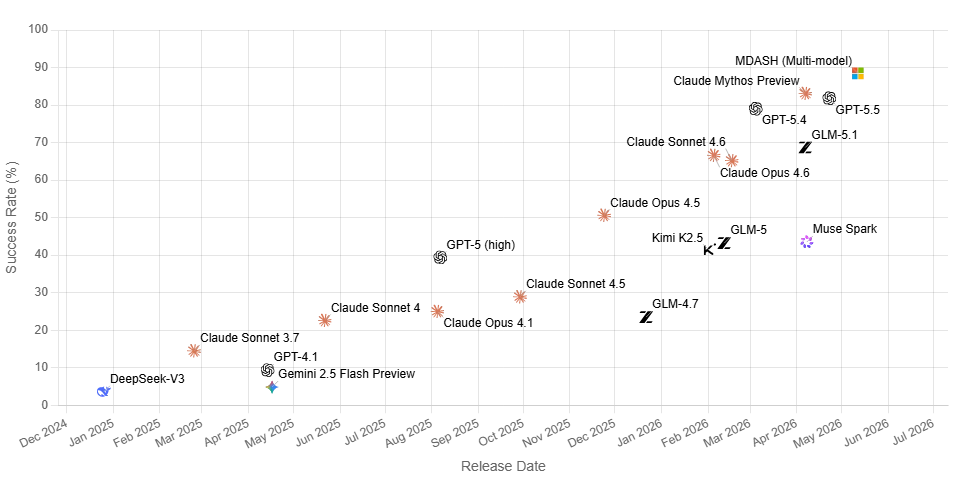
The modern digital battleground has evolved far beyond human cognitive bandwidth. Adversaries no longer rely solely on static malware or predictable phishing scripts; they deploy autonomous AI agents capable of mutating code, exploiting zero-day vulnerabilities, and lateral movement across cloud infrastructure within microsecond windows. In response to this existential threat, Microsoft Corp. unleashed its most aggressive countermeasure to date on May 12, 2026. Unveiled via the Microsoft Security Blog and championed by Taesoo Kim, Vice President of Agentic Security, the tech giant introduced a multi-model agentic security system that has decisively conquered leading industry security benchmarks.
This development marks a watershed moment in enterprise risk mitigation. For years, Chief Information Security Officers (CISOs) have grappled with alert fatigue, soaring dwell times, and an acute talent shortage in specialized cybersecurity personnel. Traditional security information and event management (SIEM) and extended detection and response (XDR) tools, while robust, ultimately function as passive recording devices or reactive filters that require human operators to interpret data lakes and execute remediation plays. Microsoft’s new architecture flips this dynamic entirely by introducing active, reasoning-based autonomous agents capable of collaborative threat hunting and autonomous containment.
Orchestrating Intelligence: Inside the Multi-Model Framework
Unlike monolithic large language models that attempt to solve every computational problem with a single set of weights, Microsoft’s agentic security system utilizes a sophisticated orchestration layer of specialized, fine-tuned models. According to technical disclosures from the Microsoft Security division, these models operate in a decentralized, cooperative consensus loop. One model specializes in network anomaly detection, another in static and dynamic binary analysis, and a third in threat-actor attribution and behavioral psychology.
When an anomalous event hits the telemetry pipeline—whether in an Azure cloud environment, an on-premises enterprise data center, or an endpoint device—the system does not merely log the event. Instead, autonomous agents spawn dynamically, sandbox the suspicious process, query global threat intelligence feeds, simulate potential attack vectors, and execute surgical remediation protocols within milliseconds. This capability effectively closes the asymmetry gap between defenders and attackers, bringing defense speeds down to the algorithmic velocity of modern malware.
The Catalytic Timing: Market Dynamics and Competitive Disruption
The timing of Microsoft’s announcement is strategically momentous. Dropping into the market just days before the scheduled retirement of competing intelligence models—such as the legacy Grok iterations slated for sundown on May 15, 2026—the release underscores a ruthless consolidation phase in the artificial intelligence and cybersecurity sectors. Enterprise buyers are increasingly exhausted by fragmented tool stacks that require expensive API glue and complex compliance mapping.
By baking agentic security directly into the foundational fabric of its cloud compute architecture, Microsoft is offering a compelling value proposition: lower total cost of ownership (TCO) paired with exponential improvements in risk posture. This move places immense pressure on standalone cybersecurity vendors, whose valuation multiples have historically thrived on the promise of best-of-breed point solutions. When a hyperscaler delivers elite, benchmark-topping agentic defense as an integrated ecosystem feature, the boardrooms of Wall Street and the City of London take immediate notice.
Verified Metrics & Technological Architecture Comparison
A side-by-side examination of traditional security response frameworks versus Microsoft’s new multi-model agentic architecture reveals the dramatic operational efficiencies gained through autonomous orchestration:
| Performance Metric | Legacy SIEM / XDR Systems | Microsoft Multi-Model Agentic Security System | Enterprise Impact |
|---|---|---|---|
| Average Threat Dwell Time | Hours to days (dependent on human triage) | Sub-second detection and containment | Drastic reduction in lateral movement window |
| Model Architecture | Single-model heuristics or rigid rule-based engines | Multi-model collaborative agentic orchestration | Higher semantic accuracy; fewer false positives |
| Infrastructure Scalability | Constrained by manual analyst bandwidth | Elastic cloud-native compute scaling | Seamless adaptation to massive traffic spikes |
| Benchmark Performance | Variable across siloed enterprise databases | Top-tier scores on leading industry security benchmarks | Immediate regulatory and compliance validation |
Industry & Market Implications: Capital Allocation and Valuation Shifts
Institutional investors are currently re-examining portfolio weightings across the enterprise software ecosystem. The ascension of Microsoft’s agentic security framework triggers profound economic ripples:
- The Hyperscaler Moat Widens: Companies with proprietary silicon, massive training data pipelines, and deep enterprise distribution channels (such as Microsoft, Amazon, and Google) are solidifying their monopolistic grip on mission-critical IT budgets. Standalone security startups without proprietary foundational capabilities face margin compression.
- CFO Capital Allocation Strategy: Corporate finance leaders are mandating vendor consolidation. Maintaining thirty disparate security tools is no longer defensible when an integrated multi-model security fabric can automate threat mitigation at a fraction of the operational expenditure.
- Regulatory Compliance and Risk Mitigation: With global regulatory bodies—from the SEC in the United States to the European Union's stringent cybersecurity mandates—demanding verifiable, prompt incident reporting, autonomous systems provide a verifiable audit trail that protects institutions from catastrophic liability and shareholder derivative suits.
Frequently Asked Questions (People Also Ask)
What is a multi-model agentic security system?
A multi-model agentic security system is an advanced AI architecture that utilizes multiple specialized, autonomous artificial intelligence models working in concert. Instead of relying on a single algorithm, these systems deploy specialized agents that can reason, communicate with each other, execute complex workflows, and make split-second decisions to neutralize cyber threats without human intervention.
How does Microsoft’s new security system achieve top benchmark scores?
Under the leadership of Taesoo Kim, VP of Agentic Security, Microsoft engineered an orchestration layer that minimizes latency and maximizes contextual awareness. By combining specialized domain-specific models with real-time threat telemetry from global cloud networks, the system achieves unprecedented accuracy in identifying sophisticated, multi-stage attacks while minimizing false positive rates.
What does this mean for enterprise security budgets and traditional cybersecurity vendors?
For enterprise buyers, it signals a shift toward platform consolidation, allowing organizations to streamline vendor relationships and reduce operational overhead. For pure-play cybersecurity vendors, it increases competitive pressure, forcing them to either partner with hyperscalers or aggressively innovate their proprietary AI orchestration layers to justify their market valuations.
How does this release relate to broader AI ecosystem changes in May 2026?
The launch coincides with a broader market pruning and technological maturation phase across the tech sector—highlighted by structural shifts such as model retirements (including upcoming model transitions on May 15, 2026). Enterprises are aggressively moving past experimental generative AI deployments toward highly reliable, mission-critical autonomous agents.
Future Outlook & Strategic Milestones to Watch
As Microsoft rolls out its multi-model agentic security architecture across global commercial tiers throughout Q2 and Q3 2026, market observers must track several critical inflection points:
- Enterprise Adoption Velocity: Monitor Fortune 500 CISO migration metrics away from legacy point solutions toward integrated hyperscaler agentic fabrics.
- Adversarial Counter-AI Developments: Observe how malicious threat actors adapt their own automated attack toolkits to probe and test the boundaries of Microsoft's defensive agent consensus loops.
- Regulatory Precedents: Evaluate how international cybersecurity regulators formally grade autonomous security systems regarding accountability, explainable AI mandates, and data sovereignty compliance.
The era of passive, human-paced cybersecurity is officially closed. In its place stands a high-velocity, machine-speed domain where institutional survival belongs entirely to those who master the art of algorithmic defense.