Executive Takeaways
- Tokenisation Paradigm Shift: European Central Bank Executive Board member Piero Cipollone warns that public-private financial integration must pivot toward wholesale central bank digital currency (wCBDC) to prevent systemic fragmentation.
- Infrastructure Scalability & ROI: Traditional settlement rails face severe valuation multiples compression as distributed ledger technology (DLT) promises instantaneous atomic settlement and radical reductions in capital allocation friction.
- Monetary Policy Transmission: Unregulated or poorly anchored commercial digital assets threaten to disrupt the ECB's market liquidity controls and long-term risk mitigation frameworks.
- Global Regulatory Compliance: Frankfurt is accelerating its technical roadmap to ensure enterprise cloud compute architecture and cryptographic payment layers align with strict MiCA and Basel III capital adequacy rules.
FRANKFURT — In the high-security corridors of the European Central Bank, a quiet revolution has turned into an urgent institutional defense of monetary sovereignty. Addressing a high-level symposium on digital asset integration in Frankfurt am Main, ECB Executive Board member Piero Cipollone delivered a definitive evaluation of the forces reshaping global capital markets: tokenisation, distributed payment rails, and the unyielding imperative of central bank intervention.
For institutional investors, corporate treasurers, and risk managers, the stakes could not be higher. As global finance hurtles toward automated, blockchain-based value transfer, the friction of legacy infrastructure is colliding with the raw speed of enterprise digital assets. Yet, beneath the promise of exponential payment efficiency lies a profound threat to monetary policy transmission. As the ECB frames its strategy for the late 2020s, the outcome of this policy pivot will dictate market liquidity, valuation multiples across fintech and banking sectors, and the ultimate architectural integrity of the euro area's financial system.
The Anatomy of Tokenisation: From Siloed Ledgers to Programmable Liquidity
Test Our Free AI & Tech Utilities Suite
Calculate LLM API token costs, analyze article dwell-time, or simulate tech DCA returns.
To understand the ECB’s current posture, one must examine the mechanics of tokenisation. For decades, financial assets—ranging from sovereign debt instruments and corporate equities to complex derivatives—have been traded and settled across fragmented, siloed ledgers. This legacy architecture necessitates multi-day clearing cycles, substantial collateral buffering, and complex counterparty reconciliation processes.
Tokenisation transforms these traditional assets into cryptographically secure digital tokens on programmable ledgers. Proponents argue this unlocks unprecedented infrastructure scalability. By executing atomic settlement—where the transfer of the asset and the payment occur simultaneously—firms can optimize capital allocation, slash operational overhead, and liberate trapped liquidity that would otherwise sit idle in margin accounts.
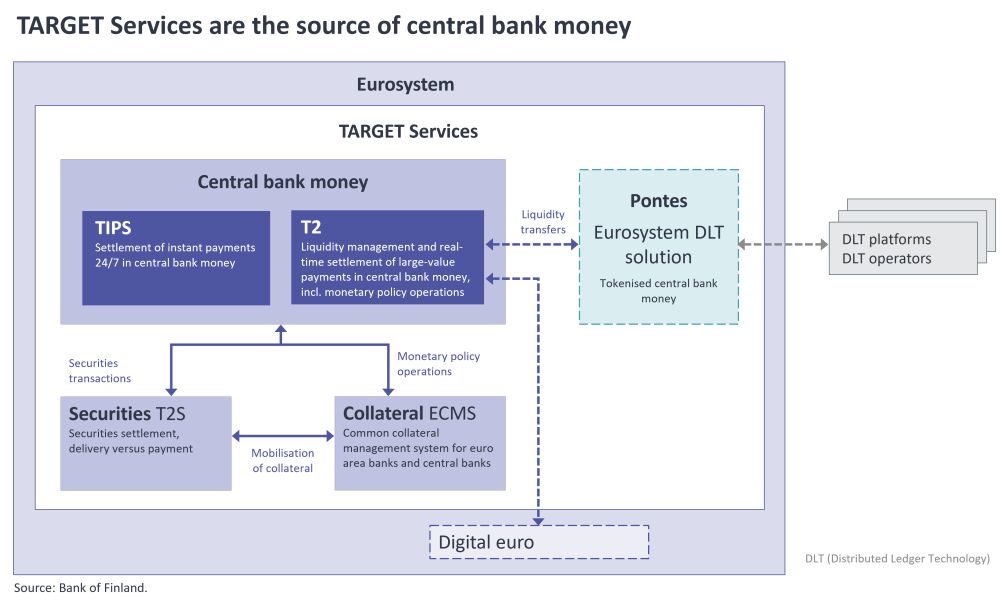
However, Cipollone and other central banking authorities have raised critical red flags regarding the collateral assets backing these digital tokens. If private entities issue tokens pegged to fiat without robust, transparent, and liquid reserves, a sudden liquidity crunch could trigger a modern digital bank run. The ECB’s analytical framework insists that while distributed ledger technology (DLT) offers undeniable efficiency gains, the ultimate settlement asset must remain risk-free central bank money.
Payment Efficiency vs. Monetary Control: The Central Banker’s Dilemma

The core tension highlighted in Frankfurt centers on the dual mandate of modern central banks: maintaining price stability while ensuring smooth, efficient payment systems. In an ideal economic model, payment efficiency reduces transaction costs, accelerates velocity of money, and stimulates commercial enterprise ROI. However, when digital assets are intermediated outside the traditional banking perimeter, the transmission channels of monetary policy risk becoming severely distorted.
Consider how central banks manage inflation and economic cycles. By adjusting policy rates, the ECB influences commercial bank lending rates, which in turn dictates consumer spending and corporate investment. If corporations and retail consumers migrate en masse to private, yield-bearing stablecoins or decentralized finance (DeFi) protocols, commercial banks face deposit flight. This depletion of core deposit funding forces banks to contract credit, driving up borrowing costs independently of ECB policy rate cuts.
| Feature / Metric | Legacy Settlement Infrastructure | Tokenised Financial Ecosystem (wCBDC) |
|---|---|---|
| Settlement Speed | T+1 to T+2 Business Days | Instantaneous (Atomic Settlement) |
| Capital Allocation Efficiency | High collateral drag; redundant buffering | Optimized; minimal margin requirements |
| Counterparty Risk | Mitigated via central clearinghouses | Eliminated via cryptographic finality |
| Monetary Policy Transmission | Direct and predictable via banking sector | Requires regulated integration to prevent leakage |
Industry & Market Implications: Who Wins and Who Loses
The strategic pivot toward tokenised central bank money creates clear structural winners and losers across the global financial landscape. Financial institutions that fail to modernize their cloud compute architecture and digital asset capabilities face existential valuation multiples compression. Conversely, forward-thinking universal banks and enterprise software providers are positioning themselves to capture massive fee streams by bridging legacy core banking systems with DLT networks.
- Winners: Enterprise infrastructure providers offering institutional-grade cryptographic security, forward-looking commercial banks capable of integrating wholesale CBDCs, and regulatory compliance technology firms specializing in real-time transaction monitoring.
- Losers: Legacy custodians clinging to manual reconciliation models, high-fee correspondent banking networks vulnerable to disintermediation, and unregulated issuers of private digital tokens unable to meet stringent capital adequacy rules.
Furthermore, corporate treasurers stand to gain substantial operational efficiencies. By automating cross-border liquidity management through smart contracts, multinational corporations can minimize foreign exchange friction and optimize working capital deployment across global subsidiaries.
Frequently Asked Questions (People Also Ask)
What is the primary difference between retail and wholesale central bank digital currencies (CBDCs)?
Wholesale CBDCs (wCBDC) are restricted to financial institutions for settling interbank transactions and wholesale tokenised assets, minimizing systemic risk. Retail CBDCs, by contrast, are designed for the general public for everyday retail transactions, serving as a digital equivalent of physical banknotes.
How does tokenisation impact commercial bank liquidity and lending capacity?
If tokenisation drives depositors to shift funds out of traditional commercial bank accounts into private yield-generating digital assets, banks lose low-cost deposit funding. This contraction in bank reserves can constrain credit creation, forcing commercial lenders to compete aggressively for deposits or scale back lending operations.
Why is the European Central Bank taking such a cautious stance on private digital assets?
The ECB's caution stems from the potential for private digital assets and unregulated stablecoins to fragment the monetary union, bypass anti-money laundering (AML) controls, and undermine the central bank's ability to maintain price stability and smooth monetary policy transmission.
What role do cloud compute architecture and regulatory compliance play in digital asset integration?
Modern financial DLT networks require ultra-secure, scalable cloud compute architecture to handle high-frequency transaction verification while maintaining strict regulatory compliance with frameworks like the European Union's Markets in Crypto-Assets (MiCA) regulation and Basel III capital standards.
Future Outlook: Milestones to Watch
As the European Central Bank refines its operational framework, several key milestones will dictate the pace of digital asset adoption in global markets. Market participants must monitor upcoming ECB trials on wholesale DLT settlement interoperability, ongoing legislative adjustments to European financial market regulations, and the readiness of commercial banking consortia to deploy production-grade cryptographic ledgers.
Ultimately, the synthesis of digital assets, payment efficiency, and monetary policy will redefine the boundaries of global finance. Institutions that master this transition—balancing technological innovation with rigorous risk mitigation—will secure a dominant competitive advantage in the decade ahead.