Executive Takeaways
- Tokenisation Imperative: Central banks must actively integrate distributed ledger technology (DLT) to prevent fragmented capital allocation and secure enterprise ROI across financial markets.
- Monetary Policy Transmission: Unregulated private stablecoins and tokenised assets risk disrupting bank liquidity, altering the velocity of money, and undermining the European Central Bank’s control over market interest rates.
- Infrastructure Scalability: The ECB is accelerating trials using central bank money for wholesale settlement, balancing cloud compute architecture with stringent risk mitigation and regulatory compliance.
- Cross-Border Efficiency: Modernising legacy payment rails is no longer optional; failing to adopt digital assets threatens European market liquidity and global competitiveness against rival jurisdictions.
FRANKFURT — In a sweeping policy address that underscores a historic turning point for global finance, European Central Bank (ECB) Executive Board member Piero Cipollone laid out an aggressive blueprint for the future of digital assets, tokenisation, and monetary policy. Speaking before an elite gathering of central bankers, market liquidity experts, and financial technologists in Frankfurt, Cipollone warned that the rapid, unchecked evolution of tokenised assets poses both a profound opportunity and a systemic risk to the stability of the Eurozone.
As institutional capital allocation shifts toward distributed ledger technology (DLT), central banks find themselves in a high-stakes race against time. The core tension lies between the explosive payment efficiency promised by smart contracts and the foundational mandate of central banks: maintaining monetary sovereignty, financial stability, and predictable policy transmission.
The Structural Shift: Understanding Tokenisation and Market Liquidity
Test Our Free AI & Tech Utilities Suite
Calculate LLM API token costs, analyze article dwell-time, or simulate tech DCA returns.
For decades, traditional financial market infrastructures (FMIs) have relied on centralized ledgers, batch processing, and siloed clearinghouses. While robust, this architecture introduces settlement friction, trapped collateral, and elevated counterparty risk. Tokenisation—the representation of real-world assets (RWAs) and financial instruments on programmable ledgers—promises to eliminate these inefficiencies by enabling atomic settlement (simultaneous, instant exchange of assets and payment).
However, Cipollone cautioned that the uncoordinated adoption of tokenised assets could fracture market liquidity. When private entities issue digital tokens without a reliable, risk-free settlement asset anchored in central bank money, the financial system invites systemic vulnerabilities reminiscent of historical "free banking" eras.
"Tokenisation is fundamentally reshaping how capital moves across borders and balance sheets," said a senior regulatory strategist attending the Frankfurt summit. "If the official sector fails to provide a scalable, trusted digital settlement medium, private stablecoins and fragmented token platforms will crowd out public money, severely impairing the ECB’s ability to calibrate interest rates."
Monetary Policy Transmission Under Threat

The crux of the ECB’s investigative concern centers on monetary policy transmission. When the central bank adjusts its policy rates, it relies on commercial banks to pass these costs through to the broader economy via lending and deposit rates. The rise of tokenised deposits and yield-bearing stablecoins complicates this transmission channel in several ways:
- Deposit Flight and Bank Liquidity: If retail and corporate depositors rapidly migrate traditional bank reserves into blockchain-native stablecoins offering higher or alternative yields, commercial banks face sudden deposit contraction. This forces them to rely on more expensive wholesale funding, tightening credit conditions independently of central bank actions.
- Velocity of Money: Programmable money and instant cross-border settlement alter the velocity of money. Traditional monetary aggregates (M1, M2, M3) become less reliable indicators of economic activity when capital moves fluidly across decentralized protocols.
- Collateral Fragmentation: Tokenised assets deployed across disparate Layer-1 and Layer-2 blockchains can trap high-quality liquid assets (HQLA), reducing overall market liquidity during periods of systemic stress.
Verified Data & Metrics Breakdown
To contextualise the scale of transformation in digital assets and wholesale payment systems, the following matrix outlines key performance indicators, infrastructure metrics, and regulatory milestones shaping the ECB's current policy stance.
| Metric / Parameter | Traditional Settlement Rails | Tokenised DLT Infrastructure | Strategic Implication |
|---|---|---|---|
| Settlement Speed | T+1 to T+2 business days | Near-instantaneous (Atomic) | Drastic reduction in counterparty risk and margin requirements. |
| Operational Cost Efficiency | High intermediary overhead | Optimised cloud compute & smart contracts | Lower valuation multiples for legacy clearing intermediaries; higher enterprise ROI for adopters. |
| Asset Class Coverage | Siloed securities depositories (CSDs) | Interoperable real-world assets (RWAs) | Unlocks fractional ownership and globalized market liquidity. |
| Risk Mitigation & Compliance | Mature, heavily audited regulatory frameworks | Evolving (MiCA, DLT Pilot Regime) | Requires rigorous cryptographic security and continuous regulatory compliance. |
Industry & Market Implications: Winners and Losers
The macroeconomic ramifications of the ECB's aggressive posture toward digital assets will create clear divides across the global financial ecosystem:
- The Winners — Tech-Forward Financial Institutions and FinTechs: Commercial banks and market infrastructure providers that successfully integrate tokenised platforms and embrace interoperability between legacy RTGS (Real-Time Gross Settlement) systems and DLT will capture substantial efficiency gains. Enterprise clients will benefit from streamlined capital allocation and reduced operational friction.
- The Losers — High-Cost Intermediaries and Laggards: Traditional custodians, correspondent banking networks relying on outdated messaging protocols, and institutions slow to upgrade their cloud compute architecture face severe margin compression. Furthermore, unregulated stablecoin issuers operating outside compliant frameworks will face mounting regulatory crackdowns.
- Broader Economic Impact: For the European economy at large, a frictionless, tokenised financial market can unlock billions of euros in trapped collateral, spurring venture investment and deepening the Capital Markets Union (CMU). However, execution missteps could introduce systemic operational risks, necessitating robust public-private coordination.
Frequently Asked Questions (People Also Ask)
How does tokenisation impact central bank monetary policy?
Tokenisation alters monetary policy by changing how money moves and where liquidity is stored. If private digital assets or tokenised deposits substitute for commercial bank reserves, the transmission of ECB interest rate hikes to the broader economy can be distorted, reducing the central bank's ability to control inflation and stabilize economic cycles.
Why is the ECB prioritizing central bank digital money for wholesale settlement?
Using central bank money for wholesale settlement ensures that large-scale financial transactions remain risk-free. Unlike commercial stablecoins, central bank digital money eliminates credit and liquidity risk, maintaining trust and stability across the core infrastructure of the financial system.
What are the primary risks associated with the widespread adoption of digital assets?
Key risks include fragmented market liquidity, heightened cyber and operational vulnerabilities, potential bank disintermediation resulting from deposit flight, and complex regulatory compliance challenges across cross-border jurisdictions.
How does DLT improve payment efficiency compared to legacy systems?
Distributed ledger technology enables atomic settlement—the simultaneous exchange of assets and payment without intermediaries. This drastically reduces settlement times from days (T+1/T+2) to seconds, lowering capital requirements and operational overhead.
Future Outlook: Strategic Milestones to Watch
As the European Central Bank continues its exploratory trials and collaborative workshops on digital assets, market participants must monitor several critical milestones over the next 24 to 36 months:
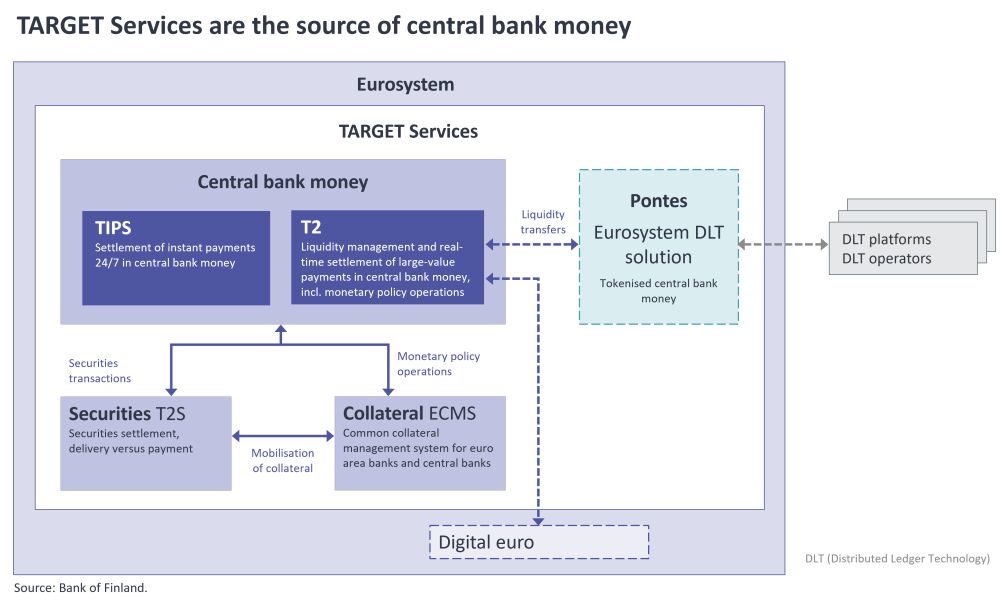
- Interoperability Trials: The formal integration testing between ECB wholesale settlement solutions and commercial DLT platforms, aiming to bridge legacy TARGET services with decentralized networks.
- Regulatory Enforcement of MiCA: Full enforcement and refinement of the Markets in Crypto-Assets (MiCA) regulation, setting global benchmarks for stablecoin backing, operational resilience, and transparency.
- Tokenised Collateral Expansion: The gradual expansion of eligible collateral frameworks to include tokenised short-term debt instruments and high-quality liquid assets within Eurosystem monetary policy operations.
Ultimately, Cipollone’s address signals that the ECB is no longer observing the digital asset revolution from the sidelines. By proactively shaping the infrastructure of tokenisation, Europe aims to safeguard its monetary sovereignty while unlocking the profound payment efficiencies demanded by the modern global economy.