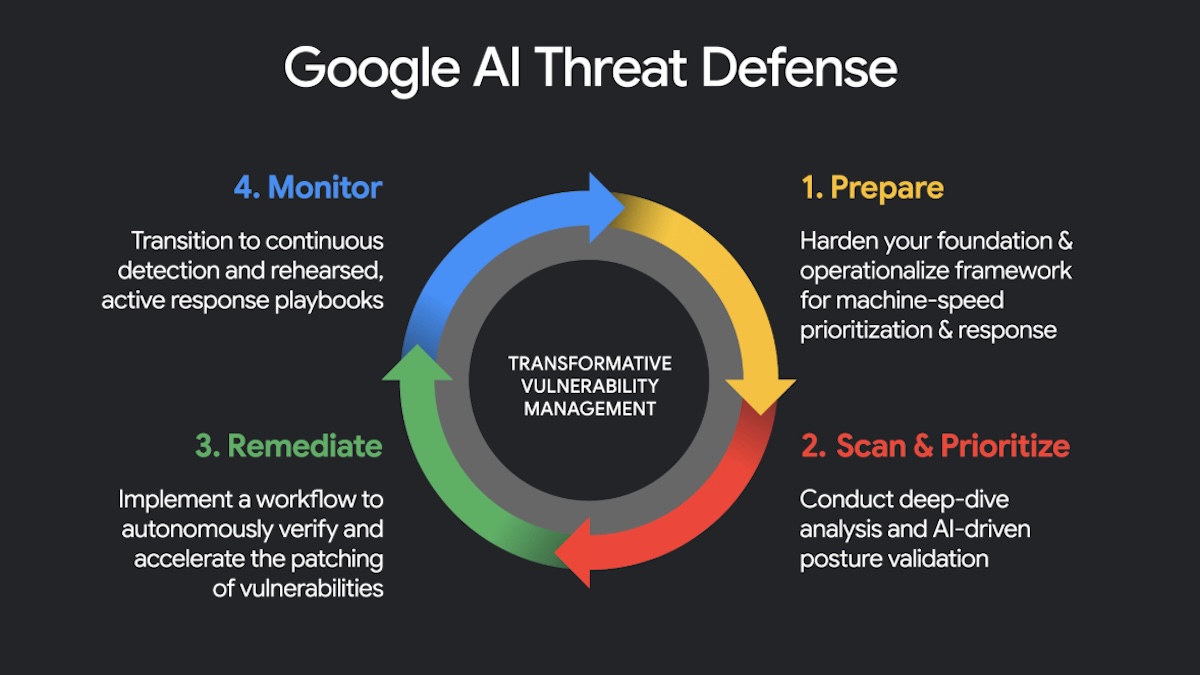
MOUNTAIN VIEW, CA — May 29, 2026 — In a seminal move that dramatically redefines the competitive contours of enterprise cybersecurity, Google Cloud today officially unveiled its next-generation AI-driven Threat Defense Platform. Built upon specialized Gemini-native Security Large Language Models (LLMs) and integrated directly into the core Google Cloud architecture, the platform transitions enterprise defense from passive detection to real-time, autonomous threat remediation. The announcement marks a critical inflection point for Chief Information Security Officers (CISOs) and enterprise IT architects navigating an environment where cyber threats operate at machine speed.
Executive Takeaways
- Autonomous Incident Remediation: Google Cloud’s new AI threat defense system reduces Mean Time to Respond (MTTR) from hours to under 12 seconds by executing agentic, policy-governed containment protocols across hybrid and multicloud environments.
- Direct Integration of Mandiant Intelligence: The platform continuously ingests real-time telemetry from Google’s Mandiant frontline intelligence unit, training customized micro-models to neutralize zero-day exploits before public disclosure.
- Enterprise Capital Reallocation: Early deployment data indicates a 60% decrease in Security Operations Center (SOC) operational expenditure, driving significant enterprise ROI and putting structural pressure on traditional point-solution cybersecurity vendors.
- Regulatory Compliance Automation: Built-in generative compliance engines automate continuous audit readiness for SEC cyber disclosure mandates, NIS2 directives, and global data privacy frameworks.
The Catalytic Shift: Google Cloud’s Autonomous AI Security Infrastructure

For over two decades, enterprise cybersecurity strategy relied on perimeter defenses, reactive signature updates, and human-dependent Security Operations Centers (SOCs). However, the escalation of AI-synthesized malware, automated polymorphic exploits, and credential harvesting scripts has pushed traditional detection tools past operational efficacy. Security analysts face unprecedented cognitive fatigue, drowning in millions of daily uncontextualized alerts while dwell times for sophisticated intrusions remain dangerously high.
Google Cloud’s May 29, 2026 rollout directly targets this structural vulnerability. By embedding autonomous AI agents into the infrastructure layer, the platform transforms cloud telemetry—spanning network logs, identity governance feeds, container runtime behaviors, and API endpoints—into a dynamic threat graph. Unlike legacy Security Information and Event Management (SIEM) systems that merely flag potential anomalies, Google's platform synthesizes incident context in micro-seconds, formulates containment strategies, and executes remediation playbooks without requiring manual human intervention for routine alerts.
This strategic push leverages Google’s multitrillion-parameter Gemini multimodal models, fine-tuned specifically on billions of security events, threat actor profiles, and defensive code bases. By uniting the global threat intelligence of Mandiant—acquired by Google for $5.4 billion—with hyper-scalable cloud compute architecture, Google Cloud provides enterprises with a proactive, self-healing security perimeter.
Architecture of Autonomous Defense: Inside the Gemini Security Engine
The technical architecture of Google Cloud’s threat defense engine relies on a three-tiered pipeline designed for sub-second execution, zero-trust enforcement, and multicloud scalability:
1. Real-Time Telemetry Ingestion & Hyper-Graph Synthesis
The platform natively processes streaming data across Google Cloud Platform (GCP), Amazon Web Services (AWS), Microsoft Azure, and legacy on-premises datacenters. Utilizing low-latency eBPF (Extended Berkeley Packet Filter) kernel-level probes, the system collects telemetry without imposing performance penalties on host workloads. This data feeds directly into a real-time semantic graph that correlates user identity, network flow, and application state.
2. Agentic Reasoning & Synthetic Threat Simulation
Upon detecting anomalous pattern variations, specialized autonomous AI agents simulate potential blast radiuses using parallel cloud compute capacity. Rather than evaluating isolated indicators of compromise (IoCs), the model analyzes the attack intent and potential lateral movement vectors. It projects the attacker's trajectory five steps ahead, allowing the platform to deploy preemptive network isolation micro-segments.
3. Policy-Governed Autonomous Remediation
To eliminate operational risk, automated interventions operate within predefined enterprise guardrails. Low-risk, high-confidence mitigations—such as revoking compromised OAuth tokens, isolating hijacked Kubernetes pods, or injecting dynamic firewall rules—are executed autonomously. For mission-critical infrastructure changes, the engine constructs a single-click natural language brief for security engineers, complete with root-cause analysis and recommended long-term hardening patches.
Quantifiable Impact: Traditional SOC vs. Google AI Threat Defense
The operational and financial advantages of migrating to an AI-native security posture are highlighted in the comparative performance metrics below:
| Security Metric / Performance Indicator | Traditional SIEM / SOC Architecture | Google AI-Driven Threat Defense | Enterprise Financial & Operational Impact |
|---|---|---|---|
| Mean Time to Detect (MTTD) | 16 Hours to 207 Days | < 4.2 Seconds | Mitigates regulatory fines and prevents large-scale exfiltration. |
| Mean Time to Respond (MTTR) | 4.5 Hours per critical alert | 11.8 Seconds (Autonomous) | Reduces business downtime and operational disruption costs. |
| Alert Noise / False Positives | 68% to 85% of total volume | < 2.1% across enterprise workloads | Recovers up to 70% of SOC analyst bandwidth for proactive hunting. |
| Infrastructure Ingestion Cost | High per-GB pricing model | Bundled compute allocation | 35% to 50% reduction in platform software TCO. |
| Zero-Day Response Acceleration | Days to weeks for patch deployment | Instantaneous virtual patching | Protects unpatched legacy applications automatically. |
Industry & Market Implications: Reallocating Enterprise Capital
The arrival of Google Cloud’s platform triggers a strategic shift across the $200 billion global cybersecurity market. For the past decade, enterprise IT budgets were fragmented across dozens of specialized, single-capability software vendors—ranging from Endpoint Detection and Response (EDR) to Cloud Security Posture Management (CSPM). Google Cloud’s integrated platform approach accelerates the market consolidation trend, threatening the growth multiples of standalone security vendors.
The Winners: Enterprise technology buyers stand to gain significant capital efficiency. By consolidating fragmented security stacks into Google Cloud’s AI security framework, Chief Financial Officers (CFOs) can achieve meaningful reductions in Total Cost of Ownership (TCO) while improving security outcomes. Cloud-native enterprises and highly regulated industries—such as banking, healthcare, and defense infrastructure—gain immediate infrastructure scalability and automated compliance auditing capabilities.
The Losers: Legacy SIEM providers and pure-play security vendors relying on volume-based ingestion pricing models face structural margin pressure. As Google, Microsoft (via Security Copilot), and Amazon Web Services integrate native AI security engines into their hyper-scaler fabrics, intermediate point-solution vendors must either innovate through deep specialization or risk margin compression and customer attrition.
Furthermore, venture capital allocation within the cybersecurity sector is shifting away from simple detection tools toward autonomous governance, identity-first security, and AI agent auditing software. Enterprise valuation multiples for pure-play security companies are likely to adjust as buyers demand native AI platform architectures.
People Also Ask (Frequently Asked Questions)
1. How does Google Cloud’s AI threat defense differ from traditional SIEM and EDR solutions?
Traditional SIEM and EDR tools rely on rule-based heuristics, manual correlation scripts, and heavy analyst intervention to triage alerts. Google Cloud’s platform utilizes specialized Gemini security models to autonomously contextualize millions of continuous cloud logs in real time. Rather than generating raw alerts, it identifies attack sequences, simulates threat propagation, and automatically executes remediation scripts (e.g., isolating pods or revoking credentials) in seconds under strict enterprise governance rules.
2. Can Google Cloud’s AI security engine protect multicloud and on-premises environments?
Yes. Although natively integrated into Google Cloud Platform (GCP), the threat defense platform employs cross-cloud API adapters and low-overhead eBPF sensors to ingest telemetry and enforce zero-trust security policies across Amazon Web Services (AWS), Microsoft Azure, hybrid cloud setups, and physical on-premises datacenters. This provides CISOs with a single operational pane for enterprise-wide risk mitigation.
3. What are the regulatory compliance advantages of deploying AI-driven threat defense?
Regulatory frameworks such as the SEC Cyber Disclosure Rules, EU NIS2 Directive, and DORA require organizations to detect, contain, and report material cyber incidents within tight timeframes (often 72 hours or less). Google Cloud’s platform features a dynamic generative reporting engine that creates real-time audit trails, forensic timelines, and impact assessments, helping legal and security teams satisfy strict reporting obligations without interrupting active defense operations.
4. How does the system prevent AI hallucination or unauthorized autonomous actions?
The system operates under a multi-layered security boundary governed by "Policy-as-Code" rules. Critical infrastructure changes—such as taking primary database clusters offline—require explicit multi-factor authorization from human security leads. The platform uses deterministic validation engines to verify generative AI remediation recommendations before execution, eliminating the risk of destructive AI actions within critical production pipelines.
Future Outlook: The Road to the Completely Autonomous SOC (2026–2028)
Google Cloud’s release marks the first phase of a broader multi-year transition toward completely autonomous Security Operations Centers. As generative and agentic models mature, security teams will pivot from operational triage to strategic governance, threat model design, and high-level policy definition.
Over the next 18 to 24 months, market watchers expect hyper-scaler competition to center around three key technological vectors:
- Self-Healing Software Stacks: AI defense engines will not only block malicious traffic, but automatically refactor dynamic application source code in production to permanently fix underlying vulnerabilities.
- Quantum-Resistant Telemetry Encryption: As quantum computing threats emerge, cloud security architectures will natively integrate post-quantum cryptography across all ingestion pipelines and persistent data stores.
- Dynamic Cyber Insurance Integration: Autonomous security postures that offer verifiable, real-time risk mitigation will link directly to algorithmic underwriting platforms, yielding significantly lower cyber insurance premiums for enterprise adopters.
By leveraging its expertise in massive compute scale, artificial intelligence research, and frontline threat intelligence, Google Cloud is redefining modern defense strategies. Organizations that adopt autonomous AI security architectures will build resilient, self-defending digital enterprises capable of neutralizing threats at machine speed.