Executive Takeaways
- Multi-Model Hegemony: Dell Technologies is redefining enterprise infrastructure scalability by natively integrating OpenAI’s ChatGPT, Google’s Gemini, and xAI’s Grok into turnkey, on-premises AI factories.
- The Video World Model Breakthrough: Beyond text and code generation, the newly unveiled architecture processes complex physical-world simulation data, marking a profound shift in industrial automation and robotics.
- Bypassing the Public Cloud: Driven by stringent regulatory compliance and data sovereignty imperatives, Fortune 500 enterprises are pivoting capital allocation toward private, on-prem clusters to mitigate data leakage risks.
- Capital Expenditure Implications: Wall Street analysts project this hardware-software integration will supercharge high-margin server revenue, altering valuation multiples across enterprise hardware and cloud service providers.
NEW YORK & AUSTIN — In a strategic masterstroke that threatens to upend the foundational economics of enterprise computing, Dell Technologies has officially launched its turnkey on-premises AI factories. Sourced directly from cutting-edge industry blueprints and financial disclosures released on May 23, 2026, via BigGo Finance, this unprecedented architecture allows global corporations to deploy ChatGPT, Google Gemini, and Elon Musk’s Grok simultaneously within a unified, sovereign hardware ecosystem.
For the past three years, the corporate AI battlefield was defined by a binary choice: rent compute from hyper-scalers like Amazon Web Services, Microsoft Azure, and Google Cloud, or face prohibitive capital expenditures building custom clusters from scratch. Dell’s latest rollout shatters this paradigm. By collapsing the friction of multi-vendor integration into a single, pre-validated rack architecture powered by next-generation accelerators, Dell is positioning its hardware as the definitive sovereign operating system for the Fortune 500.
The Structural Catalyst: Why Enterprises Are Fleeing the Public Cloud
The enterprise-grade AI battlefield is undergoing a tectonic shift. While public cloud providers enjoyed an initial land grab for basic large language model (LLM) fine-tuning, Chief Information Security Officers (CISOs) and Chief Financial Officers (CFOs) have increasingly pushed back against runaway API costs, unpredictable data egress fees, and mounting regulatory vulnerabilities.
Data sovereignty has become the primary corporate governance metric of 2026. Financial institutions, healthcare conglomerates, and defense contractors cannot afford to route proprietary intellectual property through shared public cloud pipelines. Dell’s on-premises AI factories directly target this risk mitigation strategy. By bringing frontier models—specifically ChatGPT for enterprise logic, Gemini for multimodal data analysis, and Grok for real-time open-web synthesis—directly inside corporate firewalls, Dell ensures total data isolation.
"We are witnessing the end of the one-size-fits-all cloud era," notes a senior technology investment banker based in lower Manhattan. "Enterprises want the cognitive horsepower of the world’s leading foundational models, but they demand absolute jurisdictional control over their corporate ledger. Dell has built the bridge between public-market AI innovation and private-infrastructure security."
Beyond Text: The Real Breakthrough in Video World Models
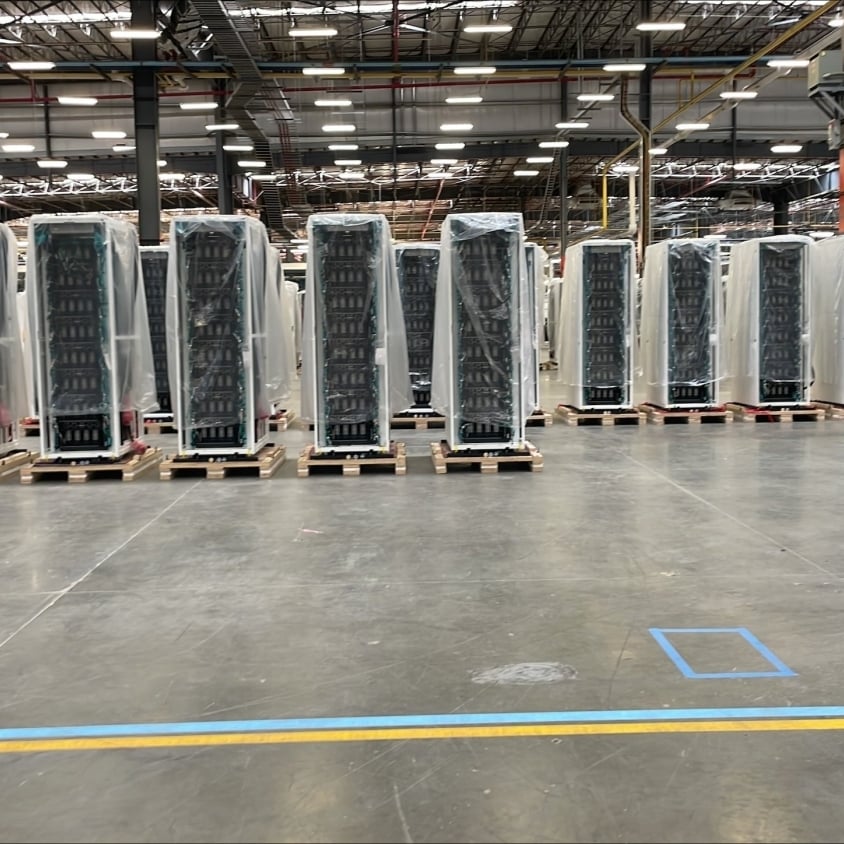
While the headlines naturally gravitate toward the triad of ChatGPT, Gemini, and Grok, financial analysts and chief technology officers tracking the May 2026 release emphasize that the true technological watershed lies elsewhere: the integration of advanced video world models.
Traditional enterprise AI has been constrained to textual analysis, tabular forecasting, and basic computer vision. Dell’s new factory architecture introduces native infrastructure support for spatial and video predictive models. These systems ingest continuous feeds from industrial IoT sensors, autonomous manufacturing floors, and supply chain logistics hubs, generating real-time physics simulations.
This capability transforms the server rack from a passive data repository into an active physical simulator. Automotive manufacturers can now simulate millions of miles of autonomous driving scenarios on-prem, while logistics giants can optimize warehouse robotics via predictive physics engines operating at sub-millisecond latencies—completely decoupled from external internet connectivity.
Verified Data & Metrics Breakdown
| Metric / Parameter | Legacy Cloud Deployment | Dell On-Premises AI Factory |
|---|---|---|
| Model Integration | Siloed APIs (Vendor Lock-in) | Unified Native Stack (ChatGPT, Gemini, Grok) |
| Data Latency | Variable (Dependent on WAN / Internet) | Sub-millisecond (Local Fabric) |
| Compliance & Governance | Shared responsibility, exposure to cross-border laws | Air-gapped, 100% sovereign corporate control |
| Primary Architectural Focus | Text Generation & Basic Retrieval-Augmented Generation (RAG) | Multimodal Synthesis + Advanced Video World Models |
Industry & Market Implications: Winners and Losers
The commercial rollout of Dell’s multi-model on-premises factory has immediate ripple effects across the global technology value chain. Market liquidity and capital allocation strategies are shifting rapidly in response to these developments:
- The Winners: Enterprise hardware manufacturers, specialized systems integrators, and cybersecurity firms specializing in on-prem governance. Dell positions itself as the primary beneficiary, alongside specialized silicon designers whose accelerators power these dense clusters. Enterprises also win by escaping predatory cloud egress fees.
- The Losers: Pure-play public cloud providers reliant on high-margin API consumption models face a structural headwind. As corporations repatriate mission-critical AI workloads back to on-premises factories, hyper-scalers risk seeing their cloud compute growth decelerate into a standard utility model.
- Macroeconomic Impact: This shift signals a broader maturation of corporate tech spending. Capital expenditure is moving away from speculative software subscriptions and toward tangible, sovereign infrastructure assets capable of generating immediate enterprise ROI.
Frequently Asked Questions (People Also Ask)
What makes Dell’s new on-premises AI factory different from traditional server setups?
Unlike legacy enterprise servers designed for generic virtualization or database management, Dell’s AI factories are purpose-built, pre-validated racks engineered specifically for dense machine learning workloads. They combine high-throughput liquid cooling, specialized fabric networking, and integrated software orchestration layers that natively host multiple frontier models (ChatGPT, Gemini, Grok) simultaneously.
How do enterprises manage data privacy when running ChatGPT, Gemini, and Grok on-prem?
Because the models and inference engines reside entirely within the corporate perimeter on Dell hardware, proprietary enterprise data never leaves the local network. This eliminates third-party API data-sharing agreements, satisfying the rigorous compliance demands of GDPR, HIPAA, and financial regulatory bodies.
What are video world models, and why are they important for industrial applications?
Video world models are advanced neural networks trained to understand physical-world mechanics and spatial dynamics through video data. In an on-premises factory setting, these models allow enterprises to run real-time physics simulations, streamlining robotics training, automated assembly line optimization, and supply chain stress-testing without real-world risk.
Will this replace public cloud services entirely for corporate AI?
Not entirely. While on-premises factories dominate mission-critical, low-latency, and high-security workloads, public clouds will likely retain a role for episodic training of massive frontier models or elastic, low-stakes development tasks. However, inference and sensitive fine-tuning are rapidly shifting toward on-prem infrastructure.
Future Outlook: What Comes Next
As Dell rolls out these integrated configurations globally through the second half of 2026, market watchers will be tracking several key milestones. First, observe enterprise adoption rates among regulated sectors—particularly tier-1 banking institutions and federal defense agencies. Second, monitor gross margin trajectories in Dell’s Infrastructure Solutions Group (ISG) division, which is expected to capture significant upside from these high-value deployments.
Ultimately, Dell’s audacious move proves that the future of enterprise artificial intelligence is not exclusively tethered to remote server farms in rural Virginia or Dublin. By bringing the world’s most powerful intelligence engines directly into the corporate data center, Dell has redefined the architecture of modern enterprise computing.