Executive Takeaways
- Autonomous Mitigation: Google Cloud's newly deployed AI-driven security suite moves beyond passive alerting, introducing automated remediation loops designed to neutralize advanced persistent threats (APTs) in milliseconds.
- Capital Allocation Shift: Enterprise CIOs and CISOs are rapidly reallocating budget toward cognitive cloud architectures as legacy perimeter-based defense systems struggle with sophisticated, polymorphic payloads.
- Valuation and Market Dynamics: The launch intensifies the high-stakes competitive triad between Google Cloud, Microsoft Azure, and Amazon Web Services (AWS) for enterprise market share, directly impacting sector valuation multiples.
- Regulatory Alignment: The framework incorporates automated compliance mapping, directly addressing stringent global data sovereignty laws and lowering enterprise risk exposure.
NEW YORK & BENGALURU — In a strategic escalation of the cloud security wars, Google Cloud has officially introduced a next-generation, AI-driven threat defense architecture tailored for global enterprises. Unveiled amid a shifting threat landscape characterized by state-sponsored cyberespionage and automated ransomware deployment, the platform represents a paradigm shift from reactive cybersecurity analytics to preemptive, autonomous system neutralization.
The announcement, which builds upon foundational disclosures originating from major technology desks, comes at a critical juncture for corporate risk management. As digital transformation initiatives expand corporate attack surfaces, enterprise executives face mounting pressure to protect mission-critical workloads while optimizing cloud compute architecture and containing operational expenditures.
The Catalytic Shift: Moving Beyond Signature-Based Defense
Test Our Free AI & Tech Utilities Suite
Calculate LLM API token costs, analyze article dwell-time, or simulate tech DCA returns.
For decades, enterprise security relied heavily on signature-based detection models and manual log analysis—methods increasingly rendered obsolete by the velocity and scale of modern cyberattacks. Threat actors now leverage generative adversarial networks (GANs) and automated vulnerability scanners to probe corporate networks at machine speed, rendering human-driven incident response times mathematically uncompetitive.
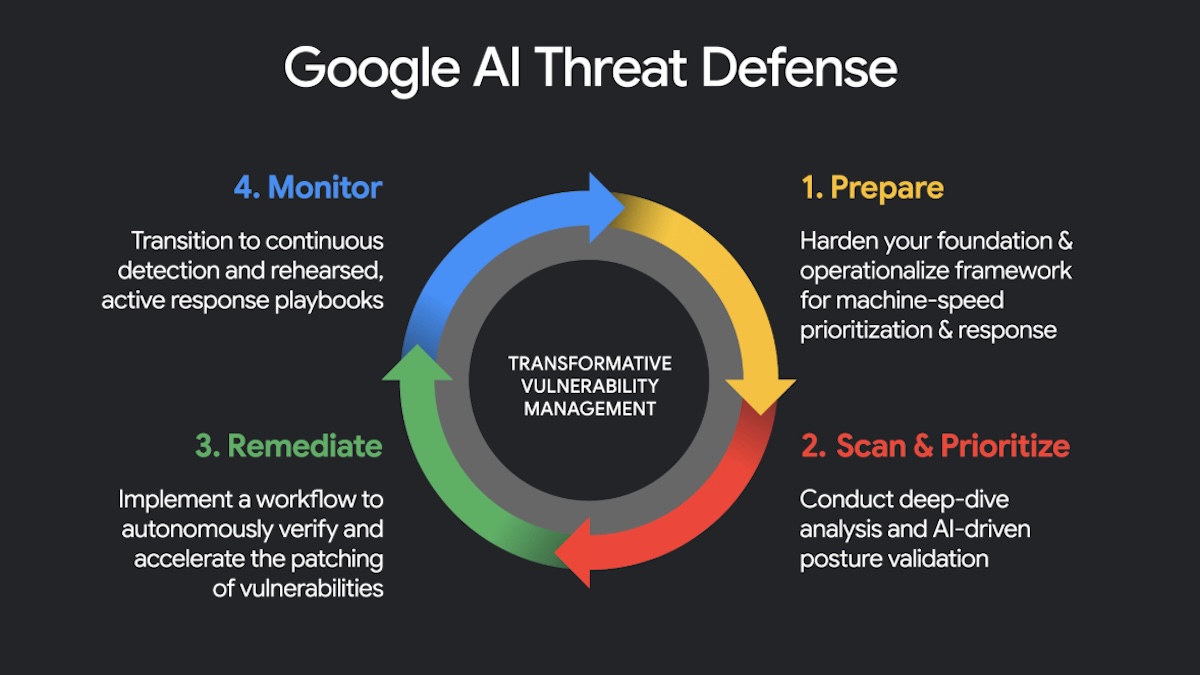
Google Cloud’s new defense suite addresses this asymmetry by embedding advanced machine learning models directly into the infrastructure fabric. Rather than merely flagging anomalies for security operations center (SOC) analysts, the system utilizes real-time behavioral telemetry to isolate compromised nodes, dynamically rewrite firewall rules, and patch memory-injection vulnerabilities instantaneously.
Financial analysts tracking infrastructure scalability and enterprise ROI note that this automated remediation cycle directly targets one of the most persistent cost drivers in modern IT operations: the escalating expense of talent acquisition and retention within specialized SOC environments. By offloading Tier-1 and Tier-2 triage to autonomous algorithms, organizations can reallocate human capital toward strategic risk mitigation and architectural governance.
Technical Architecture and Operational Mechanics

At the core of Google’s new offering is an integrated neural network trained on global threat intelligence gathered across billions of endpoints and enterprise cloud deployments. This proprietary large-scale model processes telemetry data across multiple vectors:
- Identity and Access Management (IAM): Real-time behavioral profiling of administrative credentials to detect lateral movement and privilege escalation attempts before authentication tokens are compromised.
- Container and Kubernetes Workload Protection: Deep inspection of microservices communication pathways, automatically terminating anomalous container pods without disrupting baseline application uptime.
- API Gateway Monitoring: Heuristic analysis of inbound API requests to intercept zero-day injection attacks and credential-stuffing campaigns at the edge of the cloud perimeter.
- Data Exfiltration Deterrence: Cognitive monitoring of outbound data flows that identifies unauthorized staging and encryption routines typical of advanced ransomware extortion schemes.
This deep integration into the underlying cloud compute architecture ensures that security overhead does not impede application performance—a historical bottleneck that frequently frustrated enterprise developers and delayed product deployment cycles.
Verified Data & Metrics Breakdown
| Metric / Parameter | Legacy Security Architecture | Google Cloud AI Threat Defense |
|---|---|---|
| Average Threat Detection Time | Hours to Days (Manual Triage) | Sub-Second (Real-Time Inference) |
| Remediation Latency | Dependent on Human Intervention | Automated Isolation (< 100ms) |
| False Positive Rate | High (Banner Alert Fatigue) | Minimized via Contextual LLM Reasoning |
| Regulatory Compliance Mapping | Siloed Audits & Manual Reports | Continuous, Automated Audit Trails |
Industry & Market Implications
The commercial rollout of Google Cloud's AI defense system carries profound ramifications for market liquidity, vendor consolidation, and enterprise budgeting cycles. As global boards of directors scrutinize cyber resilience following high-profile supply chain compromises, cloud security capabilities have become a primary differentiator in enterprise vendor selection.
Who Wins: Enterprise CISOs and Hyperscale Providers
Enterprise risk officers and chief information security officers emerge as primary beneficiaries, gaining access to military-grade defense tools previously accessible only to sovereign intelligence agencies or the world's largest financial institutions. Concurrently, hyperscale cloud providers with proprietary AI infrastructure—specifically Alphabet, Microsoft, and Amazon—cement their dominance, capturing higher-margin software service revenue as customers consolidate multi-vendor point solutions into integrated cloud fabrics.
Who Loses: Standalone Point-Solution Vendors
Conversely, traditional, standalone cybersecurity vendors specializing in narrow signature detection or basic endpoint protection face an existential compression of their addressable market. As platformization accelerates, enterprise buyers increasingly favor native cloud security suites over complex, patchwork integrations that require extensive API maintenance and custom middleware.
People Also Ask (FAQ)
Frequently Asked Questions
How does Google Cloud’s AI threat defense differ from traditional SIEM solutions?
Traditional Security Information and Event Management (SIEM) platforms aggregate logs and generate alerts for human analysts to investigate. Google Cloud’s AI-driven defense architecture utilizes machine learning models to autonomously execute remediation workflows—such as isolating compromised virtual machines and revoking compromised tokens—in real-time without requiring human intervention.
What impact does automated threat mitigation have on enterprise compliance frameworks?
Automated mitigation drastically reduces compliance friction by generating continuous, immutable audit trails. The system maps detected anomalies and executed countermeasures directly against regulatory standards such as GDPR, HIPAA, and SOC 2, minimizing the risk of costly regulatory penalties.
Is this AI security suite compatible with multi-cloud and hybrid enterprise environments?
Yes. Recognizing that modern enterprises rarely operate in single-vendor silos, Google Cloud has engineered the threat defense framework to ingest telemetry from hybrid infrastructure and competing cloud environments through open standards and API connectors.
How does Google ensure data privacy when training its security models?
Google employs advanced privacy-preserving techniques, including federated learning and cryptographic anonymization, ensuring that proprietary enterprise telemetry and sensitive customer data are never exposed or cross-contaminated during model training cycles.
Future Outlook & Key Milestones to Watch
As the enterprise software market absorbs this release, industry observers are tracking several key milestones over the subsequent fiscal quarters. First, market analysts will monitor enterprise adoption velocity through quarterly cloud revenue disclosures, gauging whether automated security features accelerate migration from legacy on-premise data centers.
Second, regulatory bodies in the European Union and North America are expected to issue preliminary guidance regarding the governance of autonomous AI decision-making in critical infrastructure. How Google Cloud and its competitors adapt their cognitive defense frameworks to meet evolving explainable-AI mandates will dictate long-term market leadership.
Ultimately, the deployment of autonomous AI threat defense marks the crossing of a Rubicon in enterprise technology: security has ceased to be a reactive administrative function and has matured into an autonomous, self-healing core capability of the digital economy.