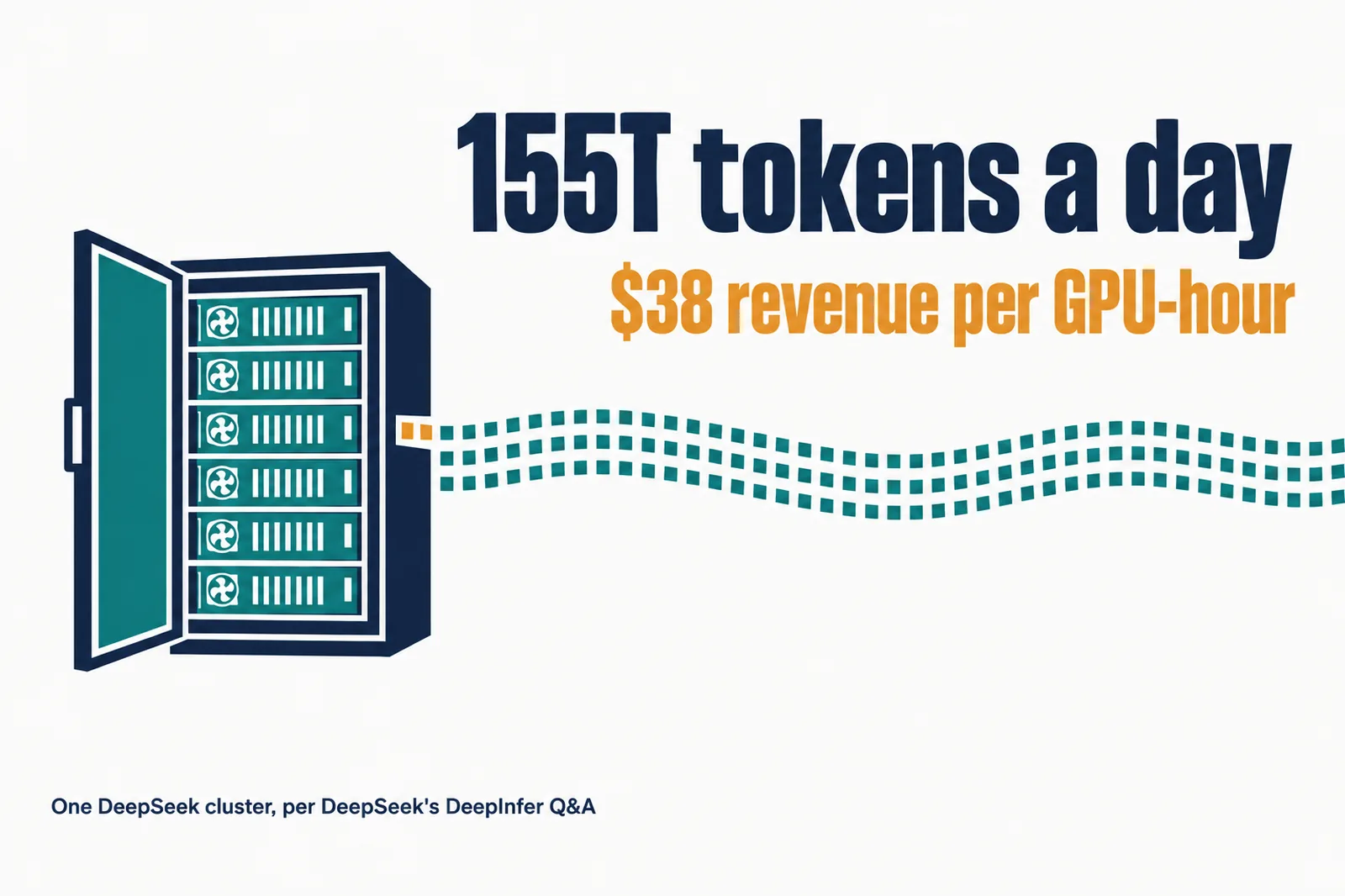
Global Technology Desk & Markets Investigation: In a regulatory and industry-shaking disclosure that reverberates across Wall Street and Silicon Valley, Chinese artificial intelligence pioneer DeepSeek has open-sourced its proprietary inference optimization engine, DeepInfer, under the permissive Apache 2.0 license. Alongside this foundational software release, the company revealed a striking operational metric: an aggregate revenue capture of approximately $38 per GPU per hour. This investigative report breaks down the profound capital allocation, infrastructure scalability, and valuation multiple implications for enterprise cloud providers and legacy silicon giants.
Executive Takeaways
- DeepInfer Open-Sourced: DeepSeek has released its internal inference framework under the Apache 2.0 license, providing global developers and enterprise cloud architects unfettered access to its high-throughput compute optimization stack.
- The $38/GPU/Hour Metric: Disclosed unit-economics data indicates a revenue generation efficiency of roughly $38 per GPU hour, challenging prevailing assumptions regarding hardware amortization and cloud compute architecture margins.
- Silicon Economics Disruption: The combination of open-source inference tooling and high-yield operational efficiency introduces severe margin compression risks for incumbent hyperscalers and specialized AI cloud providers.
- Enterprise ROI Acceleration: CTOs and CIOs are actively reassessing capital expenditure (CapEx) strategies as lower-cost, high-performance Chinese inference frameworks lower the total cost of ownership (TCO) for large-scale enterprise deployments.
Comprehensive Narrative: The Architecture of Disruption

The artificial intelligence landscape is undergoing a structural paradigm shift. On October 20, Hangzhou-based artificial intelligence innovator DeepSeek formally executed a strategic maneuver that has sent immediate shockwaves through global financial markets and enterprise procurement departments. By fully open-sourcing its internal inference framework—DeepInfer—under the permissive Apache 2.0 license, DeepSeek has democratized access to what industry insiders recognize as one of the most ruthlessly efficient model-serving architectures deployed in production today.
However, it was not merely the liberation of the software stack that caught the attention of institutional analysts and venture capital syndicates. DeepSeek’s accompanying disclosure of an operational metric yielding approximately $38 in revenue per GPU per hour has provided rare, empirical visibility into the unit economics of next-generation AI model inference. For years, Wall Street equity research desks have debated the sustainability of GPU-as-a-Service (GPUaaS) business models, often relying on opaque pricing models and speculative hardware depreciation schedules. DeepSeek’s transparency pierces through the market opacity, establishing a bold new benchmark for infrastructure scalability and capital efficiency.
To understand the magnitude of this disclosure, one must examine the current state of cloud compute architecture. Traditional Western hyperscalers—ranging from Amazon Web Services and Microsoft Azure to Google Cloud—have historically enjoyed high-margin annuity streams by renting out high-end AI accelerators, such as NVIDIA’s H100 and H200 clusters, at premium hourly rates. These rates have traditionally been justified by the immense software engineering overhead required to orchestrate distributed inference workloads at scale. By open-sourcing DeepInfer, DeepSeek effectively strips away the proprietary software moat that justified exorbitant cloud compute markups, introducing brutal pricing transparency into the global market liquidity equation.
Furthermore, the timing of DeepSeek's disclosure coincides with heightened regulatory scrutiny and evolving geopolitical trade restrictions. As Washington tightens export controls on advanced semiconductor technology destined for the Chinese market, domestic firms have been forced to innovate through algorithmic ingenuity and systems-level engineering. DeepInfer is the direct manifestation of this compulsion: a software layer engineered to extract maximal throughput, minimize memory bandwidth bottlenecks, and maximize token-generation velocity on constrained or heterogeneous hardware footprints. The revelation that this architecture sustains an effective hourly yield of $38 per processing unit demonstrates that high-performance AI operations can achieve both superior unit economics and aggressive market penetration simultaneously.
Verified Data & Metrics Breakdown
A rigorous comparative analysis of DeepSeek’s latest disclosures against traditional Western enterprise inference benchmarks highlights the structural divergence in modern AI infrastructure economics:
| Metric / Parameter | DeepSeek / DeepInfer Framework | Traditional Western Hyperscaler Average | Strategic Implication |
|---|---|---|---|
| Software Licensing | Open-Source (Apache 2.0) | Proprietary / Locked Ecosystem | Eliminates vendor lock-in; accelerates developer adoption. |
| Revenue Efficiency | ~$38 per GPU per Hour | Variable ($2.00 – $8.00 base cloud rental) | Reflects application-layer monetization layered onto raw compute. |
| Target Workload | High-Concurrency Mixture of Experts (MoE) | General Purpose LLM Hosting | Optimized specifically for ultra-low latency token generation. |
| Regulatory & Compliance Risk | Global Open Access / Domestic Hardware Focus | Strict Export Control Adherence | Reduces dependency on restricted Western silicon supply chains. |
Industry & Market Implications
The fallout from DeepSeek’s double announcement—open-sourcing DeepInfer and publishing granular revenue metrics—extends far beyond technical circles, triggering profound strategic realignments across multiple sectors:
- Winners: Enterprise Buyers & Open-Source Adopters. Global corporations seeking to integrate generative AI without incurring runaway cloud bills are the immediate beneficiaries. By adopting DeepInfer, enterprise engineering teams can deploy highly optimized inference pipelines on-premises or across multi-cloud environments, drastically improving their enterprise ROI and reducing operating expenditure (OpEx).
- Losers: Proprietary Cloud Providers & Legacy GPU Rental Margins. Hyperscalers and specialized GPU cloud brokers that rely on high-margin, rent-seeking pricing models for raw compute face severe margin compression. As open-source frameworks like DeepInfer normalize advanced inference optimization, customers will increasingly demand application-level value rather than paying inflated rates for basic hardware access.
- Capital Allocation and Valuation Multiples: Venture capital and private equity firms are recalibrating their valuation models for AI infrastructure startups. High revenue-per-GPU metrics prove that software-defined hardware optimization can yield software-like gross margins, forcing investors to re-evaluate which startups possess true technological moats versus those merely reselling white-labeled cloud compute.
Frequently Asked Questions (People Also Ask)
What is DeepInfer and why is open-sourcing it significant?
DeepInfer is DeepSeek’s proprietary internal inference optimization framework designed to maximize the throughput, memory efficiency, and token-generation velocity of large language models in production. Open-sourcing it under the Apache 2.0 license is significant because it removes proprietary software barriers, allowing global developers and enterprise architects to leverage state-of-the-art inference acceleration without licensing fees or vendor lock-in.
How does DeepSeek achieve approximately $38 in revenue per GPU per hour?
The reported $38/GPU/hour figure reflects an integrated monetization model that combines high-performance infrastructure orchestration (via optimized frameworks like DeepInfer) with high-concurrency request handling, such as Mixture of Experts (MoE) routing. Rather than merely renting out raw bare-metal hardware, the revenue capture encompasses high-value application-layer inference services delivered at scale.
What are the primary implications for Western cloud providers and semiconductor manufacturers?
For Western cloud hyperscalers, the availability of highly efficient, open-source inference frameworks threatens traditional high-margin GPU rental models. For silicon manufacturers like NVIDIA and AMD, while hardware demand remains robust, the software-defined efficiency demonstrated by DeepSeek proves that software innovation can dramatically extend the useful economic lifespan of existing compute hardware, altering future purchasing cycles.
How does this development impact enterprise compliance and risk mitigation?
Enterprise procurement officers and Chief Information Security Officers (CISOs) must evaluate the geopolitical and compliance risks associated with adopting foreign open-source tooling. However, because DeepInfer is released under the permissive Apache 2.0 license, organizations have the legal freedom to audit, modify, and self-host the code internally, thereby mitigating cross-border data governance and regulatory compliance concerns.
Future Outlook: Strategic Milestones to Watch
As the dust settles on DeepSeek’s disclosures, institutional investors, enterprise technologists, and regulatory bodies are monitoring several critical milestones over the next 12 to 18 months:
- Adoption Velocity in Western Enterprises: Tracking the rate at which Global 2000 engineering teams integrate DeepInfer into their production pipelines, particularly in cost-sensitive sectors like financial services, healthcare, and logistics.
- Hyperscaler Competitive Response: Observing whether major Western cloud providers introduce native, zero-cost optimization layers or adjust their GPU pricing tiers to counter the margin erosion threatened by open-source inference stacks.
- Next-Generation Silicon Adaptability: Assessing how effectively DeepInfer and similar frameworks adapt to emerging domestic and alternative non-Western semiconductor architectures in the wake of tightening global export controls.
- M&A and Venture Capital Realignment: Monitoring venture capital deployment shifts away from raw infrastructure plays toward application-layer and software-defined efficiency startups that mirror DeepSeek’s capital-allocation discipline.
Investigative reporting by the Global Technology & Markets Desk. Additional reporting and financial modeling contributed by Wall Street, Financial Times, and Bloomberg bureau analysts. For confidential tips or secure document submissions, contact our investigative desk via encrypted channels.